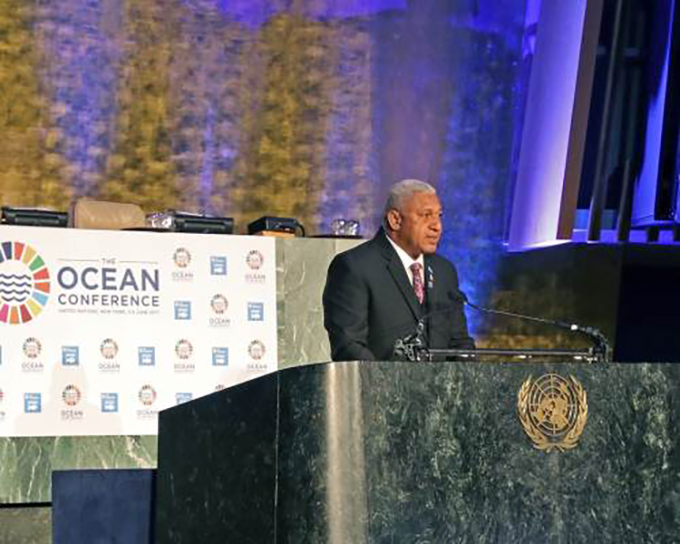
Fiji’s Prime Minister Voreqe Bainimarama closing UN Oceans Conference… “Paris Agreement not enough to save us”. Image: The Ocean Conference
Current national contributions by countries to the Paris Agreement on climate change are not enough to save the Pacific, says Fiji’s Prime Minister Voreqe Bainimarama.
“We have to try to persuade the rest of the world to embrace even more ambitious action in the years to come, because we all know that even the current national contributions to the Paris Agreement are not enough to save us,”
he said, addressing Pacific leaders as the UN Oceans Conference came to a close in New York last week.
As the incoming president of COP23, Bainimarama called on the Pacific and its leaders to stand by him and demand decisive action, as climate change was an issue of critical importance to the region’s collective future.
“I want your input. I need your input. And I want every Pacific leader beside me as we demand decisive action to protect the security of our people and those in other vulnerable parts of the world.”
Bainimarama also outlined his worry that America’s decision to abandon the Paris Agreement may also encourage other nations to either back away from the commitments they have made or not implement them with the same resolve.
“We are all, quite naturally, bitterly disappointed by the decision of the Trump Administration to abandon the Paris Agreement,” he said.
“Not only because of the loss of American leadership on this issue of critical importance to the whole world, but because it may also encourage other nations to either back away from the commitments they have made or not implement them with the same resolve.
“But something wonderful is also happening. The American decision is galvanising opinion around the world in support of decisive climate action.
‘Widespread rebellion’ “Other nations and blocs like China, the European Union and India are stepping forward to assume the leadership that Donald Trump has abandoned. And within America itself, there is a widespread rebellion against the decision the President has taken.”
Bainimarama said dozens of American state governors and city mayors were banding together with leaders of the private sector, civil society and ordinary citizens to redouble their efforts to meet this challenge.
“So while the Trump Administration may have abandoned its leadership on climate change, the American people haven’t.
“Next week, I will go to California to meet the Democrat Governor Jerry Brown and sign up to the climate action initiative that he is spearheading. I am also in contact with his Republican predecessor, Arnold Schwarzenegger, who shares Governor Brown’s commitment.
“The point is that on both sides of American politics, we have friends who are standing with us in this struggle. And I am inviting both Governor Brown and the famous ‘Terminator’ to come to our pre-COP gathering in Fiji in October, where we hope they will join us in a gesture of solidarity with the vulnerable just before COP23 itself in Bonn the following month.”
The Paris Agreement, which Fiji has ratified, sets out a global action plan to put the world on track to avoid dangerous climate change by limiting global warming to well below 2 degrees Celsius.
Four New Caledonian anti-independence parties have agreed to a joint declaration of unity ahead of this weekend’s run-off election of a new French National Assembly.They call to work for a New Caledonia that stays with France and lives in peace.
This comes amid worsening rifts within the anti-independence camp which have been exacerbated by the election campaign.
An unsuccessful candidate and former president Harold Martin said in this weekend’s run-off, voters should choose the pro-independence candidate Louis Mapou over Philippe Gomes, who is the most prominent anti-independence politician and the incumbent in the Paris seat.
The local National Front chapter also urged voters not to vote for Mr Gomes.
A senior member of the Republicans Gael Yanno said unless there is a change the loyalist camp will end up destroying itself.
The declaration said there is a need to prepare for a future within France as the independence referendum is due next year while there is huge change of the political landscape in France.
The sudden rise of the Emmanuel Macron-led movement has removed all French veteran leaders who had been involved in the decolonisation process outlined in the 1998 Noumea Accord.
JAKARTA, Indonesia — A major church in Indonesia’s predominantly Christian Papua province said a riot in the provincial capital last month was sparked by the military burning Bibles, contradicting the police account of events.
A report by the Evangelical Christian Church in Papua said a priest and another man from a local congregation took photos of burnt New Testament Bibles at a military base in Jayapura and took several away as evidence.
It said the two men and city officials unsuccessfully tried to calm the crowd that gathered outside the base on May 25 after reports of Bible burning spread on social media. Protesters threw rocks, burned tires and blocked a road as they demanded that soldiers be handed over to them for punishment.
At the time, police said soldiers had burned rubbish and distributed photos of a mass of burned materials that included a book on theology that they annotated with text saying “this is not the Bible.”
The military’s spokesman in Papua, Teguh Pudji Rahardjo, on Thursday acknowledged that Bibles had been burnt but said it was an accident that was still being investigated.
He said some bibles and theological books that had been brought from Java for distribution to Christians in Papua were inadvertently mixed in with rubbish that was cleared out of the base’s mess.
“Like all Indonesians, we as members of the Indonesian Military are religious people, and we respect all religions,” Rahardjo said.
The incident is indicative of the tensions that simmer in Indonesia’s two easternmost provinces of Papua and West Papua, which are culturally and ethnically distinct from the rest of the sprawling Southeast Asian archipelago, the world’s most populous Muslim nation.
A low-level insurgency and resentment at Indonesian rule has endured since the 1960s, when Indonesia annexed the region. It restricts foreign journalists from reporting in both provinces.
Jayapura’s chief of police was bruised in an attack by protesters and his aide was hospitalized with stab wounds and an injured nose and jaw, according to both church and police accounts. Three protesters suffered gunshot wounds when police and troops dispersed the crowd.
The police statement said a water cannon was used but the church’s report said two armored vehicles from the military base had fired at the crowd.
The Evangelical Christian Church in Papua has about 600,000 members and dates its origins to German missionaries in the 1850s.
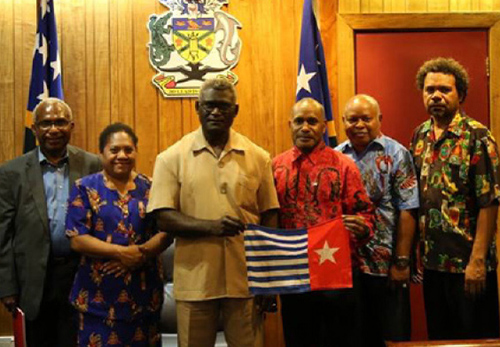
Full support … West Papuan Independence leader Benny Wenda (in red shirt) holds the banned West Papuan Morning Star flag with key supporter Solomon Islands Prime Minister Manasseh Sogavare during his visit last year. Image: bennywenda.org
News coverage of the alleged genocide is extremely difficult because of the restrictions on local and foreign media.
Some West Papuan journalists have also died in their effort to tell the truth about the deaths that largely occur in remote rural areas.
This makes news coverage of the alleged atrocities in the Indonesia-occupied land extremely difficult.
West Papuan independence leader Benny Wenda, in an online interview, told Wansolwara the restrictions allowed for the atrocities to remain “silenced”.
And even if access was granted after the labyrinthine effort, “journalists cannot go freely to report on politics in West Papua,” he said.
“They will get followed and questioned by Indonesian intelligence and West Papuans will suffer intimidation and threats if they speak to journalists.”
Recent prominence
Papua New Guinea Media Council president Alexander Rheeney said West Papua’s struggle of more than 50 years had only been given prominence in the region’s mainstream media in recent years.
Papua New Guinean journalist Alexander Rheeney, who is also president of the PNG Media Council. Image: PNG Media Council
Less than 10 years ago, the mainstream news media – in neighbouring countries like Fiji, Australia and New Zealand, ignored the situation in West Papua. It was effectively a media “black hole”.
Rheeney said it was more challenging for Pacific journalists whose governments recognised the sovereignty Indonesia had over West Papua.
“The media in PNG have reported on West Papua and all the human rights abuses but not as much as we would want it to despite the fact that PNG and West Papua share a land order,” he said.
The increasing coverage by Pacific news media should be commended, said journalism educator Professor David Robie.
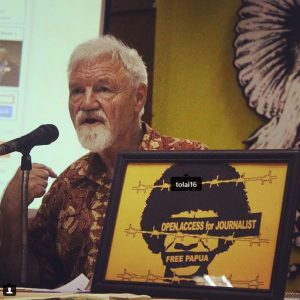
Professor David Robie speaking at the Free Media in West Papua seminar in Jakarta, Indonesia, last month. Image: Alves Fonataba/PMC
Dr Robie, director of the Auckland-based Pacific Media Centre, who has regularly written and published news on West Papua’s struggle for more than three decades, said it was a huge relief that the Pacific was “finally waking up to the issue of West Papua”.
“This an issue of Melanesian solidarity, Pacific solidarity – an issue of self-determination, and the Pacific countries that got independence on a plate ought to be telling this story,”
He spoke along with Indonesian and Papuan human rights activists and Tabloid Jubi editor Victor Mambor of Jayapura.
Pacific Freedom Forum editor Jason Brown said it was an utter disgrace that some in mainstream media published or broadcast stories on wars from other regions and “not in our own backyard”.
“In recent years, RNZI has done a much better job of covering West Papua. The recent closure of shortwave services by Radio Australia, however, means that the region has lost reliable access to news on West Papua from that source,” said Brown.
Rheeney warned that the region could not afford to fail fellow Pacific Islanders of West Papua.
He said to do so would be to doom the Pacific region to more instability.
“If a prosperous Pacific region is to be ensured, the issue of West Papua must be addressed,” he said.
Timor-Leste lessons
“As journalists we can no longer continue to turn a blind eye on all the human rights abuses that is happening.
“The PNG government can no longer turn a blind eye on what is happening on the other side of the border.”
Dr Robie said that informed political decisions could not be reached if the news media were not allowed to report freely on West Papua.
He said this lesson could easily be drawn from East-Timor’s road to independence.
East Timor, which was also occupied by Indonesia in 1975, secured its independence after a handful of journalists exposed the human rights violations through video smuggled out of the Indonesian-ruled territory, especially after the Santa Cruz massacre in the capital Dili in 1991.
Indonesia’s control rapidly fell apart after international pressure.
“In-depth and timely media coverage will save lives as West Papua lurches towards independence — which will come eventually — no matter how hard Jakarta tries to block this,” said Dr Robie.
Rheeney is also optimistic. He said Pacific journalists should continue to report on the issue, to keep the struggle in the news so that lasting solutions were found sooner and more bloodshed is prevented.
Vilimaina Naqelevuki is a final year journalism student with the USP Journalism Programme. Naqelevuki is pursuing a double major in journalism and politics, and is pictures editor of Wansolwara, the student news publication produced by the Journalism Programme.
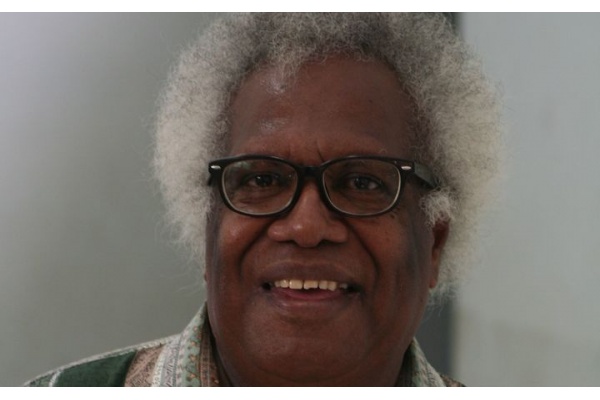
Rex Rumakiek, one of the five international representatives of the United Liberation Movement West Papua (ULMWP), will be talking about the self determination, de-colonisation and independence for West Papua from Indonesia in international arenas including the United Nations this Saturday at Sunforest organic farm. Photo supplied.
Source: http://www.echo.net.au/ – Supporting the free West Papuan liberation movement, Australia’s closest neighbour, Sunforest organic farm is hosting a traditional moomoo pig feast this Saturday.
Rex Rumakiek, one of the five international representatives of the United Liberation Movement West Papua (ULMWP), will be talking about the self determination, de-colonisation and independence for West Papua from Indonesia in international arenas including the United Nations.
‘It is still highly militarised in West Papua,’ said organiser Matthew Jamieson.
‘There is military in every single village, people are constantly under surveillance. Human Rights abuse is a major method of control by Indonesian state through its military and police, which act with impunity.
‘Recent cases of Human Rights abuse by police, such as Paniai case, continue not to be addressed even when government has promise investigation.’
Rumakiek has been active representing West Papua in the Pacific countries since the the late 1980s. He started his involvement in the liberation movement with the Organisi Papua Merdeka (OPM) which waged a guerrilla war against Indonesia in the jungle during the 1970s, 80s and early 90s.
Seven Pacific countries are currently publicly expressing concern about continuing human rights violence in West Papua, including Solomon Islands, Vanuatu, Nauru, Tuvalu, Samoa, Tonga and Marshall Islands. Solomon Islands and Vanuatu leaders, together with the leadership of the French occupied Kanaky (New Caleadonia) have voiced support for the right to self determination for the territory of West Papua
‘The Papuan population is stagnating and the Indonesian government is increasing the numbers of trans-migrants that are coming in,’ continued Jamieson.
‘In relation to the palm oil issue the locals are being threatened into signing away their land.
‘Supressing political decent by West Papuan people and backing industrial companies in conflicts over land usage is the norm for Indonesian security forces. Public outspoken criticism of Indonesia occupation and development agenda is dangerous for West Papuans in the villages and in provincial centres.
‘Development programs that are being set up to develop the region are not benefitting the local population but are to the advantage of the migrants brought in and are mostly just leading to the clearing of the forest.’
West Papua has the largest tracts of tropical forest left in the world.
‘In Merauke region about 150,000 hectares of tropical forest has been converted to rapidly expanding oil palm estates, and not counting the industrial logging impacts. The Merauke Integrated Food and Energy Estate (MIFEE) has allocated 1.2 million hectare for industrial agriculture concessions and a further 4 million hectares ear marked for of conversion from forest.’
The continued clearing of forests contributes to climate change and rising sea levels that is becoming a serious issue for Pacific countries.
The first climate change relocations that started in 2016 continue to take place from Careret Islands onto the mainland in Papua New Guinea as the islands ares swallowed by the sea.
‘Carbon emissions from burning off tropical rainforest in West Papua, Sumatra and Kalimantan which is caused by industrial oil palm plantations expansion means that Indonesia was the the third largest carbon emitter in 2015,’ highlighted Jamieson.
To find out more head along to the moomoo, the is name from Lae in PNG, at Sunforest organic farm,80 Browns Cres, McLeods Shoot from 4pm this Saturday.
‘A moo moo involves cooking one of our organic pigs and sweet potato’s in banana leaf parcels under the ground on hot rocks,’ finished Jamieson.
Calon PM Papua Nugini, Ben Micah (Foto: Pacific Energy Summit)
PORT MORESBY, SATUHARAPAN.COM – Salah seorang calon perdana menteri Papua Nugini, Ben Micah dari Partai Rakyat Progresif (PPP), memastikan akan menjadikan isu Papua sebagai prioritasnya bila terpilih jadi perdana menteri.
Ia mengatakan akan menjadikan Indonesia sebagai negara yang pertama ia kunjungi dan akan duduk empat mata dengan Presiden Joko Widodo untuk membicarakan apa yang diinginkan oleh rakyat Papua.
“Saya akan duduk dengan presiden Indonesia dan saya akan berusaha mencapai kesepakatan bersama untuk mendapatkan konsensus tentang apa isu yang paling penting bagi rakyat di bagian barat pulau besar kita,” kata Micah, dikutip dari postcourir.com.pg.
“Saya akan duduk dengan presiden Indonesia berhadap-hadapan. Negara pertama yang saya kunjungi bila saya jadi perdana menteri adalah Indonesia, bukan Australia, karena isu ini,” kata Micah, yang merupakan anggota parlemen mewakili daerah Kavieng.
“Kita harus memecahkan masalah ini dengan cara dimana kedua negara senang untuk mencapai kesepakatan bersama tentang hak rakyat kita yang hidup di bagian barat pulau kita, membicarakan apa yang mereka inginkan,” kata mantan menteri perusahaan publik Papua Nugini tersebut.
Micah menolak mengungkapkan apa agenda yang akan dia bicarakan, tetapi menegaskan bahwa ia memiliki beberapa sikap yang kuat.
“Saya tidak akan memberitahu apa yang mereka (rakyat Papua) inginkan. Terserah kepada mereka untuk mengatakannya dan pemerintah Indonesia dan Papua Nugini harus mendengarkan mereka dan mencapai kesepakatan bersama ke depan.”
“Saya akan mengumumkan bersama-sama dengan presiden (Indonesia) apa yang kami capai dan saya memiliki beberapa sikap yang saat ini tidak dapat saya beritahu,” kata Micah.
Mantan Perdana Menteri Vanuatu, Barak Sope (Foto: Ist)
DILLI, SATUHARAPAN.COM – Mantan Perdana Menteri Vanuatu, Barak Sope, yang dikenal sangat vokal menyuarakan penentuan nasib sendiri (referendum) Papua, mendapat penghargaan “Order of Timor Leste” atas kontribusinya terhadap perjuangan kemerdekaan negara itu.
Order of Timor-Leste (Bahasa Portugis: Ordem de Timor-Leste) adalah penghargaan tertinggi yang diberikan oleh pemerintah Timor Leste kepada tokoh domestik maupun asing.
Penghargaan ini mulai diberikan pada 2009, yang pada awalnya diperuntukkan bagi mereka yang berjasa bagi perjuangan kemerdekaan Timor Leste. Namun belakangan ini penghargaan itu diberikan kepada tokoh-tokoh yang memiliki jasa lebih luas dari hanya untuk kemerdekaan Timor Leste. Dewasa ini penghargaan ini diberikan kepada tokoh dalam negeri maupun asing yang memberikan kontribusi signifikan bagi Timor Leste, bagi rakyat Timor Leste dan bagi kemanusiaan secara umum.
Berbicara setelah menerima penghargaan itu, sebagaimana dilaporkan oleh radionz.co.nz, Sope mengatakan ia percaya suatu saat Papua akan merdeka dari Indonesia.
Akhir tahun lalu, ia mendorong Vanuatu untuk menjadi anggota Komite Khusus PBB untuk Dekolonisas (yang disebut Komite 24), untuk menghadapi pengaruh Indonesia yang juga berada dalam komite tersebut.
Ada 24 teritori yang termasuk dalam daftar Dekolonisasi PBB, namun Papua tidak termasuk di dalamnya. Enam teritori Pasifik yang masuk dalam komite itu adalah French Polynesia, New Caledonia, American Samoa, Guam, Tokelau and Pitcairn.
Sope juga mengeritik Papua Nugini dan Fiji sebagai negara yang menurut dia, menyebabkan Melanesian Spearhead Group (MSG) tidak efektif memperjuangkan nasib Papua.
Ketokohan Barak Sope tidak lepas dari kontroversi. Tokoh bernama lengkap Barak Tame Sope Mautamata ini, pernah menjadi PM Vanuati dari 1999 sampai 2001, namun dimakzulkan oleh parlemen.
Seusai dimakzulkan, ia didakwa atas tuduhan korupsi dan divonis tiga tahun penjara pada tahun 2002. Namun ia mendapat pengampunan pada tahun 2003, yang kemudian menuai protes dari Australia dan Selandia Baru.
Ia pernah menjadi menteri luar negeri pada 2004 tetapi hanya beberapa bulan. Ia mundur setelah dengan sangat vokal menentang pemulihan hubungan Vanuatu dengan Taiwan.
Pada bulan Desember 2004 ia diangkat menjadi menteri pertanian dan kelautan.
Pada tahun 2008 ia memenangi sebuah kursi di parlemen, namun pada 2014 ia kalah dalam pemilihan presiden. Ia dikalahkan oleh presiden saat ini, Baldwin Lonsdale.
Dari kiri: Ketua Umum Badan Pelayan Pusat Persekutuan Gereja-gereja Baptis Papua, Pdt Socratez Sofyan Yoman S.Th, MA, Presiden Gereja Injili di Indonesia (GIDI), Pdt Dorman Wandibo, S.Th, Ketua Sinode Kingmi di Tanah Papua, Pdt Dr. Benny Giay. (Foto: Ist)
JAYAPURA, SATUHARAPAN.COM – Forum Kerja Oikumenis Gereja-gereja Papua, dalam Surat Gembala berjudul Minum dari Air Sumur Sendiri, mendesak pemerintah RI mengakui keberadaan Komite Nasional Papua Barat (KNPB) dan United Liberation Movement for West Papua (ULMWP) ketimbang memberi stigma separatis kepada kedua organisasi itu.
“Kami sebagai pimpinan gereja melalui surat gembala ini, mengulangi kembali pernyataan kami di depan Presiden SBY pada tanggal 16 Desember 2011. Pandangan kami sebagai Gereja terkait kedua lembaga ini (KNPB dan ULMWP, Red) belum berubah sampai hari ini (termasuk OPM dll). Kami usul agar KNPB diterima dan diberi ruang,” demikian Surat Gembala yang ditandatangani oleh Pdt. Dorman Wandikmbo S.Th, Ketua Sinode GIDI di Tanah Papua, Dr. Socratez Sofyan Yoman, MA, Ketua Badan Pelayanan Persekutuan Gereja-gereja Baptis Papua dan Pdt Dr. Benny Giay, Ketua Sinode KINGMI di Tanah Papua dan pengacara HAM Papua, Frederika Korain SH MPA.
Alasannya, menurut Surat Gembala tersebut, karena aspirasi Papua merdeka yang mereka bawa dan perjuangkan tidak lahir begitu saja. “Mereka tidak tiba-tiba bermimpi dan langsung perjuangkan aspirasi ini. Aspirasinya tadi lahir dalam suasana interaksi dalam sejarah Indonesia dengan aparat Indonesia yang membawa kebijakan-kebijakan yang melumpuhkan Papua. Dalam bahasa Papua ‘aspirasi Papua merdeka’ (Nasionalisme Papua) yang diusung KNPB dan ULMWP ini adalah bayi yang lahir sebagai ‘buah’ dari interaksi/ perkawinan paksa Papua dengan Indonesia; seperti nasionalisme Indonesia yang lahir sebagai reaksi terhadap kebijakan Pejajahan Belanda,” demikian Surat Gembala tersebut.
Karena itu, didesak agar Idonesia menghentikan semua ‘stigma’, upaya kriminalisasi terhadap ULMWP dan KNPB.
Lagipula, menurut Surat Gembala, KNPB dan ULMWP sudah hadir di Indonesia, mereka adalah bagian dari sejarah Indonesia; Indonesia punya andil dalam menghadirkan KNPB dan ULMWP dan lembaga lainnya.
“Penyelesaiannya tidak boleh sepihak dengan politik stigma, tetapi dialog seperti: yang dilakukan Pemerintah RI dan GAM.”
Diingatkan pula bahwa Papua bukan lagi terisolir dari dunia internasional; dengan media sosial Papua dan Indonesia sudah menjadi bagian dari dunia yang tengah mengglobal.
“Kami mendengar dalam UPR di Dewan HAM PBB ada juga suara dari masyarakat internasional kepada Pemerintah NKRI yang mempersoalkan posisi Indonesia dalam hubungan dengan ULMWP dan KNPB,” demikian Surat Gembala tersebut.
Negara Mendesain Kekerasan secara Khusus di Papua
Terbitnya Surat Gembala yang terdiri dari enam bagian dan penuh dengan nada prihatin itu, dilatarbelakangi oleh berbagai perkembangan dalam satu bulan terakhir.
Para pemimpin gereja di Papua itu, dalam Surat Gembala antara lain menyebut internasionalisasi masalah Papua lewat peran tujuh negara Pasifik yang di Sidang Majelis Umum PBB di New York, September 2016 dan dalam sidang Dewan HAM PBB di Genewa, Swiss, serta catatan kritis Negara-negara terhadap evaluasi UPR Indonesia 3 Mei 2017 Dewan HAM PBB di Genewa.
Ditengarai bahwa pasca gencarnya internasionalisasi masalah Papua, Jakarta tidak tinggal diam. Jakarta mengambil sejumlah langkah, termasuk mewajibkan para Gubernur mengikuti latihan militer di Natuna; kunjungan Presiden Jokowi yang diduga untuk kepentingan pertahanan dengan kunjungan ke Perbatasan di PNG dan ke Habema Wamena untuk membangun Basis militer di sana; gencarnya usaha mempengaruhi kelompok-kelompok masyarakat Papua untuk menyerahkan diri dan upaya Kementerian Luar Negeri mengumpulkan dan memakai mahasiswa Papua untuk menciptakan image positif tentang Indonesia di luar negeri.
Pada saat yang sama, Surat Gembala tersebut juga menengarai Negara mendesain kekerasan secara khusus di Papua, antara lain terlihat dari PGGP (Persekutuan Gereja-Gereja Papua) lewat pernyataan sikapnya melegitimasi upaya negara mengkriminalisasi organisasi masyarakat sipil Papua.
Disebutkan, pada 15 Mei 2017, setelah dilantik sebagai Kapolda Papua yang baru, Kapolda menetapkan 12 program prioritas, salah satu diantaranya adalah membasmi organ-organ radikal di Tanah Papua dengan menyebut secara khusus nama KNPB. Kapolda Papua bahkan mengumumkan pada 19 Mei 2017, hendak membentuk Tim khusus untuk menangani kasus kriminalitas.
“Negara secara sistematis mengkriminalisasi KNPB sebagai organisasi gerakan masyarakat sipil Papua yang memperjuangkan keadilan dan perdamaian tanpa kekerasan, sebagai pelaku pembunuhan dan kekerasan yang marak terjadi di Jayapura dan Sentani dalam sebulan terakhir,” demikian Surat Gembala.
“Negara mempertontonkan wajah rasisme terhadap orang asli Papua, secara khusus warga Papua asal Pegunungan Tengah yang dituduh sebagai pelaku tindak kekerasan dan kriminalitas.”
Berdiri Bersama Jemaat
Di bagian lain Surat Gembala, para pemimpin gereja itu menegaskan sikap untuk tetap berdiri bersama umat, kendati berbagai penderitaan yang dialami.
“Ketegaran warga jemaat kamilah yang membuat kami pimpinan Gereja bisa berkumpul di sini hari ini. Warga jemaat kami dibunuh, distigma, KNPB yang dihina/ distigma dan kapan saja bisa dihilangkan oleh perintah seorang komandan Brimob, Polisi, Kodim, dll. Tetapi kenyataan ini juga yang membuat kami bertanya: apa arti tugas Gereja dalam dunia seperti ini? Apa yang sedang kami hadapi? Pengalaman mengikuti operasi keamanan minggu ini di Tanah ini, menolong kami mengerti bahwa kami sedang berhadapan dengan suatu sistem didikte oleh ‘rasisme Farhat Abas.'”
“Lembaga keamanan ini sudah tidak berdiri di atas semua golongan. Pertanyaannya bagi kami Gereja ialah: Bagaimana kami, Gereja bisa berdiri dan angkat muka dan keluar masuk dalam lingkungan sosial dan pemikiran sosial dan politik yang sudah bercampur baur dengan rasisme. Seperti terlihat dalam kinerja Kapolresta dan Polda yang tidak mengejar pelaku pembunuhan di Waena tetapi langsung vonis “orang Wamena”, orang Gunung, dll (tgl 19 Mei 2017) sebagai pelaku dan membiarkan kelompok etnis tertentu membunuh dan membacok Pius Kulua (yang tewas seketika) dan Yowenus sehingga dilarikan ke rumah sakit.
Perkembangan ini, membuka mata kami pimpinan Gereja, sehingga melihat perjuangan warga jemaat selama ini sebagai perlawanan terhadap apa yang Daniel Dakhidae menyebutnya sebagai ‘disguised slavey, perbudakan terselubung.'”
Minum dari Sumur Sendiri
Di bagian akhir dari Surat Gembala tersebut, kepada jemaat para pemimpin gereja menyerukan untuk mempertanggung-jawbkan imannya dengan keluarga dan para pendeta membuat komitmen bersama untuk “menyiapkan generasi masa depan Papua “yang bisa menjadi Surat Kristus” pada masa depan.
“Kami pemimpin Gereja melalui surat Gembala ini mengajak seluruh warga Gereja untuk memberi prioritas terhadap pendidikan, kemajuan dan masa depan anak-anak Papua. Kekerasan yang yang berwajah rasis ini kita lihat sebagai campuk dan lonceng dari Tuhan untuk kita menata diri, menentukan prioritas dan arah baru bagaimana anak-anak kita, banga Papua (dari Gunung dan Pantai, tanah besar dan pulau) kita giring, bentuk dan bina untuk nanti bisa tampil gemilang dalam bidang pendidikan, Hukum, teolog, kimia, biologi, dll.”
Konkritnya, warga Gereja diajak untuk bekerja keras, membangun ekonomi keluarga, bangun budaya kerja lalu sisikan uang untuk memperhatikan gizi anak-anak dan uang dan kebutuhan anak-anak Papua dan dorong pendidikan anak2 dari SD sampai ke Perguruan Tinggi.
Selain itu mereka mengimbau jemaat membangun budaya membaca dan diskusi dan sejak dini; ajar mereka mencintai bahasa dan budaya dan sejarah Papua sejak dini.
Kepada para pejabat Papua, pemimpin gereja mengimbau untuk menangkap semangat ini, “Kita bisa jaga tanah dan budaya kita, hanya dengan membiayai pendidikan bagi generasi muda dan generasi anak Papua ke depan.”
Aksi tersebut akan dilakukan di depan Kantor Gubernur Sulawesi Utara. Peserta aksi diminta menggunakan seragam hitam-merah.
Seruan aksi berbau makar tersebut dilakukan warga Minahasa sebagai bentuk protes terhadap penahanan Basuki Tjahaja Purnama alia Ahok.
Seruan Minahasa Merdeka. (Fanpage Facebook/Ancient of Minahasa)
Sementara itu, akasi menolak Fahri Hamzah menginjakkan kakinya di tanah Minahasa hari ini masih terus berlanjut. Fahri ditolak karena dianggap intoleran.
Ribuan massa dari berbagai ormas memadati Bandara Sam Ratulangi Manado dan Kantor Gubernur Sulut, Sabtu (13/5). Jalan Bandara Sam Ratulangi dipenuhi masa yang berseragam hitam.
A lifelong campaigner for a free and independent West Papua has issued a stark warning to New Zealand politicians as he visits the country this week.
Benny Wenda with wantok students at the Auckland University of Technology this week. Image: Del Abcede/PMC
Benny Wenda, a tribal chief of West Papua exiled to the United Kingdom by Indonesia, told Asia Pacific Report that time was running out for West Papua if governments such as New Zealand do not act.
“If we live with Indonesia for another 50 years, we will not be safe. We will not be safe with Indonesia.”
He said the purpose of his visit to New Zealand was to highlight the importance of West Papua returning to its Melanesian family.
“We really need Pacific Islanders, our sisters and brothers across the Pacific – particularly New Zealand and Australia – to bring West Papua back to its Pacific family. Then we can survive. Otherwise, it will be very difficult to survive with Indonesia,” he said.
Since Indonesia took over West Papua following a controversial Act of Free Choice – dubbed by critics as an “Act of no choice” – in 1969, Wenda said his people had suffered.
“Everyday someone is dead, or has been killed, and someone has been stabbed, but no one is brought to justice.”
Human rights violations
In its rush to claim former Dutch colonies in the Asia-Pacific region following West Papua’s self-declared independence from the Netherlands in late 1961, Indonesia has subjected West Papua to continued human rights violations.
Many West Papuans have been imprisoned for non-violent expressions of their political views and widespread allegations of torture have been consistently made against Indonesian authorities.
Raising West Papua’s flag – the Morning Star – can incur 15 years in prison.
Wenda, the 42-year-old founder of the Free West Papua Campaign, has himself been imprisoned, accused of inciting an attack on a police station — despite the fact he was not even in the country at the time.
With foreign media all but denied access to West Papua – despite apparent lifting of restrictions by President Joko Widodo in 2015 – much of Indonesia’s atrocities remain secret, hidden.
It is for these very reasons, Wenda said, that West Papua was fighting.
“We are fighting for our independence, but we are also fighting for our land, our forest, our mountains.”
“Lifelong” Free West Papua advocate Benny Wenda says New Zealand support is integral to the global campaign. Image: Kendall Hutt/PMC
New Zealand support sought
Wenda is calling for the New Zealand government’s integral commitment to the campaign for a free West Papua.
He said this was because New Zealand had a duty, as a part of the Pacific, to raise awareness of the atrocities in West Papua.
“West Papua is a very close neighbour, so that’s why I hope the New Zealand government will speak more about the human rights situation in West Papua.”
Wenda said it was high time for New Zealand to pull away from its business, trade and investment focus with Indonesia and speak about Indonesia’s human rights abuses.
New Zealand “needs to do more” as a country, he said, because New Zealand is a country which is meant to value human rights, respect the rule of law, freedom of speech and the right to self-determination in other parts of the world.
It is therefore time for New Zealand’s foreign policy on West Papua to change.
“West Papua’s hope is Australia and New Zealand. This is a regional issue, this will never go away from your eyes and this is something you need to look at today. Review your foreign policy and look at West Papua.”
‘We are the gatekeepers’
“Australia and New Zealand need West Papua. We are the gatekeepers, and for security reasons, West Papua is very important,” Wenda said.
Catherine Delahunty, a Green Party MP who has campaigned strongly for West Papua on New Zealand’s political front, echoed Wenda’s views.
“They are insistent – the New Zealand government – that West Papua is part of the territorial integrity of Indonesia, so we can’t get past that critical issue.”
She said she therefore did not have much faith in the current government to step up and was looking for future leadership, such as through the Labour-Greens alliance, to move the campaign for West Papuan self-determination forward on the home front.
AUT doctoral student Stephanie Sageo-Tupungu of Papua New Guinea makes a presentation to Benny Wenda on behalf of the Pacific Media Centre. Image: Kendall Hutt/PMC
“I really do think we need a different government that actually has some fundamental commitment to human rights over and above trade and being part of the US military complex around the world. We have to have change to get change. It’s not going to happen through these guys.”
In her eight years in Parliament, Delahunty said the situation in West Papua was the toughest she had had to face.
“This issue, for me, has been one of the most disturbing things I’ve ever worked on. It’s been one of the most horrible and one of the most powerful examples of the cynical use of power and the way in which people can just completely close their eyes.”
Mainstream media role
Both Wenda and Delahunty said in light of the resounding silence surrounding West Papuan media freedom during Indonesia’s hosting of World Press Freedom Day last week that raising awareness of West Papua was key for the world to finding out about the atrocities there.
The mainstream media had a large role to play in this, both acknowledged.
“West Papua really needs the media in terms of the publicity. Media publicity is very important,” Wenda said.
Wenda said it was time for New Zealand’s mainstream to pick up the baton from smaller, independent news agencies and carry stories of West Papua’s atrocities themselves.
“I really hope the mainstream media here carries this. It’s very important. We need more mainstream media. They really need to pick up on this issue.”
Paris-based Reporters Without Borders (RSF) has reported that it was not unusual for both local and foreign journalists in West Papua to be threatened anonymously or by authorities. Data by the Alliance for Independent Journalists (AJI) has revealed there has been an increase in the number of assaults on journalists in the region over the past two years.
There were 78 violent attacks on journalists in 2016, up from 42 attacks in 2015 and 40 in 2014.
The AJI found only a few attackers from those 78 attacks had been brought to justice.
‘Everything swept under the carpet’
Wenda said there was deep-seated inaction on Indonesia’s part because of its prejudice in prosecuting people who have attacked and tortured and beaten both West Papuans and also West Papuan journalists.
“Indonesia is getting away with impunity. Nobody is brought to justice. Everything is swept under the carpet.”
Delahunty reflected, however, that the world was seeing the lack of free and frank reporting play out in West Papua.
“We see the consequences of nearly fifty years of no honesty about West Papua and it’s just up the road. It breaks my heart, but it also fires me up because I really believe there are some very, very brave young people, including journalists, who are committed to this issue and I guess it’s that thing: if you have a voice, use it.”
Wenda highlighted a “united” Pacific was key in raising awareness of the “Melanesian genocide” occurring in West Papua.
Benny Wendy with wantok students…representing a “united” Pacific for West Papua. Image: Del Abcede/PMC
‘United’ Pacific key
He called on his “brothers and sisters”, but was deeply thankful of the support given already by several Pacific nations for West Papua’s cause.
These nations raised grave concerns regarding human rights violations in West Papua at the 34th session of the United Nations (UN) Human Rights Council in March.
Recent declarations by both the Solomon Islands and Vanuatu were also acknowledged by Wenda.
“We cried for 50 years, but then these countries sacrificed to take on this issue.”
Wenda told the Solomon Islanders and the people of Vanuatu gathered they should “be proud” and that their action was something to “take away in your head and heart”.
Wenda also told the remainder of his audience it was “ordinary people” and “mostly young generations” who were needed to continue the fight, with social media being their greatest tool.
Delahunty added people power and the growing solidarity movement across the globe were also central.
“The only way they’ll speak and respond to this issue at all is if we have growing public pressure and that’s the job of all of us, both inside parliament and outside parliament to raise the issue and to make it something people will feel accountable for, otherwise we just ignore the plight of our neighbours and the killing, torture, environmental desecration and human rights abuses continue.”
Wenda and Delahunty both closed their interviews with a clear message for Indonesia: “Start talking, start listening, and stop thinking that you can ever brow beat people into the dust because you want their resources because in the end, the human spirit doesn’t work like that and these people will never give up. It’s up to us to support them.”
Kendall Hutt is contributing editor of Pacific Media Watch.
Free West Papua advocate Benny Wenda presents Pacific Media Centre Professor David Robie with a traditional “bilum” for his journalism about West Papuan freedom. Image: Kendall Hutt/PMC









 Papua Merdeka News