Guam decolonisation, Trump and China

A decolonisation plebiscite on Guam that was due to be held last month is likely to be deferred to 2018.

Controversy over who was eligible to vote and fears voters wouldn’t understand their options have been blamed for the postponement.

The delay means the US colony’s plebiscite could be held during the first term of President Trump, whose reaction to the result may depend on his stance towards China.

Guam is strategically important to the United States, housing both an Air Force and Navy base. Here, a US F-16 flies along the island's coastline.
Guam is strategically important to the United States, housing both an Air Force and Navy base. Here, a US F-16 flies along the island’s coastline. Photo: US Department of Defense


An unincorporated territory of the United States, Guam has been poised to hold the non-binding plebiscite since the 1980s that would give voters a choice of three options for their Micronesian island.

Become a US state, independence, or free association with the US.

To educate voters about each option three taskforces were established in 1997.

The Independence Taskforce had been accused of delaying this year’s plebiscite, but its co-chair Victoria-Lola Leon Guerrero said Guam law required it to be held in conjunction with a gubernatorial election.

Victoria-Lola Leon Guerrero.
Victoria-Lola Leon Guerrero. Photo: Guampedia

“So what the governor had been proposing was illegal because it was in violation of Guam’s own decolonisation plebiscite laws,” said Ms Leon Guerrero.

“That’s what we were opposed to. We were also opposed to our community being rushed to vote on something,” she said.

“We were just interested in ensuring that our community was informed. That we together were all educating each other on what would be best for Guam.”

The indigenous Chamorro, Guamanians and their decendants nativised by the Organic Act of 1950 are able to vote in the plebiscite, however, that is being challenged in a US court by a long-term American resident of Guam deemed ineligible to join the decolonisation registry.

13,192 people had joined the registry by mid-December, while about 52 thousand people were registered to vote in November’s general election.

Chair of the Free Association Taskforce Adrian Cruz said the three groups would now join forces to educate Guam on the importance of the plebiscite.

“So that’s the first task. Once we get maybe within about six to seven months before the actual election is when we are really going to try to make our particular option a little more clear,” he said.

“But the first thing we’ve all agreed to do is get people to be educated about why they should vote in general.”

Co-chair of the Statehood Taskforce Eloy P. Hara said becoming a state would allow the US military to protect Guam’s fisheries as China seeks greater influence in the region.

“The Chinese are already starting to move to try to take over the Federated States of Micronesia. They’re already loaning money to the FSM government,” said Mr Hara.

“As a state we can ask the military to enforce the economic zone. Right now the Chinese, the Koreans they come in and we have no way of protecting ourselves.”

Adrian Cruz
Adrian Cruz Photo: Michael Lujan Bevacqua


With the number of US military personnel on Guam set to surge from six to 11 thousand as troops are relocated from Japan, Mr Cruz said free association would make Guam a sovereign nation with a say on America’s military presence.

He said most Guamanians have cultural and family ties to America and its military, but a recent decision to convert a culturally significant area into a live firing range made some reconsider the relationship.

“It demonstrated again how the military could unilaterally do things without our input,” said Mr Cruz.

“We’ve all seen the news from Okinawa and the protests and the grievances that they have and now we’re going to be in their shoes so to speak,” he said.

“That really made people think twice. It really gave impetus to the decolonisation movement.”

An independent Guam would have even more power to negotiate an equitable arrangement with the US military, according to Ms Leon Guerrero, which could include the return of the island’s most fertile farm land.

She said the election of President Trump had driven a surge of interest in the independence option given Guam would be at the forefront of a US-China war.

“Why would China have missiles called the Guam Killers? Because they see the United States’ presence here as an aggressive presence that’s directed at them,” said Ms Leon Guerrero.

“So those kinds of things are very terrifying that somebody like Donald Trump would make those kinds of decisions,” she said.

“Whether or not that country goes to war we will probably be the place that gets attacked and that’s really terrifying for such a small community.”

Mr Hara, who served in the US Navy, said becoming a state would drive infrastructure development on Guam to support an even larger military presence.

Eloy P. Hara
Eloy P. Hara Photo: Statehood Taskforce, Guam


“If they build Guam sufficiently the war can be fought from here instead of being fought from the mainland US, just like they did during the second world war,” he said.

“Common sense would dictate that – hey, let’s build up Guam, let’s fight the war over there if we’re fighting the Chinese and the North Koreans, let’s fight it over there.”

Given Guam’s geopolitical importance to the United States, would President Trump heed the result of the plebiscite?

Mr Cruz said it would be within best interests of the US to do so.

“Not only strategically but also to show the world that the United States really is not an imperialistic country as its critics contend it to be especially in China and Russia,” he said.

“I hope that Donald Trump does hear our vote and I hope that it also expresses to him that it’s not that we’re clamouring for rebellion on Guam but that we desire to be treated equitably in the American tradition.”

The United States entered into a Compact of Free Association with the Federated States of Micronesia and the Marshall Islands in 1986 and with Palau in 1994.

Pacific peoples lead push for Papuan decolonisation

Radio NZ – An academic specialising in West Papua says Pacific Islands peoples are taking the lead on issues of decolonisation within the region.

Dr Cammi Webb-Gannon is a research fellow at Western Sydney University’s School of Humanities and Communication Arts.

She says the unprecedented level of discussion about West Papuan self-determination and human rights at the recent UN General Assembly reflects a new momentum towards decolonisation in the Pacific.

Dr Webb-Gannon spoke to Johnny Blades about the growth of international solidarity for West Papua and the issue of regional representation.

Transcript

CAMMI WEBB-GANNON: As West Papuans have been able to get their stories out as I’ve been observing the conflict and the movement for about 10 years I’d say it’s from 2010 when this has really taken off and then in 2011 I think Indonesia was picking up on the increased traction of West Papua in the international media and so I think that’s when Indonesia decided it really needed to start to have more influence in Melanesian and Pacific politics and it was in 2011 that Indonesia was given observer status at the Melanesian Spearhead group and really started heavy diplomacy into Melanesia to try and counteract the solidarity and the civil society support for West Papua.

JOHNNY BLADES: Do you see any signs in Indonesia’s kind of response that it will do anything other than just sort of push through its viewpoint?

DW-G: Not in the near future I don’t, you heard also Indonesia’s first right of reply no doubt at the United Nations about a month ago and it was quite uninformed, very typical Indonesian government response, saying that essentially there are very few if any human right’s violations that have taken place in West Papua and that it would be impossible for them to go unscrutinised and that’s just blatantly untrue. And then you have several Indonesian NGO’s going ‘that’s ludicrous’ and you know that’s typically what the response has been. It doesn’t look like it’s changing but it does look like Indonesia’s getting more worried therefore they’re increasing their diplomatic efforts.

JB: There is this argument about regional representation for the Papuans, do you think that the Pacific support can be effective, can it overcome the geo-political forces?

DW-G: Well I think it already is, I mean the fact that for the first time West Papua’s been raised at the UN by seven countries not just Melanesian countries, but from Tonga and Tuvalu and the Marshall Islands and Nauru and Palau as well, is a huge testament to the work that the United Liberation Movement for West Papua has been undertaking so a whole lot of diplomacy by the leaders of the ULMWP around the Pacific but also this taps into the Pacific renaissance which I think has been sweeping across the Pacific for the past five or six years. So I guess for the first time since around the 1970s/80s when the Pacific was starting to decolonize, it’s a new spirit of decolonisation. I think it’s more strident than it’s ever been before and it’s more powerful and these Pacific countries are making very good use of regional fora and international fora and West Papua is one of the top issues. I think that the Pacific is really taking the lead on this.

UN adopts resolution reaffirming Western Sahara people’s right to self-determination

SPS 10/10/2016 – 21:04

New York (United Nations), October 10, 2016 (SPS) – UN General Assembly Special Political and Decolonization Committee (Fourth Committee) adopted Monday in New York a resolution reaffirming Saharawi people’s right to self-determination.

The resolution, adopted at the end of a several-day general debate on decolonization, reiterated UN general Assembly’s support of the negotiation process initiated by the Security Council to reach a just, lasting and mutually acceptable political solution ensuring Western Sahara people’s right to self-determination.

Presented by 25 countries, including Algeria, the resolution, greeted the efforts made by the UN secretary general and his personal envoy to Western Sahara, Christopher Ross, for the relaunch of the talks suspended in 2012.

The resolution adopted, by consensus, invites the parties to the conflict (Polisario Front and Morocco) and the States of the region to fully cooperate with the United Nations envoy.

The resolution has taken up UN clear and major ideas on the settlement of Western Sahara conflict, which consist in backing the relaunch of negotiations between the Polisario Front and Morocco, as well as the mediation efforts undertaken by Christopher Ross.

The delegations of the countries taking part in the Fourth Committee debate on decolonization expressed a large support to Saharawi people’s right to self-determination, calling for resumption of negotiations between the parties to the conflict. (SPS)

062/090/700

Solomon Islands Repeats Call for Independent Assessment of West Papua

SolomonTimesOnline – The Solomon Islands representative in Geneva, Switzerland, has repeated calls for Indonesia to allow a UN Special Rapporteur on Freedom of Expression to visit West Papua and Papua Provinces.

Minister Councilor at the Solomon Islands Mission in Geneva, Switzerland, Barrett Salato made the call at the start of the 33rd Human Rights Council Meeting in Geneva on Monday this week.

Mr. Salato highlighted a “worrying trend by the Member States resisting human rights scrutiny by the work of the Council.”

“More unsettling is the fact that some large democracies who profess to uphold universal human rights values are evading scrutiny on their domestic human rights practices by shielding such practices behind the principle of non-interference.”

Mr Salato says that the Solomon Islands share the view that protecting human rights of all people requires collective responsibilities and continues to condemn violations of human rights whenever it occurs.

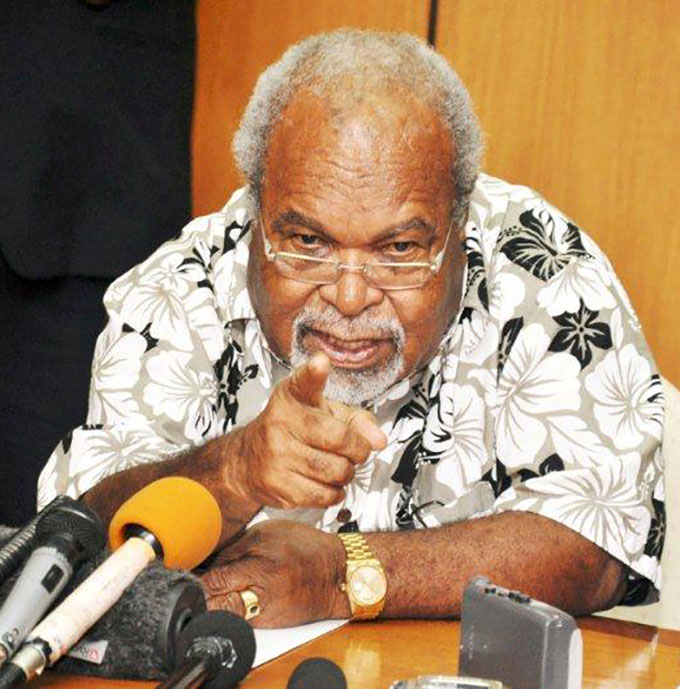
Sir Michael Somare: We Melanesians must make right choice on Papua

By PMC Editor – July 14, 2016, By Sir Michael Somare

Sir Michael Somare
Sir Michael Somare … “Our decisions made at the MSG Leaders’ Summit over these next two days will embed values in future generations of Melanesian people who will regard our solidarity with admiration if we make the right decisions regarding decolonisation and self-determination.” Image: Malumnalu.blogspot

The four Melanesian prime ministers of Papua New Guinea, Solomon Islands, Vanuatu, and Fiji will come together in Honiara, Solomon Islands today as chairman Manasseh Sogavare hosts the 23rd Melanesian Spearhead Group Special Leader’s Summit.

Decolonisation and independence of Melanesian countries are processes of liberation close to my heart. The Noumea Accord, for instance, symbolises the pursuit of self-reliance and autonomy synonymous with the rights and freedoms available to all peoples of this century.

In practice the accord provides for technical assistance, training programmes for the Kanaky people still residing under French sovereign rule.

Such arrangements already provide a legal and practical framework for the indigenous people of New Caledonia to fully exercise their right to self–determination, even as they long for independence.

Our decisions made at the MSG Leaders’ Summit over these next two days will embed values in future generations of Melanesian people who will regard our solidarity with admiration if we make the right decisions regarding decolonisation and self-determination.

From today we will tell our own story, the story of our constitutional and universal right to exercise the freedoms given to us at independence in each of our countries.

Today we can, by consensus, trigger the process for greater self-determination to be enjoyed by West Papuans.

‘Founding Father’
As a “Founding Father” I am encouraged by the progress made already on the key issue of West Papua’s full membership to the Melanesian Spearhead Group.

I am inspired that the MSG senior officials, ministers and leaders will have maintained consensus despite some complex and sensitive diplomatic, economic, social, and political issues.

Genuine and inclusive consultation among all MSG member states and one territory in considering the future path to decolonisation and self-determination for West Papua is critical now more than ever before.

We can strengthen the Melanesian Spearhead Group and our region, which includes West Papua, by ensuring that Melanesian leaders in Honiara approve the United Liberation Movement for West Papua’s application for full membership to the Melanesian Spearhead Group.

We are one people spread over many continents and oceans, separated by the sea and mountain ranges in diverse sovereign jurisdictions.

Our ancestors roamed freely over our shared land and sea for centuries prior to colonial and Christian interventions.

We must hold onto that spirit of a vast community that underpins our modern efforts within diplomacy and international cooperation and dialogue.

Political upheaval
All MSG member states and one territory have experienced some level of political upheaval and civil conflict requiring decisive political and economic reform and declarations for peaceful transitions to occur.

The export of mineral resources and agricultural commodities remains a key source of revenue for all states and one territory at the MSG.

So it is essential that we endeavor to sustain political stability in order to buttress economic and environmental sustainability for the good of all Melanesian people.

But our sub-region can only prosper when all political, economic, socio-cultural and environmental issues are considered in the same light according to the needs of all of our people.

Our growth potential relies on our diplomatic and official relationships, our ties and our linkages to the rest of the world. But as a group of ethnically linked people we have always relied on talking, exchange and cultural participation.

We are Melanesians after all. That is what makes us distinct.

We bring those distinct features to every forum but this week at the Melanesian Spearhead Group Special Leaders’ Summit we have a unique opportunity yet again to decide on our own future with integrity as self-governing and independent members of a powerful sub-regional bloc.

More than ever that sub-region needs to include West Papua as an integral part and, as an equally participating member.

Rt Hon Grand Chief Sir Michael T Somare
Port Moresby

MSG Chair Reminds Jakarta about Decolonisation

11:06 am on 25 May 2016 Radio NZ

The chairman of the Melanesian Spearhead Group has defended his criticism of Indonesia over its alleged failure to engage with the region over West Papua.

Manasseh Sogavare, who is also Solomon Islands Prime Minister, recently claimed that Indonesia joined the MSG for the purpose of protecting its own interests, rather than discussing human rights in West Papua.

It drew a sharp rebuke from Jakarta where the Director General for Asia, Pacific and Africa, Desra Percaya, said Mr Sogavare’s claims were not based on reality.

Desra Percaya from Indonesia's Ministry of Foreign Affairs

Desra Percaya from Indonesia’s Ministry of Foreign Affairs Photo: UN

He also said Mr Sogavare’s statements violated the basic principles of sovereignty and non-interference, as contained in the MSG Establishing Agreement.

However the MSG Chair’s Special Envoy on West Papua, Rex Stephen Horoi, said the chair would like to remind Jakarta that one of the key overarching principles of the group is the principle of decolonisation of Melanesia.

“This is a fundamental principle that binds the Melanesian countries and all MSG members together,” he said.

“In this principle, MSG stands for its defense and promotion of independence as the inalienable right of indigenous peoples of Melanesia.”

Mr Sogavare also sought to remind Jakarta that the United Liberation Movement for West Papua was also a part of the MSG, with observer status.

He claimed the refusal of Indonesia’s government so far to discuss West Papua with him showcases Jakarta’s intention of not engaging in dialogue about the serious allegations of human rights issues.

The MSG chair has reiterated his offer to the Indonesian President, Joko Widodo, to discuss matters of common interest within the space provided by the MSG.

Manasseh Sogavare

Manasseh Sogavare Photo: RNZI Koroi Hawkins

The Muslim occupation of West Papua after Dutch granted independence

The Muslim Issue, How often do we hear how “bad” colonialism was? Whether it is from India, Africa or Papua New Guinea and West Papua we are painted a nightmarish picture of the “wicked white man” who is described to have “destroyed” the countries they ruled. But facts are different to these exaggerated left wing fairy tales of division and racism so common amongst the liberals. They have painted the crusaders, the brave Christian army that sacrificed their own lives to save Europe from Muslim takeover, in the same light.

The story of colonialism is different from natives who actually lived under colonialism. Unlike popular claims by left wingers and their historians, colonialism did far more good than bad and offered protecting of territories from the Muslim threat and other external threats. Read here what happened when the Dutch ‘colonialists’ tried to return Papua to its own people and left the country:

The Dutch colonialists tried to give Papua New Guinea and West Papua their independence back to the natives. There was no wars or attacks on the ‘colonialists’ needed for it and the natives gained their island back by appealing to the UN. The Dutch perfectly willingly decided to give it back to the people.

Note also in the story below that the natives and tribals had been able to live freely, protected, and by their own choice and natural lives in their jungles without interferences from the Dutch at all. So much so that they did not even know much about Dutch rule of their own country until after the Dutch left – quite contrary to the claims left wing writers tend to paint the picture. This testimony is the same one can find in India where many native people did not even know their country had been under British rule because they had never even seen an English man, and never had any interferences from the English into their lives for over three hundred years.

To return independence to this island the Dutch tried to prepare them for the task to avoid a Muslim takeover from neighboring Indonesia. Unfortunately the natives did not listen, grasp or take serious the groundwork the Dutch tried to create for them. Like many colonial societies they benefited from the protection and rule colonialism had given them, and did not imagine things would change drastic without it. West Papua, like the Dutch feared, quickly fell into Muslim hands once they had left and the natives have been living under Muslim oppression, rape, arson, threats and mass murders ever since.

Up ↑

Wantok COFFEE

Organic Arabica - Papua Single Origins

MAMA Minimart

MAMA Stap, na Yumi Stap!

PT Kimarek Aruwam Agorik

Just another WordPress.com site

Wantok Coffee News

Melanesia Foods and Beverages News

Perempuan Papua

Melahirkan, Merawat dan Menyambut

UUDS ULMWP

for a Free and Independent West Papua

UUDS ULMWP 2020

Memagari untuk Membebaskan Tanah dan Bangsa Papua!

Melanesia Spirit & Nature News

Promoting the Melanesian Way Conservation

Kotokay

The Roof of the Melanesian Elders

Eight Plus One Ministry

To Spread the Gospel, from Melanesia to Indonesia!

Koteka

This is My Origin and My Destiny