‘We’ll not be safe with Indonesia,’ says West Papua’s Benny Wenda

By Kendall Hutt in Auckland

A lifelong campaigner for a free and independent West Papua has issued a stark warning to New Zealand politicians as he visits the country this week.

Benny Wenda with wantok students at the Auckland University of Technology this week. Image: Del Abcede/PMC

Benny Wenda, a tribal chief of West Papua exiled to the United Kingdom by Indonesia, told Asia Pacific Report that time was running out for West Papua if governments such as New Zealand do not act.

“If we live with Indonesia for another 50 years, we will not be safe. We will not be safe with Indonesia.”

He said the purpose of his visit to New Zealand was to highlight the importance of West Papua returning to its Melanesian family.

“We really need Pacific Islanders, our sisters and brothers across the Pacific – particularly New Zealand and Australia – to bring West Papua back to its Pacific family. Then we can survive. Otherwise, it will be very difficult to survive with Indonesia,” he said.

Since Indonesia took over West Papua following a controversial Act of Free Choice – dubbed by critics as an “Act of no choice” – in 1969, Wenda said his people had suffered.

“Everyday someone is dead, or has been killed, and someone has been stabbed, but no one is brought to justice.”


Human rights violations

In its rush to claim former Dutch colonies in the Asia-Pacific region following West Papua’s self-declared independence from the Netherlands in late 1961, Indonesia has subjected West Papua to continued human rights violations.

Many West Papuans have been imprisoned for non-violent expressions of their political views and widespread allegations of torture have been consistently made against Indonesian authorities.

Raising West Papua’s flag – the Morning Star – can incur 15 years in prison.

Wenda, the 42-year-old founder of the Free West Papua Campaign, has himself been imprisoned, accused of inciting an attack on a police station — despite the fact he was not even in the country at the time.

With foreign media all but denied access to West Papua – despite apparent lifting of restrictions by President Joko Widodo in 2015 – much of Indonesia’s atrocities remain secret, hidden.

It is for these very reasons, Wenda said, that West Papua was fighting.

“We are fighting for our independence, but we are also fighting for our land, our forest, our mountains.”

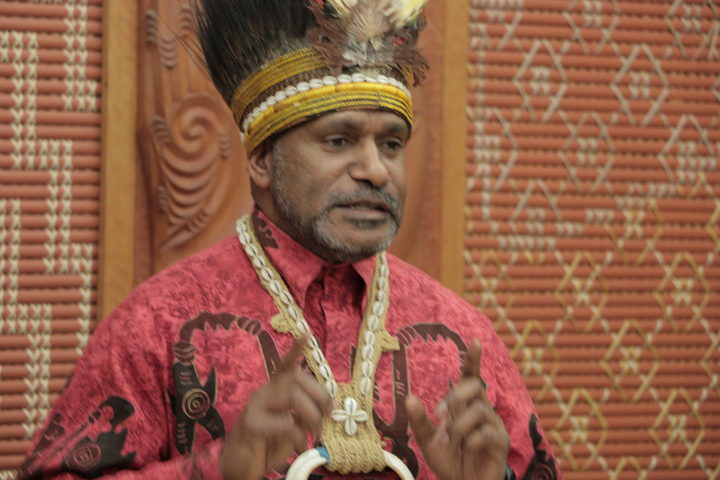
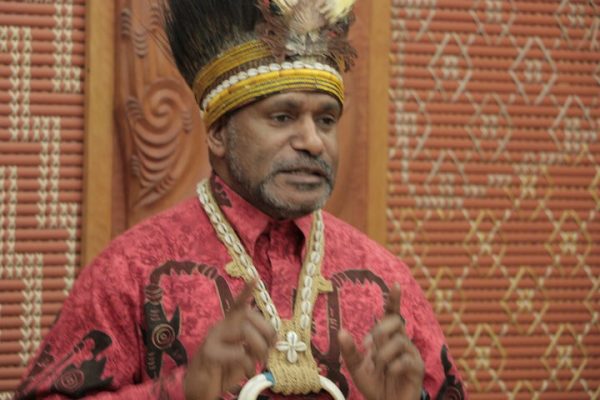
“Lifelong” Free West Papua advocate Benny Wenda says New Zealand support is integral to the global campaign. Image: Kendall Hutt/PMC

New Zealand support sought
Wenda is calling for the New Zealand government’s integral commitment to the campaign for a free West Papua.

He said this was because New Zealand had a duty, as a part of the Pacific, to raise awareness of the atrocities in West Papua.

“West Papua is a very close neighbour, so that’s why I hope the New Zealand government will speak more about the human rights situation in West Papua.”

Wenda said it was high time for New Zealand to pull away from its business, trade and investment focus with Indonesia and speak about Indonesia’s human rights abuses.

New Zealand “needs to do more” as a country, he said, because New Zealand is a country which is meant to value human rights, respect the rule of law, freedom of speech and the right to self-determination in other parts of the world.

It is therefore time for New Zealand’s foreign policy on West Papua to change.

“West Papua’s hope is Australia and New Zealand. This is a regional issue, this will never go away from your eyes and this is something you need to look at today. Review your foreign policy and look at West Papua.”


‘We are the gatekeepers’

“Australia and New Zealand need West Papua. We are the gatekeepers, and for security reasons, West Papua is very important,” Wenda said.

Catherine Delahunty, a Green Party MP who has campaigned strongly for West Papua on New Zealand’s political front, echoed Wenda’s views.

“They are insistent – the New Zealand government – that West Papua is part of the territorial integrity of Indonesia, so we can’t get past that critical issue.”

She said she therefore did not have much faith in the current government to step up and was looking for future leadership, such as through the Labour-Greens alliance, to move the campaign for West Papuan self-determination forward on the home front.

AUT doctoral student Stephanie Sageo-Tupungu of Papua New Guinea makes a presentation to Benny Wenda on behalf of the Pacific Media Centre. Image: Kendall Hutt/PMC

“I really do think we need a different government that actually has some fundamental commitment to human rights over and above trade and being part of the US military complex around the world. We have to have change to get change. It’s not going to happen through these guys.”

In her eight years in Parliament, Delahunty said the situation in West Papua was the toughest she had had to face.

“This issue, for me, has been one of the most disturbing things I’ve ever worked on. It’s been one of the most horrible and one of the most powerful examples of the cynical use of power and the way in which people can just completely close their eyes.”


Mainstream media role

Both Wenda and Delahunty said in light of the resounding silence surrounding West Papuan media freedom during Indonesia’s hosting of World Press Freedom Day last week that raising awareness of West Papua was key for the world to finding out about the atrocities there.

The mainstream media had a large role to play in this, both acknowledged.

“West Papua really needs the media in terms of the publicity. Media publicity is very important,” Wenda said.

Wenda said it was time for New Zealand’s mainstream to pick up the baton from smaller, independent news agencies and carry stories of West Papua’s atrocities themselves.

“I really hope the mainstream media here carries this. It’s very important. We need more mainstream media. They really need to pick up on this issue.”

Paris-based Reporters Without Borders (RSF) has reported that it was not unusual for both local and foreign journalists in West Papua to be threatened anonymously or by authorities. Data by the Alliance for Independent Journalists (AJI) has revealed there has been an increase in the number of assaults on journalists in the region over the past two years.

There were 78 violent attacks on journalists in 2016, up from 42 attacks in 2015 and 40 in 2014.

The AJI found only a few attackers from those 78 attacks had been brought to justice.

Only last week, independent photojournalist Yance Wenda was arrested and beaten by police while covering a peaceful demonstration, prompting condemnation from RSF that Indonesia was ‘double-dealing’ over media freedom.

‘Everything swept under the carpet’
Wenda said there was deep-seated inaction on Indonesia’s part because of its prejudice in prosecuting people who have attacked and tortured and beaten both West Papuans and also West Papuan journalists.

“Indonesia is getting away with impunity. Nobody is brought to justice. Everything is swept under the carpet.”

Delahunty reflected, however, that the world was seeing the lack of free and frank reporting play out in West Papua.

“We see the consequences of nearly fifty years of no honesty about West Papua and it’s just up the road. It breaks my heart, but it also fires me up because I really believe there are some very, very brave young people, including journalists, who are committed to this issue and I guess it’s that thing: if you have a voice, use it.”

This was Wenda’s call to an audience gathered at his talk at the Pacific Media Centre-hosted Auckland University of Technology on Tuesday evening.

“Today you are the messengers for West Papua.”

Wenda highlighted a “united” Pacific was key in raising awareness of the “Melanesian genocide” occurring in West Papua.

Benny Wendy with wantok students…representing a “united” Pacific for West Papua. Image: Del Abcede/PMC


‘United’ Pacific key

He called on his “brothers and sisters”, but was deeply thankful of the support given already by several Pacific nations for West Papua’s cause.

These nations raised grave concerns regarding human rights violations in West Papua at the 34th session of the United Nations (UN) Human Rights Council in March.

Recent declarations by both the Solomon Islands and Vanuatu were also acknowledged by Wenda.

“We cried for 50 years, but then these countries sacrificed to take on this issue.”

Wenda told the Solomon Islanders and the people of Vanuatu gathered they should “be proud” and that their action was something to “take away in your head and heart”.

Wenda also told the remainder of his audience it was “ordinary people” and “mostly young generations” who were needed to continue the fight, with social media being their greatest tool.

Delahunty added people power and the growing solidarity movement across the globe were also central.

“The only way they’ll speak and respond to this issue at all is if we have growing public pressure and that’s the job of all of us, both inside parliament and outside parliament to raise the issue and to make it something people will feel accountable for, otherwise we just ignore the plight of our neighbours and the killing, torture, environmental desecration and human rights abuses continue.”

Wenda and Delahunty both closed their interviews with a clear message for Indonesia: “Start talking, start listening, and stop thinking that you can ever brow beat people into the dust because you want their resources because in the end, the human spirit doesn’t work like that and these people will never give up. It’s up to us to support them.”

Kendall Hutt is contributing editor of Pacific Media Watch.

Free West Papua advocate Benny Wenda presents Pacific Media Centre Professor David Robie with a traditional “bilum” for his journalism about West Papuan freedom. Image: Kendall Hutt/PMC

West Papuan leader sees solidarity grow in NZ

International support for West Papuan self-determination cause is growing, according to a Papuan independence leader.

Benny Wenda is in New Zealand this week, raising awareness about the Indonesian-administered region of Papua, or West Papua, which he fled in 2003.

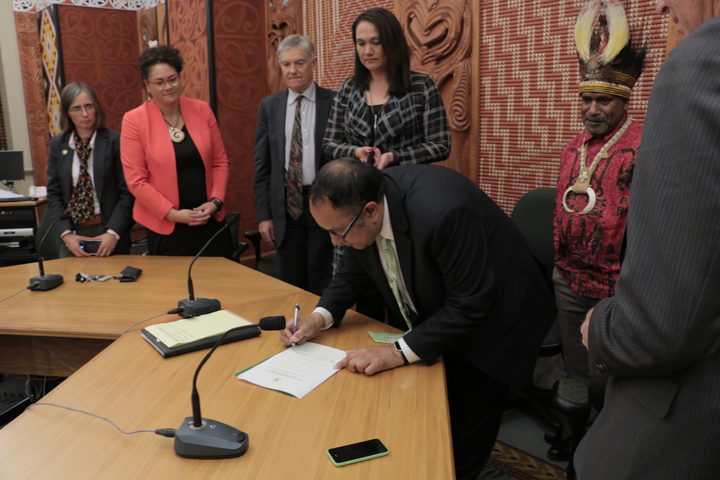
New Zealand MPs pose with the West Papua Freedom Movement's Benny Wenda after signing the International Parliamentarians for West Papua Declaration.
New Zealand MPs pose with the West Papua Freedom Movement’s Benny Wenda after signing the International Parliamentarians for West Papua Declaration.

Last night in Wellington he addressed a group of MPs, after which eleven members signed a declaration by the International Parliamentarians for West Papua.

This international organisation of MPs is calling for an internationally supervised self-determination vote in Papua.

Mr Wenda said momentum was being driven by the Pacific Coalition on West Papua, chaired by the Solomon Islands prime minister Manasseh Sogavare.

 New Zealand MPs sign the International Parliamentarians for West Papua declaration as Benny Wenda the head of the West Papua Freedom Movement looks on. Wellington 10-05-2017. Photo: RNZI/ Koroi Hawkins
New Zealand MPs sign the International Parliamentarians for West Papua declaration as Benny Wenda the head of the West Papua Freedom Movement looks on. Wellington 10-05-2017. Photo: RNZI/ Koroi Hawkins

“So the Manasseh Sogavare leadership is bringing a big impact on the West Papua issue. And the seven countries (of the coalition) I joined. It is bringing the West Papua case in United Nations level,” he said.

“So this is a big thing to change now. So we also got support from African, Carribean and the Pacific. So this is a growing number and solidarity around the world.”

Mr Wenda said West Papuans as a people had been through many grave challenges in the last five decades of Indonesian rule, but that they remained ever hopeful.

A growing solidarity network in the Pacific was giving them hope.

“The parliamentarians today…. Catherine Delahunty (New Zealand Green Party MP) lead a lot of MPs, bringing them in to sign their support.

“This is the best medicine, I think, for the people of West Papua. That’s why their spirit is alive even (though) they’re suffering under the Indonesian illegal occupation.”

New Zealand MPs pose with the West Papua Freedom Movement's Benny Wenda after signing the International Parliamentarians for West Papua Declaration.
New Zealand MPs pose with the West Papua Freedom Movement’s Benny Wenda after signing the International Parliamentarians for West Papua Declaration.

According to Mr Wenda, West Papuans were united under the United Liberation Movement for West Papua.

Indonesian government officials have characterised the Liberation Movement as a group of Papuans living abroad which lacks legitimacy to represent Papuans.

Mr Wenda dismissed this, pointing out that the leadership of the Liberation Movement is based both in and, out of necessity, outside Papua.

West Papuan grassroots support for the organisation within Papua was massive, he said.

Papuan independence leader pushes cause abroad

The West Papuan independence leader Benny Wenda says international support for his people’s cause is steadily growing.

Mr Wenda is in New Zealand this week, raising awareness about the Indonesian-administered region of Papua, or West Papua, which he fled in 2003.

Last night in Wellington he addressed a group of MPs, after which eleven members signed a declaration by the International Parliamentarians for West Papua.

This international organisation of MPs is calling for an internationally supervised self-determination vote in West Papua.

Mr Wenda spoke to Johnny Blades and began by talking about a core issue of mistrust between Papuans and the Indonesian state.

Source: http://www.radionz.co.nz


Transcript

BENNY WENDA: Distrust between Papuan and Indonesian… Jakarta always suspicious of every West papuan, whoever works in the government or ordinary people. So they’re suspicious and they’re always worried because Indonesia knows that their presence in West Papua is illegal. So they always worry. People who are working in Indonesia, in Jayapura or West Papua, they are always suspicious on them. So there is zero trust between Jakarta and Papuans, very much.

JOHNNY BLADES: This government under President Jokowi seems to have made more of an effort to listen to Papuans or to try and improve conditions on the ground, compared to previous Indonesian governments, would you agree with that?

BW: Yeah, the current president always constantly visits West Papua, almost two or three times a year. But the reality is, the governments are controlled by military. So the current president does not have power to change the situation in West Papua.

JB: There’s a lot happening in West Papua at the moment, isn’t there? The (outgoing) governor of Jakarta has been sentenced for blasphemy, and there are these radical elements who are sort of whipping up dissatisfaction with the Jokowi government. Tito Karnavian has warned that if that movement isn’t stopped, then there’ll be unrest in places like Papua. Would you agree with that?

BW: There’s a few elements that are trying to gain power, and there’s a politics angle in that, in what’s happening in Jakarta, because the military want to control. The current government is a civillian government, and so I think they want to go back where it was. So that’s why there’s a few elements like Wiranto and Prabowo trying to gain power and using these fundamentalists to manipulate them. That’s what’s happening in Indonesia. It’s something will change and unrest will happen.

JB: Do you ever hear from Indonesian government people trying to send you messages or anything?

BW: Until today they never say anything.

JB: But they are well aware of the work you’re doing. You are travelling around the world and lobbying, and things are starting to move a bit.

BW: Yeah, they’re working very hard trying to stop me, where ever I go. But this fight is not about who gains power, but this is about a humanitarian issue and this is human rights issue. That’s why I strongly believe that our right to self-determination still exists. This is something that I believe in. So Indonesia cannot stop me. My people and myself decide to free, so they cannot stop us. That’s why I’m confident.

JB: The Pacific Coalition on West Papua, which includes seven countries and of course a big civil society and church network, and the West Papuan Liberation Movement, has really internationalised the issue lately, including at the African, Caribbean and Pacific group summit this month.

BW: Yeah this is a big shift in the Pacific because Solomon Islands and Vanuatu are backing this issue, and we have formed the Pacific Coalition on West Papua, chaired by Solomon Islands prime minister Manasseh Sogavare. So the Manasseh Sogavare leadership is bringing a big impact on the West Papua issue. And the seven countries (of the coalition) I joined. It brings the West Papua case in United Nations level. So this is a big thing to change now. So we also got support from African, Caribbean and the Pacific. So this is a growing number and solidarity around the world.

JB: There’s a goal, isn’t there, to push Indonesia to have a legitimate self-determination process for the Papuans. Is that the ultimate goal?

BW: Yes that is the the ultimate goal. In fact today we signed the declaration. It’s part of the support for an internationally-supervised vote. And that Pacific Coalition and all that are part of the world, we are pushing that direction.

JB: Just now we’ve seen some New Zealand MPs sign up to it. MPs from other regions in the world have signed up to it. But can it make a difference when it comes to Jakarta?

BW: I think that at the moment, more people finding out, and parliamentarians around the world are solidarity with the people of West Papua. And here today we are signing the declaration, it’s cross-party. It’s not one particular party but Labour, Greens, National, they’re all signing the declaration. So this is, they show that around the world this fight is about a humanitarian issue. People believe in justice and freedom. That’s why these MPs are signing the declaration for West Papua internationally-supervised vote.

JB: There’s so many tribes in West Papua, could it function well as a nation on its own.

BW: Yeah I think we’ve been through many experiences in the last 50 years. We’ve learnt a lot, and we are travelling a lot. So Indonesia might say it’s a failed state. But we’ve are ready to take back our country because this is a last fight against colonialism, and we know that our neighbouring country in the Pacific they already got independence. And we also  learn from them. We’re working together to rebuild a new country democratically.

Banned Papua flag raised near Indonesian ship in NZ

A group demonstrating in front of an Indonesian naval ship in Auckland raised the Morning Star flag in support of West Papuans.

Indonesia’s KRI Banda Aceh is one of numerous warships from other countries currently in New Zealand participating in the New Zealand Navy’s 75th birthday celebration.

Demonstrators in Auckland hold up Morning Star flag to Indonesian sailors
Demonstrators in Auckland hold up Morning Star flag to Indonesian sailors Photo: supplied

The demonstration against Indonesian military involvement in West Papua was held by the solidarity groups Oceania Interrupted and West Papua Action Auckland.

Oceania Interrupted spokesperson Leilani Salesa says the demonstrators made sure their presence was felt.

She says they stood next to the naval ship holding the Papuan Morning Star flag which is banned in Indonesia.

“And to do an act that we know brothers and sister in West Papua would be punished for was a really powerful for us and it sends a very powerful message that the world is watching and we stand in opposition to the atrocities that they continue to commit.”

Raising the West Papuan flag is a crime in Indonesia punishable with years in prison.

Activists in Auckland concerned about Indonesian military
Activists in Auckland concerned about Indonesian military Photo: supplied

Pacific Journalism Review raises bar on West Papua, corruption issues

By PMC Editor – July 26, 2016

PMC chair A/Professor Camille Nakhid launches PJR with the editor, Professor David Robie, in the background. Image: Del Abcede/PMC

Pacific Media Centre chair Dr Camille Nakhid has praised the latest edition of Pacific Journalism Review with a launch coinciding with the Fourth World Journalism Education Congress (WJEC) in Auckland.

She said it was a popular journal globally as well as in the Asia-Pacific region, and noted the presence of many international contributors to the latest edition at the launch.

“This journal has progressed through the persistence of Professor David Robie, Dr Philip Cass and Professor Wendy Bacon with support of the wonderful production efforts of Del Abcede and proof reading of Susan O’Rourke,” said Dr Nakhid, who is an associate professor in AUT’s School of Social Science and Public Policy at Auckland University of Technology.

She said this latest issue of the journal, the only one regularly publishing New Zealand journalism research, was timely as it coincided with the WJEC conference and an Australian and Pacific Preconference.

There had been much attention on alleged corruption in New Zealand under the current government, particularly in reference to the Panama Papers, and ongoing corruption in the Pacific and wider Oceania region.

“This issue of the journal covers articles by those journalists and media researchers who have brought these issues to light,” she said.

“The articles also discuss the lives of journalists and their risks and dangers, our damage to the environment and many other issues.

“We need young journalists to live to become old journalists and so we very much welcome this journal and the launch of this current issue theme titled ‘Endangered Journalists’.”

NZ Govt urged to recognise West Papua ‘genocide’

The New Zealand Government is being urged to stop turning a blind eye to the atrocities playing out in West Papua.

Since May this year, at least 3000 young people have been arrested and tortured for peacefully protesting large-scale human rights abuses.

Indonesia took control of the province in 1963, and it has been under military occupation ever since.

The struggle for independence has seen around 500,000 Papuans killed, with watchdogs referring to it as a ‘mass genocide’.

Maire Leadbeater from West Papua Action Auckland says they’re launching a petition aimed at our Government, and its inability to acknowledge the horror.

“It’s a repeat of East Timor… it always seems more important to our Government to have a bilateral relationship with Indonesia, rather than speak up for the pacific people who live in West Papua,” said Ms Leadbeater.

Human rights groups have long been campaigning for countries to acknowledge the abuse, saying people are being subjected to killings, torture, beatings and neglect.

Ms Leadbeater says people remain blissfully unaware of the horror, because of strict restrictions Indonesia imposes on the media.

“The situation remains hidden as very few journalists are able to get there. It’s very out of sight.”

But she hopes that’s all about to change, as neighbouring countries begin to voice concerns about, what’s often referred to as the genocide of West Papuans.

“The Solomon Islands and Vanuatu are standing out on the issue at the likes of the United Nations… they’re really doing a great job and we need to follow their lead.”

And New Zealanders are being told it’s time to do their part, with the launch of a petition this afternoon.

Ms Leadbeater says it simply asks for the Government to speak out about the atrocities at international forums.

Newshub

Read more: http://www.newshub.co.nz/politics/nz-govt-urged-to-recognise-west-papua-genocide-2016070712#ixzz4FPbvancX

New Zealand Dukung Integritas Teritorial Indonesia di Papua

JAYAPURA [PAPOS] – Pemerintah Negara New Zealand melalui Duta Besar David Taylor mendukung integritas territorial Indonesia bagi Papua dengan mengedepankan pendekatan ekonomi yang dianggap cukup baik dalam menyelesaikan bentuk permasalahan yang terjadi di Tanah Papua.

Hal ini terbukti dari ditindaklanjutinya kerjasama Program Polisi Masyarakat [Polmas] antara Negara Indonesia dalam hal ini Kepolisian Polda Papua dengan Kepolisian New Zealand sejak tahun 2009-2010, di mana David Taylor didampingi Sekretaris III, David Theacher mengadakan pertemuan dengan Kapolda Papua, Irjen (Pol) Drs. Tito Karnavian dan Wakapolda Papua, Brigjen (Pol) Drs. Paulus Waterpauw beserta pejabat utama Polda Papua, sekitar pukul 08.00 – 10.00 Wit di ruang kerja Kapolda Papua, Senin (15/4).

“Pertemuan itu lebih kepada pembahasan Program Polmas antara Negara New Zealand dengan Negara Indonesia dalam hal ini Polisi Polda Papua sejak tahun 2009 – 2010 yang telah disepakati. Ke depan bersama akan dilakukan semacam pelatihan training of traner, di mana cara mendekatkan Polri dengan masyarakat dan juga untuk memperbaiki tingkat pelaporan yang baik dari masyarakat kepada Polri,” ucap David Taylor Dubes New Zealand di damping Sekretaris III, David Theacher usai melakukan pertemuan dengan Kapolda Papua.

Menurut David, Program Polmas ini baru berjalan pada tahun ini selama 3 tahun kesepakatan. Nantinya akan ada 2 polisi dari Negara New Zealand yang akan ditempatkan di Provinsi Papua dibantu dengan instruktur-instruktur dari New Zealand yang datang secara bergantian di Papua dengan nilai bantuan sekitar Rp 20 Milliar lebih.

David mengutarakan, tujuannya semata-mata untuk lebih mendekatkan Polisi dengan masyarakat melalui Program Polmas tersebut. “Kami yakin Program Polmas ini akan berjalan di Papua sebab sebelumnya, Kapolda Papua Tito Karnavian pernah menyelesaikan Pendidikan di New Zealand dan merupakan teman lama kami. Atas itulah kepemimpinannya sebagai Kapolda Papua, Program Polmas ini bisa berjalan di Provinsi Papua,” ungkapnya.

Di samping itu, dengan progam ini juga diharapkan bisa membantu memperbaiki kualitas pembangunan yang berada di Indonesia terlebih lagi di Provinsi Papua ini yang tentunya akan dikoordinasikan dengan Pemerintah Pusat.

Pada tahun 2013 ini bantuan yang akan diberikan Pemerintah New Zealand berupa program beasiswa bagi Indonesia, terutama untuk pelajar yang berada dari Papua. Sedikitnya 10 mahasiswa telah mengecap pendidikan di New Zealand. “Kami akan mempersiapkan program bahasa Inggris di Surabaya yang baru akan dimulai dan di tutup 20 April mendatang,” kata David.

Beasiswa yang akan diberikan Pemerintah New Zealand tahun 2013 ini ia belum tahu berapa jumlahnya, namun sekarang ini masih dibuka pendaftaran hingga 20 April mendatang. “Sekarang ini telah ada 4 pelajar dari Papua yang mengikuti pelatihan Bahasa Inggris di Surabaya, yang mana tahun sebelumnya, telah terdaftar 600 pelajar dari Indonesia termasuk pelajar dari Papua dan jumlah itu akan bertambah semakin banyak lagi,” tambahnya.

Disinggung adanya dukungan Negara New Zealand terhadap pergerakan Kemerdekaan Papua, David Taylor mengutarakan hal itu dianggap lumrah. Bukan hanya Negara New Zealand melainkan negara –negara di luar negeri juga ada yang ikut yang mendukung. Memang tak dipungkiri bahwa ada 1 atau 2 orang warga Negara New Zealand memberi dukungan terhadap pergerakan kemerdekaan Papua tetapi kebijakan resmi Pemerintah New Zealand adalah mendukung territorial Indonesia bagi Papua, ungkapnya.

Hal yang sama juga disampaikan, Kapolda Papua, Irjen (Pol) Drs. Tito Karnavian. Negara New Zealand sangat mendukung penegakan hukum yang dilakukan pihak kepolisian dalam menghadapi masalah-masalah yang terjadi di Papua. Diimbangi dengan cara pendekatan kesejahteraan kemasyarakatan yang dilakukan pihak Polda Papua saat ini.

Jadi upaya-upaya dalam pengungkapan kasus, langkah pertama yang mesti dilakukan adalah pendekatan melalui Binmas namun bila belum juga membuahkan hasil maka langkah terakhir adalah upaya paksa yang nantinya akan tertuang dalam komuniti polisi. Cara seperti itu dianggap telah berhasil di Negara New Zealand sehingga akan diterapkan juga di Provinsi Papua yang akan diikuti seluruh polisi yang ada di Polres-Polres di Papua.

Pelatihan utama akan dilakukan di Sekolah Polisi Negara[SPN] di Jayapura. Sedangkan untuk file project komuniti akan dimulai dari perkotaan Jayapura dan daerah pegunungan di Provinsi Papua. Dari itulah nanti akan dievaluasi keuntungan dan kelemahannya apa. Bila dilanjutkan, apakah pada daerah lain yang lebih luas lagi.

“Itulah 2 Program inti yang disampaikan Dubes New Zealand kepada Polda Papua selama 3 tahun yang menurut rencana akan rampung pada bulan Juli namun mulai bekerja pada Bulan September dan Oktober mendatang ,” tukasnya. [tom]

Source: Selasa, 16 April 2013 01:56, Ditulis oleh Tom/Papos

Enhanced by Zemanta

Up ↑

Wantok Coffee

Melanesia Single Origin Coffee

MAMA Minimart

MAMA Stap, na Yumi Stap!

PT Kimarek Aruwam Agorik

Just another WordPress.com site

Wantok Coffee News

Melanesia Foods and Beverages News

Perempuan Papua

Melahirkan, Merawat dan Menyambut

UUDS ULMWP

for a Free and Independent West Papua

UUDS ULMWP 2020

Memagari untuk Membebaskan Tanah dan Bangsa Papua!

Melanesia Spirit & Nature News

Promoting the Melanesian Way Conservation

Kotokay

The Roof of the Melanesian Elders

Eight Plus One Ministry

To Spread the Gospel, from Melanesia to Indonesia!

Koteka

This is My Origin and My Destiny