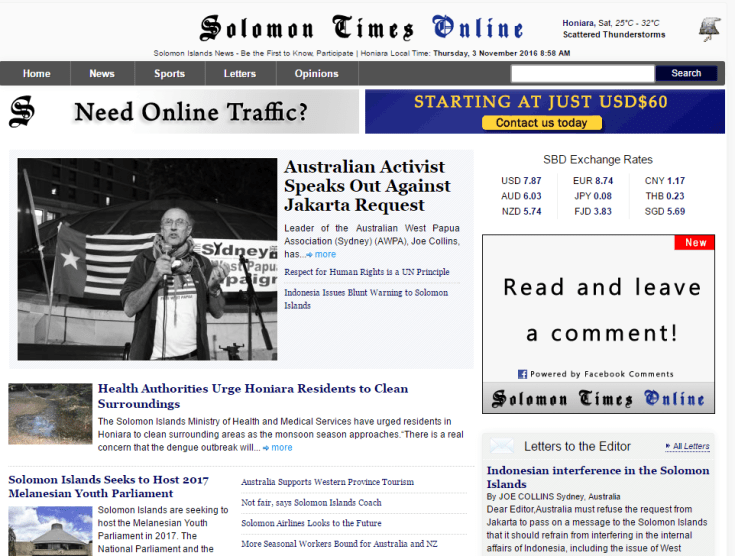
Leader of the Australian West Papua Association (Sydney) (AWPA), Joe Collins, has spoken out against reports that Jakarta has requested Australia to pass on a message to the Solomon Islands to refrain from interfering in the internal affairs of Indonesia.
“This is an outrageous request as it is the duty of all nations to raise concern about human rights abuses not only in West Papua but no matter where they are committed.
“The Solomon Islands and the other six Pacific leaders who raised concern about the human rights abuses in West Papua (at the 71st Session of the United Nations General Assembly in New York in September) are to be congratulated for their courageous stand on the issue of West Papua,” said Mr Collins.
He said that it is a pity that Australia does not follow the Pacific leaders in also condemning the ongoing human rights abuses committed by the Indonesian Military.
“Not only should Australia refuse the request of the Indonesian defence minister but should be supporting the Pacific leaders in calling on Jakarta to allow a PIF facing mission to West Papua.”
Indonesia’s Defence Minister was quoted by media as having requested Australia to pass on the message to the Solomon Islands, saying that as a major donor, Australia should raise the issue of non-interference with Solomon Islands.
—————————-
Joe Collins, along with AWPA’s Secretary Anne Noonan, were awarded the 2012 John Rumbiak Human Rights Defender Award.
AWPA’s role is to lobby and inform the Australian Government and the International Community and in particular regional organizations such as the Pacific Islands Forum and the Melanesian Spearhead Group to raise concerns about the human rights situation in West Papua.
News that the Indonesian government is upping the ante against supporters of West Papua comes as no surprise, a well-placed senior government source said.
“It is no surprise to us, and I think it is not right to say that we are interfering with the internal affairs of Indonesia, we are simply raising an issue of concern regarding our Melanesian brothers of West Papua.
“We are all members of the United Nations, and the respect for Human Rights is one of the key cornerstones of the Charter,” he says.
“That is what we are asking from the UN, to send an independent assessment team to find out the facts on the ground and to report back to the members.”
He says that it is not an unreasonable request, nor is it unprecedented, it is a process established by the UN, and one that Solomon Islands and other Pacific countries are calling on the UN to use.
He says that the membership of West Papua in the Melanesian Spearhead Group (MSG) is an issue for the MSG alone to decide.
“This is no different from the membership of New Caledonia’s FLNKS, no different, and in fact this is in line with the establishment of the MSG.”
He says that France may not have been supportive of the idea for the FLNKS to join the MSG, “but perhaps they recognized the importance of allowing the FLNKS to raise issues of concern in a proper forum.”
“We have historical and cultural ties to the West Papuan people, so we cannot stand idly by when allegations of human rights abuses are raised time and again.
“So we will use whichever fora we deem appropriate to raise such issues, not to interfere but to remind ourselves of our obligations to certain universal principles and values.”
The Defence Minister of Indonesia has urged the Australian government to rebuke Pacific states, in particular Solomon Islands, for raising Papua in global fora.
A Research Fellow at the Australian National University’s State, Society and Governance in Melanesia Program, Stewart Firth, told Radio New Zealand that “Jakarta has misinterpreted Australia’s relationship with Pacific countries.”
“These are sovereign states. And in particular in the case of Solomon Islands, Solomon Islands has a right to do that [speak out about West Papua] as a sovereign country, and Australia’s not in a very good position to tell them differently,” Dr Firth said.
‘Being a young, female Indonesian myself, I expected myself to celebrate Nara Masista Rakhmatia’s UN General Assembly speech. Instead, I was gravely disappointed.’
Several weeks ago, a young, female diplomat named Nara Masista Rakhmatia made a speech that dazzled the Indonesian public. In a video that went viral, she denied accusations from 7 Pacific country leaders about human rights abuse in Indonesia’s Papua province at the 71st Session of United Nations General Assembly in New York last September.
She further shamed their attempt to interfere with Indonesia’s sovereignty. The video gathered over 188 thousand views on Facebook, along with hundreds of comments from Indonesian citizens expressing how proud they are of Nara’s intelligence and bravery to ‘teach those foreign country leaders about how to respect Indonesia’—especially given her young age.
In their remarks, delegations from Solomon Islands, Vanuatu, Nauru, the Marshall Islands, Tuvalu, and Tonga criticized Indonesia’s human rights records in Papua. Nara in particular argued that these sentiments were largely misplaced, given that the main agenda of the Assembly was Sustainable Development Goals and a global response to climate change.
Furthermore, she claimed, these countries needed to self-reflect upon their own domestic issues before pointing their fingers to how Indonesia handles the province’s push for self-determination.
Being a young, female Indonesian myself, I expected myself to celebrate her speech. I should have been inspired and impressed by how sharp she was. Instead, as someone who studied International Relations and currently a Public Policy student, I was gravely disappointed.
Disappointed
First of all, Nara based her entire rebuttal on the obsolete definition of the sovereignty principle. While sovereignty is a crucial foundation to the United Nations, since 2005, the international community has extended its definition under the ‘Responsibility to Protect’ commitment, which stipulates that absolute sovereignty does not hold when a government fails to protect its people.
PROTEST. An arrested Papuan pro-independence demonstrator gestures from a police truck in Jakarta on December 1, 2015, after police fired tear gas at a hundreds-strong crowd hurling rocks during a protest against Indonesian rule over the eastern region of Papua. File photo by AFP
Although the concept was developed specifically as a framework for humanitarian interventions to prevent atrocity crimes and this situation has arguably not brought us that far, this core principle stands.
In other words, should these allegations stand, it is justifiable for the international community to express their concerns about the possibility of ongoing crimes against humanity.
Therefore, it is more urgent to argue about whether Indonesia has indeed violated human rights in Papua.
The speech failed to address, for example, the progress of President Joko Widodo’s promise to investigate the killing of 4 Papuan high-school students in 2014. No reports have been made available to the public around this and other pressing matters such as killings in Wasior in 2001 and Wamena in 2003. A recent op-ed contended that these were not ordinary crimes but crimes against humanity.
Nara also did not talk about the 4,587 individuals who were arrested by the police for expressing their political views in regards with the Papua issue in 13 cities, as documented by the Jakarta Legal Aid Institute.
On top of that, she spent a lot of air time explaining how Indonesia has been a member of the United Nations Human Rights Council for significantly longer periods compared to these 6 countries. She leveraged that membership status as a validation to the country’s ‘human rights commitment’.
This is a logical fallacy. In reality, Jakarta continues to maintain restrictions for human rights organizations such as Amnesty International and International Committee of the Red Cross from entering Papua. Becoming a member of a certain council hardly proved these allegations wrong. If anything, it should become an additional reason as to why the country needs to feel embarrassed about the hypocrisy at home.
Wrong focus
Some of my friends asked me to give Nara a break. After all, she was only representing her country. If anything, such response is far from surprising and rather predictable. Throwing in phrases like ‘territorial integrity’ and ‘sovereignty’ sounds like something that any other country would do in responding to such accusations at an international stage.
PROTEST HALTED. Papuan pro-independence activists, some in traditional tribal garb, march during a rally in Jayapura. AFP PHOTO
However, the issue goes beyond this. Even if we look past the messenger, the problem in Papua still exists, and the fact that the government of Indonesian preferred not to deal with it should alert us.
Thus what added to my disappointment was how mainstream media in Indonesia covered the issue. Instead of playing its role as the ‘fourth pillar’ that criticizes the government, many news outlets practically made her a heroine by echoing the flattering Facebook comments and further highlightsing how she looks.
It seems like nationalist sentiments—fueled by an ‘external threat’ from these Pacific countries’—distracted them from addressing the elephant in the room. Except for The Jakarta Post, most news seemed to avoid highlighting these allegations and instead talked about how beautiful and brave Nara was. In effect, social media discussions regarding this event rotated primarily around unproductive debates about her physical qualities.
Although concerns regarding Papua were expressed by only 7 small Pacific countries now, how will Indonesia—represented by Nara or anyone else—respond in the future, should they come from other geopolitically more powerful countries?
President Joko Widodo’s administration must know by now that something has to be done in Papua, and it should be done immediately.
Surely, we could not just continue deflecting every question with a ‘sovereignty’ card. – Rappler.com
Andhyta Firselly Utami graduated from International Relations program at Universitas Indonesia, and is currently a Master of Public Policy candidate at Harvard Kennedy School.
Jayapura, Jubi – Asian Human Rights Commission (AHRC) menyampaikan apresiasi mendalam kepada enam negara-negara Pasifik yang telah mengangkat dugaan pelanggaran HAM di Papua serta pengormatan terhadap hak penentuan nasib sendiri bagi rakyat Papua.
AHRC mengakui bahwa pelanggaran HAM sudah terjadi puluhan tahun di Papua, dan tidak ada upaya serius oleh pemerintah Indonesia untuk menanganinya.
AHRC bahkan mencatat, sejak Papua diintegrasikan ke wilayah Indonesia, banyak pelanggaran HAM sudah terjadi. Diantara yang dicatat dan dilaporkan oleh lembaga pemantau HAM di Asia ini adalah kasus Wasior Wamena, pembunuhan Theys Hiyo Eluay, penghilangan paksa Aristoteles Masoka, dugaan genosida di Puncak Jaya 1977, kasus Paniai tahun 2014 dan Tolikara.
Lembaga ini juga mengingatkan bahwa tak satupun dari kasus-kasus tersebut ditangani. Terlebih fungsi-fungsi yudisial tidak ada; polisi malah menjadi pihak yang melindungi pelaku dan melakukan pelanggaran HAM; juga tidak ada investigasi yang transparan terhadap aparat keamanan yang terlibat.
“Kami tidak tahu nama-nama unit dan jumlah orang yang terlibat. Pertanyaan-pertanyaan semacam itu tetap tak terjawab karena pemerintah tidak pernah sungguh-sungguh mengatasi kasus-kasus pelanggaran HAM,” ujar rilis AHRC yang diterima redaksi, Senin (3/10/2016).
AHRC mengakui bahwa ada beberapa inisiatif yang dilakukan pemerintah terkait Papua, seperti Unit Percepatan Pembangunan Provinsi Papua dan Provinsi Papua Barat (UP4B) di masa Presiden SBY, pembentukan tim KOMNAS HAM untuk persoalan HAM di Papua, kebijakan Presiden Joko Widodo terkait pembebasan beberapa tahanan politik.
Namun upaya-upaya tersebut tidak menunjukkan hasil bagi Papua. “Sebaliknya, pelanggaran HAM terus terjadi, pembunuh Theys jadi kepala KaBAIS, dan secara umum tidak ada keadilan dan pemulihan terhadap korban,” ujar AHRC.
AHRC menyerukan kepada pemerintah Indonesia untuk dengan serius menerima semua poin dan rekomendasi yang diberikan oleh enak negara Pasifik tersebut; pemerintah juga harus membuka akses bagi badan independen untuk memonitor perlindungan HAM di Papua.
Pemerintah Indonesia juga diminta untuk membuka ruang dialog dengan rakyat Papua difasilitasi oleh pihak ketiga yang independen dan kredibel dibawah dukungan PBB.
Pemantauan khusus PBB
Senada dengan itu Lembaga Bantuan Hukum (LBH) Jakarta, dalam siaran persnya belum lama ini, juga membantah jawaban delegasi tetap Indonesia di PBB terhadap 7 negara Pasifik terkait penegakan HAM di Papua.
“Keterangan yang disampakan perwakilan Indonesia pada Sidang Umum Perserikatan Bangsa-Bangsa Ke 71 tersebut sangatlah bertolak belakang dengan realita yang ditemukan di Papua,” ujar Pratiwi Febri yang menangani isu Papua di LBH Jakarta.
Jumlah penangkapan di Papua tahun 2012-2016 – dokumen LBH JakartaMenurut data yang dihimpun oleh LBH Jakarta bersama jaringan, terhitung sejak April 2016 hingga 16 September 2016, total penangkapan telah terjadi terhadap 2.282 orang Papua yang melakukan aksi damai. Dalam kurun waktu 28 Mei hingga 27 Juli 2016, total terdapat 1.889 demonstran yang ditangkap. Sedangkan terhitung hingga 15 Agustus 2016, terdapat 77 demonstran yang ditangkap.
Penangkapan tersebut dilakukan di beberapa tempat berbeda di Papua dan mayoritas disertai dengan intimidasi dan tindak kekerasan. Dari data yang dihimpun sejak tahun 2012 sampai Juni 2016 terhimpun jumlah penangkapan mencapai 4.198 orang Papua.
LBH Jakarta secara khusus juga menyoroti dampak pasca diberlakukanya Maklumat oleh Kapolda Papua tanggal 1 Juli 2016, yang pada intinya melakukan pembatasan kebebasan berekspresi melalui penjatuhan stigma sparatis atau pemberontak kepada masyarakat yang melakukan unjuk rasa yang berdampak pada pembubaran dan penangkapan setiap unjuk rasa.
Menurut catatan LBH Jakrata, terhitung 13 Agustus sampai 16 September telah terjadi penangkapan lagi terhadap 112 demonstran yang sedang melakukan aksi damai di berbagai tempat di Papua.
“Menyikapi hal ini Lembaga Bantuan Hukum Jakarta mendorong Perserikatan Bangsa-Bangsa (PBB) untuk melakukan pemantauan khusus terkait pelanggaran hak asasi manusia di Papua.” LBH Jakarta juga menekankan agar Presiden Joko Widodo lebih terbuka dalam memberikan informasi terkait pelanggaran hak asasi manusia di Papua serta menghentikan segala bentuk pelanggaran hak asasi manusia yang terjadi di Papua.(*)
Radio NZ – The leaders of the Melanesian Spearhead Group are expected to announce whether or not West Papua will gain full membership this afternoon.
An organisation representing West Papua independence groups, the United Liberation Movement for West Papua, was last year granted observer status within the MSG.
But Indonesia, which considers the movement a separatist group with no legitimacy, was also granted associate status.
Jakarta has this year warned Melanesian leaders to “think carefully” about any decision about West Papuan membership, and has put great effort into lobbying ahead of today’s summit.
Vanuatu, a key advocate for West Papua, is pushing for the movement to gain full membership, which is supported by Solomon Islands and New Caledonia’s FLNKS movement.
But Papua New Guinea and Fiji have expressed their support for Indonesia’s sovereignty over West Papua, and are unlikely to support the country’s removal from the MSG, which Vanuatu is pushing for.
The announcement has been brought forward to this afternoon as Fiji’s prime minister, Frank Bainimarama, has to leave Honiara later today.
Church calls for consideration
The Catholic Church in Papua New Guinea said MSG leaders should consider West Papua’s application.
The Archbishop of Port Moresby, Sir John Ribat, says the movement should be allowed full membership because of its representation of the indigenous Papuans, who are Melanesian.
He said human rights concerns in West Papua need to be discussed within the framework of the MSG, and Indonesia should be involved with them too, but as an observer.
Jayapura, Jubi – Kepulauan Solomon menegaskan kembali sikapnya terhadap isu Papua dan Melanesia, terkait status United Liberation Movement for West Papua di Melanesia Spearhead Groups (MSG)
“Indonesia bukan Melanesia dan ULMWP adalah perwakilan sah rakyat dan bangsa Papua di Melanesia,” kata Derrick Manuari kepada Jubi melalui sambungan telepon, Kamis (13/10/2016).
Manuari, anggota parlemen Kepulauan Solomon yang mewakili Solidaritas Kepulauan Solomon untuk Papua Barat menjelaskan pertimbangan soal kemelanesiaan itulah yang menjadi alasan Kepulauan Solomon dan Vanuatu serta Front Pembebasan Kanak (FLNKS) memutuskan untuk menerima ULMWP sebagai anggota MSG pada bulan Desember nanti.
Sekalipun Fiji dan Papua Nugini (PNG), dua negara terbesar di MSG tidak menghadiri pertemuan anggota MSG pada Desember nanti, tiga anggota ini telah menentukan sikap mereka.
Manuari menambahkan, sikap tiga anggota ini diputuskan setelah melakukan lobi intens dengan beberapa negara Pasifik seperti Tokelau, Nauru, Tonga dan Marshall Islands.
“Tentu saja akan ada protes dari anggota lain. Fiji dan PNG punya hubungan yang sangat dekat dengan Indonesia. Namun solidaritas Melanesia seharusnya mendukung bangsa Papua Barat daripada mempromosikan Indonesia di Melanesia,”
jelas Manuari.
Lanjutnya, meskipun Fiji dan PNG tidak mendukung keputusan yang diambil tiga anggota penuh lainnya, MSG akan berdiri pada prinsip pendirian MSG, yaitu mempromosikan solidaritas Melanesia di kawasan.
“Kembali kami tegaskan, Indonesia bukan Melanesia dan ULMWP adalah perwakilan sah bangsa dan rakyat Papua yang adalah bangsa dan rakyat Melanesia,” tegas Manuari.
Indonesia, lanjutnya, selalu melakukan protes terhadap apa saja yang dilakukan bangsa-bangsa di Melanesia dan Pasifik yang berkaitan dengan Papua baik dalam forum MSG maupun Pacific Islands Forum (PIF). Sikap Indonesia ini, menurutnya bukanlah sikap yang biasa ditunjukkan oleh bangsa Melanesia.
“Posisi Solomon jelas dalam hal ini. Kami tidak bisa terus menerus menggunakan alasan teknis soal keanggotaan untuk menghalangi hak bangsa dan rakyat Melanesia lainnya untuk terlibat dalam solidaritas Melanesia dan MSG. Karena disitulah prinsip dasar MSG diletakkan oleh para pendiri,”
Radio NZ – Reports from Vanuatu say West Papua is poised to be granted full membership of the Melanesian Spearhead Group (MSG) in December.
The Daily Post said this was announced by the MSG chair, the Solomon Islands prime minister Manasseh Sogavare, in Port Vila at a meeting with West Papuan representatives.
Mr Sogavare reportedly said Solomon Islands, Vanuatu and New Caledonia’s FLNKS movement would admit West Papua at the next MSG Leaders Summit in Vanuatu even if Papua New Guinea and Fiji stay away.
An MSG summit planned for last week was cancelled without a reason being given after it had already been deferred earlier in the year.
The United Liberation Movement for West Papua has been seeking to become a full member of the MSG which last year made Indonesia as an associate member.
The Chairman of the Vanuatu Free West Papua Association Pastor Allan Nafuki said if Fiji and Papua New Guinea do not turn up for the next summit, the three other members will have no alternative but to go ahead and vote West Papua into full MSG membership.
Concern about human rights abuses by Indonesian forces in West Papua was raised by several Pacific Islands countries at the United Nations last month, triggering a rebuke from Jakarta for alleged interference in Indonesia’s domestic affairs.
Radio NZ, Reports from Vanuatu say West Papua is poised to be granted full membership of the Melanesian Spearhead Group (MSG) in December.
The Daily Post said this was announced by the MSG chair, the Solomon Islands prime minister Manasseh Sogavare, in Port Vila at a meeting with West Papuan representatives.
Mr Sogavare reportedly said Solomon Islands, Vanuatu and New Caledonia’s FLNKS movement would admit West Papua at the next MSG Leaders Summit in Vanuatu even if Papua New Guinea and Fiji stay away.
An MSG summit planned for last week was cancelled without a reason being given after it had already been deferred earlier in the year.
The United Liberation Movement for West Papua has been seeking to become a full member of the MSG which last year made Indonesia as an associate member.
The Chairman of the Vanuatu Free West Papua Association Pastor Allan Nafuki said if Fiji and Papua New Guinea do not turn up for the next summit, the three other members will have no alternative but to go ahead and vote West Papua into full MSG membership.
Concern about human rights abuses by Indonesian forces in West Papua was raised by several Pacific Islands countries at the United Nations last month, triggering a rebuke from Jakarta for alleged interference in Indonesia’s domestic affairs.
The community in West Papua acknowledged the support shown by the Pacific leaders at the UN General Assesmbly this year. Image: The West Papua National Authority
West Papua will be granted full membership of the Melanesian Spearhead Group (MSG) in December, 2016.
The Vanuatu Daily Post reported that the announcement was made by the chairman of the MSG and prime minister of the Solomon Islands, Manasseh Sogavare, while he met with the chairman of Vanuatu Free West Papua Association, Pastor Allan Nafuki and prominent West Papua prominent leaders Jacob Rumbiak, Benny Wenda and Andy Ayamiseba in Port Vila last week.
‘overdue smile’
The Daily Post stated: “The Chairman of VFWPA said he smiled a long overdue smile and breathed a sigh of relief saying, ‘Now I can go to my home island of Erromango and have a peaceful sleep with my grandchildren, with no disturbance whatsoever.’”
At the 71st Session of the United Nations General Assembly, this year in September, Pacific Islands leaders from the Marshall Islands, Nauru, Palau, Solomon Islands, Tonga, Tuvalu and Vanuatu supported West Papua’s right to self determination. They also called on the UN to investigate the country’s ongoing human rights abuses.
It was the first time several Pacific Island leaders spoke collectively about West Papua on a global platform.
During the time of the Assembly a new report which detailed the human rights violations in West Papua and explained why full MSG membership is an essential step for peace was published online. The research aimed to convince Pacific leaders on providing full membership of the MSG to the ULMWP.
‘incredible solidarity’
Over the weekend the ULMWP released a statement thanking the island nations for their support.
“On behalf of the people of West Papua, the United Liberation Movement for West Papua (ULMWP) would like to express its deepest and sincerest thanks and encouragement to you all for your incredible solidarity and support for our people, at the 71st Session of the United Nations General Assembly.”
“It brings tears to our eyes and joy to our hearts to witness such strong Pacific Island solidarity for our people who have suffered the most sever human rights violations for over 50 years.”
JAKARTA, SATUHARAPAN.COM – Direktur Lingkar Madani Indonesia Ray Rangkuti mengatakan perwakilan Indonesia di sidang PBB hanya beretorika dalam pidato balasan terhadap tudingan pelanggaran Hak Azasi Manusia (HAM) yang disampaikan tujuh negara pasifik.
“Pemerintah Indonesia tidak menjelaskan secara terperinci karena Indonesia hanya menyampaikan bahwa telah terjadi perbaikan aturan dan konvensi HAM secara heroik,” kata dia di Grha Oikoumene, Jakarta pada hari Rabu (5/10).
Menurut dia, pemerintah Indonesia harusnya menjelaskan sejauh apa kebenaraan atau ungkapan dari tujuh pimpinan negara Pasifik mengenai persoalaan di Papua.
“Kalau di Papua dikatakan 50 tahun belakangan melakukan pelanggaran HAM maka perwakilan Indonesia harus menjelaskan dengan menjawab pertanyaan dari tujuh negara tersebut artinya data harus dijawab dengan data,” kata dia
Sebelumnya, Anggota delegasi Indonesia di Perserikatan Bangsa-bangsa, Nara Masista Rakhmatia, mendapat perhatian dan simpati di dalam negeri atas langkahnya memberikan respons terhadap diangkatnya isu Papua oleh enam negara anggota PBB di Sidang Umum ke-71 PBB di New York, pekan lalu.
Diplomat muda jebolan Sekolah Departemen Luar Negeri dan lulus pada tahun 2008 itu menyampaikan sikap Indonesia yang membantah secara kategoris tuduhan-tuduhan yang dialamatkan oleh enam kepala pemerintahan dari enam negara Pasifik, yaitu Solomon Islands, Vanuatu, Nauru, Marshall Islands, Tuvalu dan Tonga.



 Andhyta Firselly Utami


 Papua Merdeka News