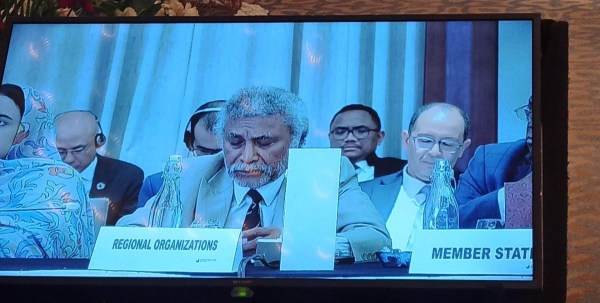
MSG SECRETARIAT REITERATES SUPPORT FOR FLNKS AT C-24

PORT VILA, VANUATU (25 May 2023): The Melanesian Spearhead Group (MSG) Secretariat has reiterated its support for the call by the Kanak and Socialist National Liberation Front (FLNKS) on the Administering power to return to the spirit of the Noumea Accord, in the negotiations post-Referendums, which has resulted in the peaceful co-existence of all stakeholders in New Caledonia.

Director General of the MSG Secretariat, Leonard Louma, made the call while delivering his remarks at the Pacific Regional Seminar on the Implementation of the Fourth International Decade for the Eradication of Colonialism in Bali, Indonesia on 24 May 2023.

With the theme “Innovative steps to ensure the attainment of the Sustainable Development Goals (SDGs) in the Non-Self-Governing Territories”, the seminar was held under the auspices of the Special Committee on the Situation with regard to the Implementation of the Declaration on the Granting of Independence to Colonial Countries and Peoples (C-24).

DG Louma said that the FLNKS, a member of the MSG family, consists of and represents the indigenous and colonised people of New Caledonia – a Non-Self-Governing Territory within the meaning of the UN Charter and Resolution 1514 (XV) and entitled to the ultimate objectives of the decolonisation process – that of independence.

“We are here to support the FLNKS and Kanaks call for New Caledonia to be released from the shackles of colonialism.”

“For us at the MSG, that were in the vanguard of action to have New Caledonia re-inscribed on the Committee of 24 list in 1986, we value the recognition by the UN family of New Caledonia’s continuing status as a Non-Self-Governing Territory and by that virtue affording its colonised people’s an entitlement to aspire for independence,” he stated.

DG Louma said that as a party and signatory to the Noumea Accord, FLNKS continues to engage, in good faith, with the Administering Power to achieve its aspirations of full sovereignty. He emphasised that the spirit and intent that went into the framing of the Noumea Accord embodies the “irreversibility” of the process towards full sovereignty.

He noted that the circumstances and manner in which the Third Referendum in New Caledonia was conducted in December 2021 during the height of Covid 19 challenges, and despite calls to defer the referendum by the FLNKS, leaves much to be desired.

This he said, has inevitably called to question the credibility of the process and the legitimacy of the results when 56.13% of the registered voters did not participate in the referendum.

“We remain ready to assist FLNKS in its efforts to seek legal validation of its position on the Third Referendum and the questionable validity of its results,” he added.

DG Louma emphasised that, MSG is of the view that in the absence of a decision by the General Assembly that New Caledonia, a Non-Self-Governing Territory, has attained a full measure of self-government in terms of Chapter XI of the UN Charter, the Administering Power has the obligation to faithfully discharge its responsibilities to prepare New Caledonia for independence within the spirit and meaning of the UN Resolution 1514 (XV).

MSG countries he said, are committed to do whatever they can to help New Caledonia through the FLNKS vehicle attain its aspirations of sovereignty through peaceful means.

“Let us all utilise the opportunity provided by the Fourth International Decade for the Eradication of Colonialism to re-examine our efforts and inject more vigour in our commitment to end colonialism. In some cases we may require to correct course in our strategies and efforts,” he noted.

DG Louma proudly acknowledged Fiji and Papua New Guinea, for their unremitting involvement in the work of the Committee of 24, with regards to specific contribution by MSG to advance the decolonisation agenda concerning the remaining territories on the list of Non-Self-Governing Territories (New Caledonia),

“We at the MSG recognise our responsibility to assist with the efforts to prepare the Kanaks and New Caledonia towards the genuine exercise of their right to self-determination and eventual accession to independence status,” DG Louma said.

New Caledonia continues to enjoy invitations from the MSG to participate in our sporting and cultural events, as part of the MSG’s recalibrated strategy and plans, namely their participation at the MSG’s flagship cultural event, the Melanesian Arts and Culture Festival (MACFEST), and the MSG Prime Minister’s Cup Football Tournament.

Another is the inclusion of FLNKS Representatives on MSG countries’ Delegations to International Meetings as part of the diplomatic efforts to solicit support for New Caledonia’s independence, among others.

In an effort to build transformative pathways to advance the Fourth International Decade for Ending Colonialism, DG Louma proposed a number of ideas including the proposal that New Caledonia be allowed to enter into Trade Agreements with neighbouring Pacific Countries.

DG Louma concluded that there is an important nexus between the attainment of SDG in Non-Self-Governing Territories and their aspirations of self-determination and independence.

“Actions aimed at attainment of these SDG targets will ensure that when Territories and Peoples to which Resolution 1514 (XV) applies eventually attain full self-determination and independence, they will be better placed to take on responsibilities of governance, better assured of maintaining sustainable economic prosperity, better able to sustain equitable and decent living standards and able to take their seats amongst the family of nations as viable independent states,” he said.

For DG Louma’s full speech please click below:

Caption: Director General of the MSG Secretariat, Leonard Louma delivering his remarks at the Pacific Regional Seminar on the Implementation of the Fourth International Decade for the Eradication of Colonialism in Bali, Indonesia on 24 May 2023.

1.8 million West Papuans petition UN for independence vote

West Papuan independence leader Benny Wenda.
West Papuan independence leader Benny Wenda. Photo: RNZI/ Koroi Hawkins

A petition with the signatures of 1.8 million West Papuans in Indonesia has been presented to the United Nations in New York demanding an internationally supervised vote on independence.

The exiled West Papuan independence leader Benny Wenda presented the document to the C24, the special committee on decolonisation on Tuesday.

Dr Jason MacLeod from the University of Sydney is a West Papua expert who has just returned from the Indonesian territory to verify the petition.

He said it was fair and accurate representation of the West Papuan people’s will and the UN needed to pay due attention.

“They’ve got two choices before them. They can either re-list West Papua on the UN Committee for Decolonisation or they can put pressure on the Indonesian government to hold a referendum. One of those two things really need to happen.”

The Free West Papua movement said the 1.8 million people who signed the petition account for more than 70 percent of the region’s population.

Ballot box in a Vanuatu election.
Calls persist to revisit the 1969 vote which passed the former Dutch colony into Indonesian possession Photo: RNZ / Johnny Blades

 Source: http://www.radionz.co.nz/

Peter O’Neill: any discussion on the issue of sovereignty should be taken up appropriately with the United Nations Decolonisation Committee (C24)

any discussion on the issue of sovereignty should be taken up appropriately with the United Nations Decolonisation Committee (C24) in New York and the Human Rights Commission in Geneva. [https://papuapost.wordpress.com/]

Ada dua hal di sini, pertama, kalau bicara tentang kemerdekaan politik yang terkait dengan kedaulatan, maka kita harus membawanya ke Komite-24, atau Komite Dekolonisasi PBB. Kedua, kalau kita bicara soal pelanggaran HAM, maka kita bawah masalahnya ke Komisi HAM PBB di Geneva.

Sudah berulangkali PMNews menyiarkan protes yang disampaikan oleh Tentara Revolusi West Papua (TRWP) dengan penekanan bahwa bangsa Papua harus menentukan sikap, harus berbagi tugas, harus jelas dan tegas

  1. mau selesaikan pelanggaran HAM, ataukah
  2. mau selesaikan soal Politik?

Kalau mau urus politik, maka kita harus menggunakan kiblat MSG – New York, dan kalau kita mau selesaikan masalah HAM, maka kita gunakan poros MSG – HAM – Geneva.

Tetapi kalau ada orang-orang ULMWP yang bersikeras mau urus HAM, maka tidak menjadi masalah, asalkan fokus ke New York tidak kita abaikan.

Kita harus menghindari menghabiskan uang, tenaga dan waktu dalam membahas soal HAM. Sudah banyak kelompok kepentingan, sudah banyak organisasi, sudah banyak negara berkepentingan untuk HAM.

Kepentingan bangsa Papua ialah melepaskan diri dari NKRI, persoalan politik, persoalan kedaulatan, itulah sebabnya Peter O’Neill katakan

any discussion on the issue of sovereignty should be taken up appropriately with the United Nations Decolonisation Committee (C24) in New York

  • Apakah masih ada yang bingung?
  • Apakah masih ada yang tidak jelas?
  • Apakah ULMWP menunggu malaikat dari surga untuk datang menjelaskan ini semua?

UN makes call on Tahiti’s self-determination

RNZ  – 7:24 am on 12 December 2016

The United Nations has adopted a resolution asking France to put in place a self-determination process for French Polynesia.

The resolution said the people of French Polynesia should freely choose its political status, noting that over 30 years France carried out nuclear weapons tests which have had an impact on health and the environment.

It called on France to intensify the dialogue despite French Polynesia’s government in October calling for the territory to be removed from the United Nations decolonisation list.

France has refused to organise a referendum in Tahiti despite being asked by the territorial assembly three years ago.

France pulled the so-called French Establishments in Oceania off the UN decolonisation list in 1947 – 67 years after it annexed the erstwhile Kingdom of Tahiti.

However, in 2013 the UN General Assembly returned French Polynesia to the list.

The move angered Paris which labelled it as glaring interference by the UN and it has shunned co-operation with the UN on the matter.

France does however recognise the UN in the decolonisation process of its other Pacific territory, New Caledonia, which is due for a referendum on independence within two years.

New momentum towards decolonisation in Pacific

 One of the peace rallies in support of the Pacific Coalition on West Papua representation at the UN General Assembly. Monday 19 September 2016. Photo: Supplied/ Whens Tebay
One of the peace rallies in support of the Pacific Coalition on West Papua representation at the UN General Assembly. Monday 19 September 2016. Photo: Supplied/ Whens Tebay

Radio NZ – West Papua specialist Dr Cammi Webb-Gannon said the unprecedented level of discussion about West Papuan self-determination and human rights at the recent UN General Assembly reflected a new momentum towards decolonisation in the Pacific.

Dr Webb-Gannon, from Western Sydney University’s School of Humanities and Communication Arts, said the Melanesian Spearhead Group chairman and Solomon Islands prime minister Manasseh Sogavare had been particularly pivotal.

“So he’s brought together a lot of Pacific Island countries who have just taken the West Papua issue to the UN but are also hoping to take it to the UN decolonisation committee. So more than ever before, West Papuans are getting their cause on the international radar and that’s really due to the incredible action that’s taken by other Pacific countries.”

Meanwhile, there are hopes among West Papuans that the new United Nations Secretary-General will help protect the human rights of Papua’s indigenous people.

Antonio Guterres, the former Portuguese prime minister, was been unanimously elected to take over the UN top job from Ban Ki-moon at the start of next year.

 Antonio Guterres Photo: AFP
Antonio Guterres Photo: AFP

As Portugal prime minister, Mr Guterres played a key role in the UN intervention in East Timor shortly before it gained independence from Indonesia.

The United Liberation Movement for West Papua’s Pacific regional ambassador, Akouboo Amatus Douw, said that unlike Portugal’s efforts to do the right thing by Timor, the Dutch have not met their moral obligation to Papuans.

However, he hoped that Mr Guterres can similarly help Papuans facilitate calls by seven countries at the UN general assembly last month for an investigation into alleged rights violations in Papua.

Mr Guterres was also the UN High Commissioner for Refugees for 10 years and his work in this role was acknowledged by Mr Douw.

Under Mr Guterres’s leadership, the UNHCR provided legal and humanitarian assistance for over 10,000 West Papuan refugees in PNG.

“In my rough estimation we have 30,000 Papuan political refugees all around the globe including myself,” said Mr Douw.

He said the main reason that Papuans have to flee Indonesian rule is the denial of their absolute rights of self-determination in their home country.

“As I was of 43 West Papua political asylum seekers who escaped from West Papua and landed in Australia in 2006, I have very positive thoughts on his (Guterres’) priorities in seeking to revolve core issues behind why these people became marginalised and suffered in all aspects.”

Pacific peoples lead push for Papuan decolonisation

Radio NZ – An academic specialising in West Papua says Pacific Islands peoples are taking the lead on issues of decolonisation within the region.

Dr Cammi Webb-Gannon is a research fellow at Western Sydney University’s School of Humanities and Communication Arts.

She says the unprecedented level of discussion about West Papuan self-determination and human rights at the recent UN General Assembly reflects a new momentum towards decolonisation in the Pacific.

Dr Webb-Gannon spoke to Johnny Blades about the growth of international solidarity for West Papua and the issue of regional representation.

Transcript

CAMMI WEBB-GANNON: As West Papuans have been able to get their stories out as I’ve been observing the conflict and the movement for about 10 years I’d say it’s from 2010 when this has really taken off and then in 2011 I think Indonesia was picking up on the increased traction of West Papua in the international media and so I think that’s when Indonesia decided it really needed to start to have more influence in Melanesian and Pacific politics and it was in 2011 that Indonesia was given observer status at the Melanesian Spearhead group and really started heavy diplomacy into Melanesia to try and counteract the solidarity and the civil society support for West Papua.

JOHNNY BLADES: Do you see any signs in Indonesia’s kind of response that it will do anything other than just sort of push through its viewpoint?

DW-G: Not in the near future I don’t, you heard also Indonesia’s first right of reply no doubt at the United Nations about a month ago and it was quite uninformed, very typical Indonesian government response, saying that essentially there are very few if any human right’s violations that have taken place in West Papua and that it would be impossible for them to go unscrutinised and that’s just blatantly untrue. And then you have several Indonesian NGO’s going ‘that’s ludicrous’ and you know that’s typically what the response has been. It doesn’t look like it’s changing but it does look like Indonesia’s getting more worried therefore they’re increasing their diplomatic efforts.

JB: There is this argument about regional representation for the Papuans, do you think that the Pacific support can be effective, can it overcome the geo-political forces?

DW-G: Well I think it already is, I mean the fact that for the first time West Papua’s been raised at the UN by seven countries not just Melanesian countries, but from Tonga and Tuvalu and the Marshall Islands and Nauru and Palau as well, is a huge testament to the work that the United Liberation Movement for West Papua has been undertaking so a whole lot of diplomacy by the leaders of the ULMWP around the Pacific but also this taps into the Pacific renaissance which I think has been sweeping across the Pacific for the past five or six years. So I guess for the first time since around the 1970s/80s when the Pacific was starting to decolonize, it’s a new spirit of decolonisation. I think it’s more strident than it’s ever been before and it’s more powerful and these Pacific countries are making very good use of regional fora and international fora and West Papua is one of the top issues. I think that the Pacific is really taking the lead on this.

UN adopts resolution reaffirming Western Sahara people’s right to self-determination

SPS 10/10/2016 – 21:04

New York (United Nations), October 10, 2016 (SPS) – UN General Assembly Special Political and Decolonization Committee (Fourth Committee) adopted Monday in New York a resolution reaffirming Saharawi people’s right to self-determination.

The resolution, adopted at the end of a several-day general debate on decolonization, reiterated UN general Assembly’s support of the negotiation process initiated by the Security Council to reach a just, lasting and mutually acceptable political solution ensuring Western Sahara people’s right to self-determination.

Presented by 25 countries, including Algeria, the resolution, greeted the efforts made by the UN secretary general and his personal envoy to Western Sahara, Christopher Ross, for the relaunch of the talks suspended in 2012.

The resolution adopted, by consensus, invites the parties to the conflict (Polisario Front and Morocco) and the States of the region to fully cooperate with the United Nations envoy.

The resolution has taken up UN clear and major ideas on the settlement of Western Sahara conflict, which consist in backing the relaunch of negotiations between the Polisario Front and Morocco, as well as the mediation efforts undertaken by Christopher Ross.

The delegations of the countries taking part in the Fourth Committee debate on decolonization expressed a large support to Saharawi people’s right to self-determination, calling for resumption of negotiations between the parties to the conflict. (SPS)

062/090/700

How the UN Failed West Papua

The Diplomat.com – By Prianka Srinivasan, September 19, 2016

NEW YORK — A decade ago, Herman Wainggai caused a diplomatic furor between Indonesia and Australia when he boarded a homemade canoe and crossed the Arafura Sea to the northern tip of Australia. Escaping his home in the Indonesian-controlled territory of West Papua, Wainggai feared that his campaign for West Papuan independence would soon cost him his life. In March 2006, Australia recognized Wainggai as a refugee and granted him protection. Indonesia responded by temporarily recalling its Australian ambassador.

With reports of renewed intimidation by Indonesian authorities in West Papua, Wainggai will once again embark on a controversial journey to seek justice for his people. This time, his destination is New York’s UN headquarters to lobby at its 71st General Assembly. “We want to remind the UN they can’t let West Papua be colonized for so long,” said Wainggai in a telephone interview.

But Wainggai’s task will not be easy. The UN has slumbered in its decolonization efforts, with only one state, Timor-Leste, achieving independence in the past 20 years. Added to that, West Papua is currently unrecognized by the world body as a colonized “non-self-governing territory”—it lost this designation over four decades ago, when West Papua was integrated by Indonesia through controversial means.

Enjoying this article? Click here to subscribe for full access. Just $5 a month.This leaves West Papuan independence activists in a uniquely undesirable position: fighting to be recognized by a world body that has lost much of its ability and will to bring about decolonization.

Decolonization once defined the United Nation’s very existence. When the UN was first conceived in 1945, a third of the world’s population still lived under colonial rule and many of those territories were agitating for autonomy. Under the heat of global anti-imperial movements, colonial territories disintegrated to form independent states, and the UN’s membership doubled in size in just 20 years. In 1960, the UN General Assembly adopted United Nations Resolution 1514, which declared the “necessity of bringing to a speedy and unconditional end colonialism in all its forms and manifestations.” A year later, the Special Committee of Decolonization formed to carry out the UN’s mandate and help colonized nations achieve autonomy.

But this help came at a price. The UN’s decolonization mandate was often brought in and out of play by its two largest powerbrokers—the United States and the Soviet Union—so they could extend their influence in the post-colonial world. As a result, the UN’s decolonization efforts did not always make the autonomy of colonized peoples its first priority.

West Papuans became one of the first causalities of the UN’s perfidious promise of self-determination. In 1968, under the watch of UN observers and U.S. diplomats, Indonesia was handed control over West Papua when its military hand-picked a fraction of West Papua’s population, and ordered them to vote in favor of Indonesian annexation in the UN-supervised “Act of Free Choice.” A 2004 report by the International Human Rights Clinic at Yale Law School explains that “Indonesian military leaders began making public threats against Papuan leaders… vowing to shoot them on the spot if they did not vote for Indonesian control.” The United States, acting both independently and through the UN, tacitly allowed West Papua’s annexation to ensure Indonesia would not fall to communism.

In such a way, the UN’s decolonization efforts were always conditional on the whims of international politicians. As U.S. and Soviet tensions receded, so too did the UN’s ambition to guide colonized territories to independence. The U.K., U.S. and France all moved to abolish the Special Committee on Decolonization in the early 1990s, and the U.K. and U.S. formally withdrew from the committee in 1986 and 1992 respectively. Persistent campaigning from the world’s small territories was all that revived the Special Committee from its deathbed, though doing so compromised much of its function and scope.

“That really left a gap, a vacuum which still exists today,” said Dr. Carlyle Corbin, a former minister of the U.S.-controlled Virgin Islands who serves as an international expert to the UN on self-determination. Though there continues to be a need for the UN to follow its decolonization mandate, particularly in relation to its 17 recognized colonial territories, Corbin says that member states blatantly ignore this duty. Representatives from France, one of the few administrative powers that still interacts with the UN’s decolonization committee, make a point of walking out of discussions whenever the topic is French Polynesia.

UN members accept this lack of commitment since colonization is no longer seen as a modern phenomenon. “Decolonization is not on the radar,” Corbin said. “The idea is that it’s over.” Administrative powers that preside over colonial territories are able to hide behind this misconception, claiming that their dependent territories could not possibly be associated with this evil, outdated practice.

The United States, which currently administers three territories listed by the UN’s decolonization committee, argues that its territories have implied self-governance and therefore should be removed from decolonization talks. Indeed, many of the 17 recognized colonial territories have some quasi form of self-governance—Guam, American Samoa, and the U.S. Virgin Islands all have non-voting representation in the U.S. Congress, and Britain’s overseas territories maintain localized governments, with ultimate constitutional authority remaining with Britain. In some cases, such as in the Falkland Islands and Gibraltar, local populations do not want to concede their dependency relationships.

But for Corbin, this is beside the point. “Colonization by consent is not self-governance,” he said, and if the UN is to follow its own resolution on the rights of indigenous people, then it should work to eradicate any remnant of colonialism, however benign.

For West Papua, where instances of state oppression by Indonesian authorities harken back to more overt forms of colonialism, the UN has still failed to support its independence. The world body does not even recognize West Papua as a colonized territory, thus effectively depriving West Papuans of UN resources to fuel their struggle for self-determination.

The result of this omission is calamitous. There is strong evidence of gross human rights violations in Indonesian-held West Papua, yet the UN is has not yet intervened in this territory. The counterterrorism squad, Detachment 88, which was developed in 2003 by funding through the United States government, is accused of being especially violent toward indigenous West Papuans.

“They can operate independently and together, intimidating, harassing, beating up, and indeed killing people,” said Peter Arndt, executive officer of the Catholic Justice and Peace Commission of the Archdiocese of Brisbane. He made the remarks last March following a visit to West Papua. A report compiled by Arndt accuses the Indonesian government of making new, violent incursions into the region, systematically expelling Papuans from their homes in what the report calls a “slow-motion genocide.” Some 30 years ago, 96 percent of West Papua was inhabited by its indigenous population. Today, that number is closer to 40 percent.

In such a state of emergency, the solution for West Papua might be to abandon the UN’s decolonization process all together. Wainggai and other West Papuan activists have chosen to bring their plight instead to human rights organizations, like the UN’s Human Rights Council, to urge change on humanitarian grounds.

There are also regional movements to recognize West Papuan independence—the Solomon Islands and Tonga both articulated support for West Papuans at last year’s UN General Assembly, with the Solomon Islands’ Prime Minister Manasseh Sogavare calling for “the full and swift implementation of the 1960 declaration on the granting of Independence to colonized countries and peoples.”

Nevertheless, Wainggai remains hopeful that one day, as the UN’s member states convene for another General Assembly in New York, a free and autonomous West Papua will be included in discussions. “That’s my American dream,” he said.

Prianka Srinivasan is an Australian freelance journalist based in New York. She has spent a number of years working and researching in the Pacific region.

Up ↑

Wantok COFFEE

Organic Arabica - Papua Single Origins

MAMA Minimart

MAMA Stap, na Yumi Stap!

PT Kimarek Aruwam Agorik

Just another WordPress.com site

Wantok Coffee News

Melanesia Foods and Beverages News

Perempuan Papua

Melahirkan, Merawat dan Menyambut

UUDS ULMWP

for a Free and Independent West Papua

UUDS ULMWP 2020

Memagari untuk Membebaskan Tanah dan Bangsa Papua!

Melanesia Spirit & Nature News

Promoting the Melanesian Way Conservation

Kotokay

The Roof of the Melanesian Elders

Eight Plus One Ministry

To Spread the Gospel, from Melanesia to Indonesia!

Koteka

This is My Origin and My Destiny