he United Nations General Assembly Hall where leaders convene every September to discuss UN Agendas in the world.
By PM Press, Prime Minister Hon Manasseh Sogavare has reiterated Solomon Islands call on the United Nations for the recognition of Taiwan and expressed concern about the human rights violations in West Papua when he addressed the 71st United Nations General Assembly yesterday, Friday 23rd September.
Solomon Islands commits a section in its annual address to the United Nations General Assembly to call on the UN for the recognition of Taiwan and when reiterating that call yesterday, the Prime Minister said, “Solomon Islands recognises the fundamental right of Taiwan’s 23 million people to participate meaningfully in the United Nations specialised bodies.”
However, the Prime Minister said Solomon Islands finds Taiwan’s limited and restricted participation with the World Health Organisation regrettable, especially at a time when the spread of infectious diseases is impacting children and needs everyone to assist.
He said similarly, Taiwan remains unjustly on the fringes of the International Civil Aviation Organisation’s decision-making process despite managing more than a million flights or 58 million passengers through ‘Taipei Flight Information Region.’
“We (therefore) call for Taiwan’s open and free access to all WHO meetings and also call for Taiwan’s predictable and certain participation in ICAO gatherings.
“There has always been two political systems along the Taiwan Strait and the reality is the world works with one and turns a blind eye to the other.”
He said the implementation of the (UN) 2030 Agenda calls for all hands on deck and therefore the UN must put the interest of humanity first and work with all including Taiwan.
On the issue of human rights violations in West Papua, the Prime Minister said Solomon Islands is gravely concerned about the human rights violations against Melanesians in that region.
And he added that the human rights violations and the pursuit for self-determination of West Papua are two sides of the same coin.
“Many reports on the human rights violations in West Papua emphasise the inherent corroboration between the rights to self-determination that results in direct violations of human rights by Indonesia in its attempts to smother any form of opposition.”
The Prime Minister said, “The principle of sovereignty is paramount to any institution whose core rationale is the respect for sovereignty. If the justification of sovereignty rests on a series of decisions that are questionable, then there is a case to challenge the legality of the argument of sovereignty.”
He added that, “As the chair of the Melanesian Spearhead Group that also includes Indonesia as an associate member and the United Liberation Movement of West Papua (ULMWP) as an Observer, Solomon Islands affirms the need for constructive engagement with Indonesia and looks forward in cooperating with Indonesia to address the violations of human rights in West Papua.
The Prime Minister also took the opportunity to reaffirm Solomon Islands support for the unalienable right of the people of the Territory of French Polynesia pursuant to annual resolutions of the UNGA beginning in 2013.
He said Solomon Islands continues to request the Administering power to work and cooperate with the UN Special Committee on the question of French Polynesia and C24 (UN Committee on Decolonisation).
The Prime Minister also made mentioned the question of New Caledonia on the United Nations Agenda.
He said the Melanesian Spearhead Group continues this issue and wished the people of New Caledonia all the best as they prepare to decide on their political future in 2018.
Leaders of six Pacific Island nations have highlighted concern about West Papua while speaking at the United Nations General Assembly.
At the general debate of the Assembly’s 71st session, Vanuatu, Solomon Islands, Tonga, Nauru, Marshall Islands and Tuvalu called for UN action on alleged human rights abuses in Papua.
Calls for West Papuan self-determination rights to be respected were also made by some of the leaders.
Pacific leaders at the UN General Assembly expressed concern about human rights abuses in Papua. Top L to R: Vanuatu Prime Minister Charlot Salwai; Solomon Islands Prime Minister Manasseh Sogavare; Tonga Prime Minister ‘Akilisi Pohiva. Bottom L to R: Nauru President Baron Waqa; Marshall Islands President Hilda Heine; Tuvalu Prime Minister Enele Sopoaga Photo: UN Photo
SolomonTimesOnline – The Solomon Islands representative in Geneva, Switzerland, has repeated calls for Indonesia to allow a UN Special Rapporteur on Freedom of Expression to visit West Papua and Papua Provinces.
Minister Councilor at the Solomon Islands Mission in Geneva, Switzerland, Barrett Salato made the call at the start of the 33rd Human Rights Council Meeting in Geneva on Monday this week.
Mr. Salato highlighted a “worrying trend by the Member States resisting human rights scrutiny by the work of the Council.”
“More unsettling is the fact that some large democracies who profess to uphold universal human rights values are evading scrutiny on their domestic human rights practices by shielding such practices behind the principle of non-interference.”
Mr Salato says that the Solomon Islands share the view that protecting human rights of all people requires collective responsibilities and continues to condemn violations of human rights whenever it occurs.
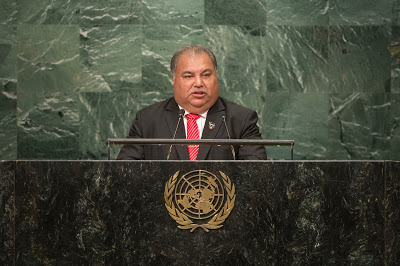
Presiden Nauru, Baron Divavesi Waqa (Foto: UN Photo/Cia Pak)
New York, Tabloid-WANI — Seperti sudah diperkirakan sebelumnya, Presiden Republik Nauru, Baron Divavesi Waqa, mengangkat isu pelanggaran Hak Asasi Manusia (HAM) di Papua saat berpidato pada Sidang Umum Perserikatan Bangsa-bangsa di New Yok, (21/9).
Dalam salah satu bagian pidatonya, ia mengatakan negaranya sangat prihatin dengan situasi di Papua, terkait dengan tuduhan pelanggaran HAM di sana. “Nauru sangat prihatin dengan situasi di Papua (Barat) termasuk adanya tuduhan pelanggaran HAM,” kata dia, yang juga disiarkan oleh televisi internet PBB. Oleh karena itu, kata dia, Nauru menekankan perlunya dilaksanakan rekomendasi yang telah disampaikan oleh Pacific Islands Forum (PIF) pada pertemuan pemimpinnya di Republik Federasi Mikronesia belum lama itu. Rekomendasi itu adalah tentang perlunya dialog yang konstruktif dengan pemerintah Indonesia tentang Papua. Berikut ini Video pidato Presiden Nauru di PBB
Di bagian lain pidatonya, ia juga menyinggung soal Korea Utara. Menurut dia, Nauru juga prihatin dengan meningkatnya tensi yang diprovokasi oleh tindakan Korea Utara. “Wilayah Pasifik sudah mengalami terlalu banyak kekerasan dan penderitaan pada abad 20 dan tidak bisa membiarkan bencana perang kembali lagi. Tidak ada tempat di dunia yang berkelanjutan untuk proliferasi nuklir,” kata lanjut dia.
Presiden Nauru juga bersuara tentang Taiwan, yang menurutnya adalah teman dekat negaranya. Ia menyerukan agar 23 juta penduduk Taiwan juga menikmati hak-hak dasar yang diatur dalam Piagam PBB. “Taiwan telah memberikan kontribusi kepada Majelis Kesehatan Dunia dan International Civil Aviation Organization (ICAO).
Negara ini juga mempromosikan pembangunan berkelanjutan dan membantu untuk memimpin jalan ke ekonomi rendah karbon. Taiwan adalah pemangku kepentingan utama di dalam masyarakat internasional. Dan kita harus melakukan upaya untuk mengatur partisipasi mereka di seluruh sistem PBB, sehingga semua negara anggota dapat memperoleh manfaat dari kontribusi substansialnya,” kata dia.
Sebelumnya, dalam salah satu butir komunike bersama PIF, dimana Nauru menjadi salah satu anggotanya, isu pelanggaran HAM Papua disebut meskipun forum ini menganggap hal itu merupakan isu sensitif. “Para pemimpin (PIF) mengakui sensitivitas isu Papua dan setuju bahwa tuduhan pelanggaran HAM di Papua tetap menjadi agenda mereka. Para pemimpin juga menyepakati pentingnya dialog yang terbuka dan konstruktif dengan Indonesia terkait dengan isu ini,” demikian bunyi salah satu butir komunike.
Baca ini: Solomon dan Nauru Tekan Pemerintah Indonesia di dua Badan PBB PIF adalah forum beranggotakan 16 negara dan wilayah di Pasifik, terdiri dari Australia, Cook Islands, Federated States of Micronesia, Fiji, Kiribati, Nauru, Selandia Baru, Niue, Papau, Papua New Guinea, Republic of Marshall Islands, Samoa, Solomon Islands, Tonga, Tuvalu dan Vanuatu.
Dalam pertemuan PIF pekan lalu, anggotanya bertambah dua lagi dengan disahkannya keanggotaan French Polynesia dan New Caledonia. Selain di PIF, Nauru juga baru-baru ini ikut bergabung dengan kelompok negara-negara Pasifik yang peduli pada nasib Papua, yaitu Pacific Island Coalition for West Papua (PICWP).
Koalisi yang dipimpin oleh PM Solomon Islands ini, bertujuan untuk menggalang dukungan negara-negara Pasifik untuk menyerukan Perserikatan Bangsa-bangsa (PBB) melakukan intervensi atas pelanggaran HAM dan penentuan nasib sendiri bagi Papua. Anggota awal PICWP terdiri dari Pemerintah Kepulauan Solomon, Pemerintah Vanuatu, kelompok Front de Liberation Nationale Kanak et Socialiste(FLNKS), Pemerintah Tuvalu, Republik Nauru, United Liberation Movement for West Papua (ULMWP) dan kelompok Lembaga Swadaya Masyarakat (LSM) Pasifik, Pacific Islands Association Non Govermental Organization (PIANGO).
New York, Tabloid-WANI — Seperti sudah diperkirakan sebelumnya, Presiden Republik Nauru, Baron Divavesi Waqa, mengangkat isu pelanggaran Hak Asasi Manusia (HAM) di Papua saat berpidato pada Sidang Umum Perserikatan Bangsa-bangsa di New Yok, (21/9). Dalam salah satu bagian pidatonya, ia mengatakan negaranya sangat prihatin dengan situasi di Papua, terkait dengan tuduhan pelanggaran HAM di sana.
“Nauru sangat prihatin dengan situasi di Papua (Barat) termasuk adanya tuduhan pelanggaran HAM,” kata dia, yang juga disiarkan oleh televisi internet PBB. Oleh karena itu, kata dia, Nauru menekankan perlunya dilaksanakan rekomendasi yang telah disampaikan oleh Pacific Islands Forum (PIF) pada pertemuan pemimpinnya di Republik Federasi Mikronesia belum lama itu. Rekomendasi itu adalah tentang perlunya dialog yang konstruktif dengan pemerintah Indonesia tentang Papua. Berikut ini Video pidato Presiden Nauru di PBB
Di bagian lain pidatonya, ia juga menyinggung soal Korea Utara. Menurut dia, Nauru juga prihatin dengan meningkatnya tensi yang diprovokasi oleh tindakan Korea Utara. “Wilayah Pasifik sudah mengalami terlalu banyak kekerasan dan penderitaan pada abad 20 dan tidak bisa membiarkan bencana perang kembali lagi. Tidak ada tempat di dunia yang berkelanjutan untuk proliferasi nuklir,” kata lanjut dia. Baca ini: Isu HAM Papua ke PBB,
Presiden Nauru juga bersuara tentang Taiwan, yang menurutnya adalah teman dekat negaranya. Ia menyerukan agar 23 juta penduduk Taiwan juga menikmati hak-hak dasar yang diatur dalam Piagam PBB. “Taiwan telah memberikan kontribusi kepada Majelis Kesehatan Dunia dan International Civil Aviation Organization (ICAO).
Negara ini juga mempromosikan pembangunan berkelanjutan dan membantu untuk memimpin jalan ke ekonomi rendah karbon. Taiwan adalah pemangku kepentingan utama di dalam masyarakat internasional. Dan kita harus melakukan upaya untuk mengatur partisipasi mereka di seluruh sistem PBB, sehingga semua negara anggota dapat memperoleh manfaat dari kontribusi substansialnya,” kata dia. Sebelumnya, dalam salah satu butir komunike bersama PIF, dimana Nauru menjadi salah satu anggotanya, isu pelanggaran HAM Papua disebut meskipun forum ini menganggap hal itu merupakan isu sensitif. “Para pemimpin (PIF) mengakui sensitivitas isu Papua dan setuju bahwa tuduhan pelanggaran HAM di Papua tetap menjadi agenda mereka.
Para pemimpin juga menyepakati pentingnya dialog yang terbuka dan konstruktif dengan Indonesia terkait dengan isu ini,” demikian bunyi salah satu butir komunike.
PIF adalah forum beranggotakan 16 negara dan wilayah di Pasifik, terdiri dari Australia, Cook Islands, Federated States of Micronesia, Fiji, Kiribati, Nauru, Selandia Baru, Niue, Papau, Papua New Guinea, Republic of Marshall Islands, Samoa, Solomon Islands, Tonga, Tuvalu dan Vanuatu. Dalam pertemuan PIF pekan lalu, anggotanya bertambah dua lagi dengan disahkannya keanggotaan French Polynesia dan New Caledonia. Selain di PIF, Nauru juga baru-baru ini ikut bergabung dengan kelompok negara-negara Pasifik yang peduli pada nasib Papua, yaitu Pacific Island Coalition for West Papua (PICWP). Koalisi yang dipimpin oleh PM Solomon Islands ini, bertujuan untuk menggalang dukungan negara-negara Pasifik untuk menyerukan Perserikatan Bangsa-bangsa (PBB) melakukan intervensi atas pelanggaran HAM dan penentuan nasib sendiri bagi Papua. Anggota awal PICWP terdiri dari Pemerintah Kepulauan Solomon, Pemerintah Vanuatu, kelompok Front de Liberation Nationale Kanak et Socialiste(FLNKS), Pemerintah Tuvalu, Republik Nauru, United Liberation Movement for West Papua (ULMWP) dan kelompok Lembaga Swadaya Masyarakat (LSM) Pasifik, Pacific Islands Association Non Govermental Organization (PIANGO).
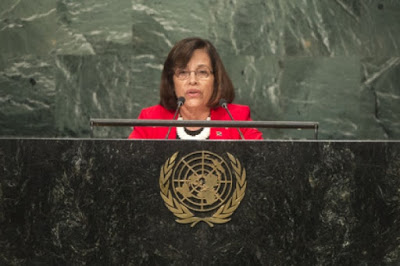
Presiden Marshall Islands, Hilda C.Heine (Foto: UN Photo/Cia Pak)
New York, Tabloid-WANI — Setelah Presiden Nauru mengangkat isu pelanggaran Hak Asasi Manusia (HAM) di Papua saat berpidato pada Sidang Umum Perserikatan Bangsa-bangsa (PBB) di New York (22/9), satu lagi kepala negara Pasifik juga menyuarakan hal yang sama di forum yang sama.
Ketika mendapat kesempatan berpidato, Presiden Marshall Islands, Hilda C.Heine, menyerukan agar Dewan HAM PBB membentuk investigasi independen dan kredibel atas pelanggaran HAM di Papua.
Ia menyerukan hal itu karena menurut dia, HAM sangat penting bagi negaranya.
“Karena pentingnya HAM bagi negara kami, saya meminta Dewan HAM PBB untuk menginisiasi investigasi yang kredibel dan independen atas pelanggaran HAM di Papua (Barat),” kata dia, di akhir pidatonya.
Marshall Islands atau Republik Kepulauan Marshall adalah sebuah negara kepulauan yang terletak di Samudra Pasifik bagian barat. Negara ini berbatasan dengan Republik Nauru dan Kiribati di sebelah selatan, Mikronesia di barat, dan Pulau Wake di utara.
Wilayah ini awalnya ditemukan oleh penjelajah Spanyol tetapi kapten Inggris John Marshall yang mengunjuginya pada 1788 lah yang menamainya sebagai pulah Marshall. kepulauan ini dinamakan menurut namanya.
Jepang menguasai kepulauan ini pada Perang Dunia I berdasarkan mandat Liga Bangsa-Bangsa. Namun, pada 1944 saat Perang Dunia II, Amerika Serikat menyerbu kepulauan ini dan memasukkannya ke dalam Wilayah Perwalian Kepulauan Pasifik (Trust Territory of the Pacific Islands).
Setelah perang berakhir, AS mulai melaksanakan beberapa uji coba nuklir di Kep. Marshall yang berlanjut hingga 1960-an. Akibatnya, banyak penduduk Marshall yang terkena efek tingkat radiasi tinggi sehingga klaim kompensasi masih berlangsung hingga kini.
Pada 1979, Republik Kepulauan Marshall didirikan dan sebuah perjanjian Compact of Free Association dengan AS ditandatangani, yang mulai berlaku pada 1986.
Negara ini tergolong kecil, sama dengan sebagian besar negara kepulauan lainnya di Pasifik. Luas perairannya 750.000 mil persegi (1.900.000 km2) sedangkan luas daratan hanya 70 mil persegi (180 km2). Kendati demikian, di PBB suara mereka diperhitungkan sama dengan anggota lainnya.
Marshall Islands adalah salah satu negara yang telah ikut menyatakan dukungan kepada Koalisi Pulau Pasifik untuk Papua atau Pacific Islands Coalition for West Papua (PICWP) atau Koalisi Pasifik untuk Papua Barat. Koalisi yang diinisiasi oleh Presiden Kepulauan Solomon, Manasye Sogavare, ini bertujuan untuk menggalang dukungan negara-negara Pasifik untuk menyerukan Perserikatan Bangsa-bangsa (PBB) melakukan intervensi atas pelanggaran HAM dan penentuan nasib sendiri bagi Papua.
Anggota awal PICWP terdiri dari Pemerintah Kepulauan Solomon, Pemerintah Vanuatu, kelompok Front de Liberation Nationale Kanak et Socialiste (FLNKS), United Liberation Movement for West Papua (ULMWP) dan kelompok Lembaga Swadaya Masyarakat (LSM) Pasifik, Pacific Islands Association Non Govermental Organization (PIANGO).
Selanjutnya dalam pertemuan mereka di Aloha, Honolulu, pada hari 2 September lalu, dukungan terhadap koalisi ini bertambah dengan bergabungnya dua negara Pasifik lain, yaitu Pemerintah Tuvalu dan Republik Nauru. Belakangan dukungan pun bertambah lagi yaitu dari Kerajaan Tonga dan Republik Kepulauan Marshall.
Korea Utara dan Taiwan Di bagian lain pidatonya, Heine mengatakan negaranya akan melanjutkan ratifikasi kesepakatan tentang HAM PBB menjadi undang-undang pada sidang parlemen medatang. “Sebagian dari kesepakatan ini telah tercermin dalam konstitusi kami,” kata dia.
Dalam kaitan itu pula, ia menyerukan agar PBBI mengakui peranan Taiwan sebagai salah satu pemangku kepentingan kunci dan berperan penting dalam urusan global. “Saya menyerukan kepada komunitas internasional untuk mendukung Taiwan dan upaya-upaya negara itu dalam dialog dan stabilitas perdamaian regional dan global,” kata dia.
“PBB harus memberikan komitmen yang lebih besar untuk menjamin pengakuan atas hak-hak dasar Taiwan untuk berpartisipasi di berbagai mekanisme, rapat dan aktivitas badan-badan khusus PBB, atas kontribusinya dalam bekerja sama dengan kita,” lanjut dia.
Di bagian lain pidatonya, Heine juga mendesak Korea Utara untuk menghentikan percobaan nuklir sampai tercapai perlucutan senjata nuklir. Tanggapan Indonesia Sementara itu Indonesia belum memberikan tanggapan atas hal ini. Wakil Presiden Jusuf Kalla, dijadwalkan akan berbicara di Sidang Umum PBB pada hari Kamis (23/9) sore waktu setempat.
Perdana Menteri Kepulauan Solomon, Manasseh Sogavare, dalam pidatonya dihadapan Majelis Umum PBB Jumat, (23/9/2016) mendukung hak penentuan nasib sendiri West Papua – unmultimedia.org
Manasseh Sogavare menekankan hubungan tak terpisahkan antara pelanggaran HAM dan kehendak penentuan nasib sendiri West Papua sebagai dua sisi pada mata koin yang sama, karena keinginan menentukan nasib sendiri itu berdampak langsung pada pelanggaran HAM yang dialami oleh rakyat West Papua selama ini.
Jayapura, Jubi – Tiga negara, Kepulauan Solomon, Vanuatu dan Tuvalu, menekankan dukungan mereka atas hak penentuan nasib sendiri West Papua di hadapan sesi Debat Majelis Umum PBB ke-71, Jumat (23/9/2016) di New York City-Amerika Serikat.
Pelanggaran HAM dan kehendak penentuan nasib sendiri West Papua adalah dua sisi pada mata koin yang sama, karena keinginan untuk menentukan nasib sendiri itu berdampak langsung pada pelanggaran HAM yang dialami oleh rakyat West Papua selama ini.
Manasseh Sogavare menekankan hubungan tak terpisahkan itu dalam pesan pidatonya untuk West Papua sepanjang 1 Menit 79 detik di hadapan 193 negara-negara anggota PBB.
“Kepulauan Solomon ikut prihatin atas pelanggaran HAM terhadap orang Melanesia di West Papua. Pelanggaran HAM di West Papua dan perjuangan untuk mendapatkan hak penentuan nasib sendiri adalah dua sisi dari koin yang sama,” tegasnya.
Dia menyatakan berbagai laporan terkait pelanggaran HAM di West Papua menunjukkan bahwa keinginan menentukan nasib sendiri berdampak langsung pada pelanggaran HAM yang dilakukan oleh Indonesia di Papua yang bertujuan untuk memperkecil segala bentuk oposisi (terhadap Indonesia).
Secara khusus Perdana Menteri Solomon juga menggarisbawahi penghormatan terhadap kedaulatan suatu negara sebagai hal yang penting. Namun, dia tegaskan, keabsahan yurisdiksi (status hukum) atas kedaulatan tersebut juga harus menjadi perhatian.
“Jika yurisdiksi kedaulatan itu berdiri atas dasar rangkaian keputusan yang masih dipertanyakan, maka sudah sepatutnya menggunggat keabsahaan argumen kedaulatan itu, dalam hal ini terkait keputusan New York Agreement 1962, dan Penentuan Pendapat Rakyat (PEPERA) 1969 (di West Papua),” ujar dia.
New York Aggrement 1962 adalah kesepakatan yang ditandatangani oleh Belanda dan Indonesia terkait administrasi teritori West New Guinea (sekarang Propinsi Papua dan Papua Barat).
Kesepakatan itu meminta PBB menangani administrasi teritori tersebut, dan menetapkan syarat-syarat sosial yang harus dipenuhi PBB sebelum pemindahan kekuasaan administrasi kepada pemerintah Indonesia. Kesepakatan tersebut ditandatangani 15 Agustus di Markas Besar PBB, New York City difasilitasi oleh Amerika Serikat.
Hal senada dinyatakan oleh Charlot Salwai Tabimasmas, Perdana Menteri Republik Vanuatu, yang meneruskan pernyataan Manasseh Sogavare untuk mendesak PBB mengambil inisiatif dan tindakan kongkrit untuk mengatasi persoalan West Papua.
“Masalah HAM di West Papua masih belum terurai. Dengan keyakinan moral yang sama seperti yang disampaikan sebelumnya, mendesak PBB mengambil tindakan kongkrit untuk mengatasi persoalan ini. PBB hendaknya tidak tutup mata atas HAM yang dilanggar di West Papua. Rakyat di sana sudah meminta dukungan PBB dan mencari terang atas harapan mereka terhadap kebebasan untuk menjalankan hak azasi di atas tanah mereka agar dapat bebas menegaskan kembali identitanya,” ujar Salwai.
Sementara itu, Enele Sosene Sopoaga, Perdana Menteri Tuvalu, menekankan prinsip penentuan nasib sendiri sebagai hak yang harus dihormati dan dimuliakan.
“Pelanggaran HAM di West Papua dan kehendak mereka untuk mendapatkan hak penentuan nasib sendiri, adalah kenyataan. Kenyataan itu tidak boleh terus menerus diabaikan oleh lembaga besar dan aula hebat ini. Badan ini harus memperhitungkan, tidak boleh membiarkan tindakan-tindakan yang bersembunyi dibalik topeng “non-intervensi” dan kedaulatan, sebagai alasan untuk tidak bertindak apa-apa,” tegas Sopoaga dengan nada yang sama atas sikapnya terhadap Taiwan.
Dia menuntut PBB harus bertindak terkait isu tersebut, “dan mencari solusi yang bisa dikerjakan untuk memberi otonomi bagi masyarakat asli West Papua,” ujarnya.
Respon Pemerintah Indonesia
Sehari sebelumnya, Kamis (22/9/2016) Presiden Kepulauan Marshall, Hilda Heine, perempuan pertama yang memimpin di kawasan Pasifik, juga menegaskan komitmen negaranya terhadap hak azasi manusia di West Papua, dan meminta PBB melakukan kerja kongkrit.
“Saya meminta Dewan HAM PBB memulai penyelidikan yang kredibel dan independen terhadap pelanggaran HAM yang terjadi di West Papua,” ujarnya.
Demikian pula Nauru (22/9) menekankan keprihatinannya terhadap situasi West Papua.
“Nauru juga sangat prihatin atas situasi yang terjadi di West Papua, termasuk pelanggaran HAM seperti yang ditekankan oleh hasil komunike Pacific Islands Forum (PIF), bahwa penting segera ada dialog terbuka dan konstruktif dengan Indonesia terkait situasi ini.”
Terkait hal itu, Kepulauan Solomon meminta negara Indonesia bekerja sama mengatasi pelanggaran HAM di West Papua.
“Menambah suara-suara dari negara-negara anggota lainnya; organisasi masyarakat sipil, yang prihatin atas pelanggaran HAM di West Papua; sebagai pemimpin MSG, dimana Indonesia sebagai associate member dan ULMWP sebagai observer, Kepulauan Solomon menegaskan perlunya hubungan konstruktif dengan indonesia dan berharap agar indonesia bekerja sama untuk mengatasi pelanggaran HAM di Papua,” ujar Sogavare di pengujung pidatonya terkait West Papua.
Seperti diketahui, Kepulauan Solomon memimpin Koalisi Kepulauan Pasifik untuk West Papua (PICWP) yang didukung oleh Vanuatu, Tuvalu, Nauru, Kepulauan Marshall, Tonga, FLNKS-Kaledonia Baru, ULMWP dan Aliansi NGO Kepulauan Pasifik (PIANGO).
Wakil Presiden RI Jusuf Kalla, pada kesempatan yang sama, Jumat (23/9) tampak tidak memberikan pernyataan apapun terkait West Papua. Wapres Kalla menegaskan komitmen Indonesia pada perdamaian dunia, persoalan Israel dan Palestina serta isu-isu pembangunan secara umum.
Seperti diketahu, keputusan komunike Pasifik Islands Forum (PIF) tahun 2015 membentuk misi ‘Tim Pencari Fakta’ ke West Papua, tidak ditanggapi pemerintah Indonesia karena tidak nyaman dengan istilah tersebut, sambil terus menegaskan kedaulatan Indonesia atas West Papua.
Berdasarkan laporan Human Right Watch (HRW) tahun 2015, yang bertajuk Indonesia’s Restrictions on Media Freedom and Rights Monitoring in Papua, sejak tahun 2006 hingga tahun 2013, upaya utusan-utusan khusus PBB memonitor persoalan HAM di Papua tidak membuahkan hasil.
Bulan Januari 2006, Juan Mendez, special envoy Sekjen PBB terkait pencegahan genosida, menyatakan keprihatinannya atas hambatan pemerintah Indonesia terhadap pengawasan HAM di Papua. Pada tahun 2013, pemerintah Indonesia juga tidak menggubris permintaan kunjungan oleh Special Rapporteur PBB, Frank La Rue, terkait promosi dan perlindungan hak berpendapat dan berekspresi.
“Dengan nada ramah, mereka berjanji: ‘Ya, kami sedang menentukan tanggal yang tepat, kami senang sekali menerima anda, dan sedang mencari tanggal yang tepat.’ Namun tanggal itu tidak pernah ada. Itu kan bentuk penolakan dengan cara halus. Saya kira itu menunjukkan banyak hal sedang disembunyikan di Papua,” ujar Frank La Rue seperti dikutip oleh laporan tersebut.(*)
PMPress Office – The President of the Christian Mission for the United Nations Community, Dr Garry Allen yesterday, Monday 19th September, met with Prime Minister Hon Manasseh Sogavare, inspiring him about the difference between the politician and statesperson and the challenges to the latter.
The President of the Christian Mission for the United Nations Committee, Dr Allen, with Prime Minister Sogavare and the Cabinet Sub-Committee on Gold Ridge, Hon Tovosia and the Caucus Chairman, Hon Fiulaua after their meeting.
The meeting was held at the margin of the 71st United Nations General Assembly in New York, where Prime Minister Sogavare and other heads of governments and heads of states of UN member countries are in attendance.
Dr Allen said he is convinced that the statesperson uses the authority of his/her office to serve the welfare of the people, has vision to improve the society, is receptive to the work of God in peoples’ lives, is dependent on God and accountable to him, is willing to take political risks in order to do the right thing and relentlessly strives to achieve his/her national vision.
He said in contrary, the politician thinks only of the next election, thinks only about the success of his/her party and is satisfied to make a drift.
The President of the Christian Mission for the UN Community said people the world-over are pleading for their government officials to be visionary leaders who care about their welfare and the authority of the office they hold to help them reach their God-given potential, adding that the demand for and expectation for transparency and accountability are fuelling this movement.
Dr Allen said he believes that God has been very active in Solomon Islands because all Solomon Islands Government officials he has had the privilege of meeting over the last few decades were passionate about following God and fulfilling his mission on Earth.
He said he is available to serve Prime Minister Sogavare and all others in leadership positions in Solomon Islands, adding that he sees serving Solomon Islands as the opportunity to experience blessings that few other nations have had because of their willingness to obey God.
Prime Minister Sogavare in response acknowledged the words of inspiration from Dr Allen and told him of his personal experiences as a politician striving to ensure the implementation of policy intentions that he believes would bring about positive changes to the country in the face of political challenges.
He said he draws inspiration from King Solomon’s reliance on God for wisdom and guidance in his leadership over Israel and also acknowledgement of the fear of God as the beginning of wisdom.
Prime Minister Sogavare said after taking office for the third time in late 2014 as Solomon Islands Prime Minister, his office introduced a daily devotional programme as introduction to each new working day and this has been a great enlightenment to him and his staff.
Prime Minister Sogavare also said he would like to see Dr Allen visit Solomon Islands one day to fulfil his desire to serving Solomon Islanders in leadership position including himself.
Also present at the meeting were the Chairman of Government Caucus, Hon Jackson Fiulaua and Chairman of the Cabinet Sub-Committee on Gold Ridge, Hon Bradley Tovosia.
Meanwhile, Prime Minister Hon Manasseh Sogavare today undertook Solomon Islands first engagement as Vice-President of the 71st United Nations General Assembly when he chaired the UN-OHRLLS dialogue on Climate Displacement and Dignity: Needs of the Most Vulnerable countries.
UN-OHRLLS stands for United Nations Office of the High Representative for the Least Developed Countries, Landlocked Developing Countries and Small Island Developing States.
“Climate Displacement as a growing issue faced by millions of people and its impacts can be felt at the international. Regional, national and sub-national levels
“As climate change disproportionately affects the socio-economic development of the most vulnerable countries in the world including LDCs, LLDCs and SIDS, climate-induced migration both within and across borders in those countries deserves immediate attention and effective response from the international community.
“Within this context, this meeting aims to share experiences and identify challenges faced by LDCs, LLDCs and SIDS in coping with climate displacement, and brainstorm on a strategy for a cohesive international approach across current international processes to protect climate displaced people,” the UN-OHRLLS stated.
Speaking after chairing the first UNGA dialogue, Prime Minister Sogavare said he was honoured to represent Solomon Islands in this important engagement and other UN engagements as well as other side-events that he will undertake during the course of this week in New York.
NEW YORK — A decade ago, Herman Wainggai caused a diplomatic furor between Indonesia and Australia when he boarded a homemade canoe and crossed the Arafura Sea to the northern tip of Australia. Escaping his home in the Indonesian-controlled territory of West Papua, Wainggai feared that his campaign for West Papuan independence would soon cost him his life. In March 2006, Australia recognized Wainggai as a refugee and granted him protection. Indonesia responded by temporarily recalling its Australian ambassador.
With reports of renewed intimidation by Indonesian authorities in West Papua, Wainggai will once again embark on a controversial journey to seek justice for his people. This time, his destination is New York’s UN headquarters to lobby at its 71st General Assembly. “We want to remind the UN they can’t let West Papua be colonized for so long,” said Wainggai in a telephone interview.
But Wainggai’s task will not be easy. The UN has slumbered in its decolonization efforts, with only one state, Timor-Leste, achieving independence in the past 20 years. Added to that, West Papua is currently unrecognized by the world body as a colonized “non-self-governing territory”—it lost this designation over four decades ago, when West Papua was integrated by Indonesia through controversial means.
Decolonization once defined the United Nation’s very existence. When the UN was first conceived in 1945, a third of the world’s population still lived under colonial rule and many of those territories were agitating for autonomy. Under the heat of global anti-imperial movements, colonial territories disintegrated to form independent states, and the UN’s membership doubled in size in just 20 years. In 1960, the UN General Assembly adopted United Nations Resolution 1514, which declared the “necessity of bringing to a speedy and unconditional end colonialism in all its forms and manifestations.” A year later, the Special Committee of Decolonization formed to carry out the UN’s mandate and help colonized nations achieve autonomy.
But this help came at a price. The UN’s decolonization mandate was often brought in and out of play by its two largest powerbrokers—the United States and the Soviet Union—so they could extend their influence in the post-colonial world. As a result, the UN’s decolonization efforts did not always make the autonomy of colonized peoples its first priority.
West Papuans became one of the first causalities of the UN’s perfidious promise of self-determination. In 1968, under the watch of UN observers and U.S. diplomats, Indonesia was handed control over West Papua when its military hand-picked a fraction of West Papua’s population, and ordered them to vote in favor of Indonesian annexation in the UN-supervised “Act of Free Choice.” A 2004 report by the International Human Rights Clinic at Yale Law School explains that “Indonesian military leaders began making public threats against Papuan leaders… vowing to shoot them on the spot if they did not vote for Indonesian control.” The United States, acting both independently and through the UN, tacitly allowed West Papua’s annexation to ensure Indonesia would not fall to communism.
In such a way, the UN’s decolonization efforts were always conditional on the whims of international politicians. As U.S. and Soviet tensions receded, so too did the UN’s ambition to guide colonized territories to independence. The U.K., U.S. and France all moved to abolish the Special Committee on Decolonization in the early 1990s, and the U.K. and U.S. formally withdrew from the committee in 1986 and 1992 respectively. Persistent campaigning from the world’s small territories was all that revived the Special Committee from its deathbed, though doing so compromised much of its function and scope.
“That really left a gap, a vacuum which still exists today,” said Dr. Carlyle Corbin, a former minister of the U.S.-controlled Virgin Islands who serves as an international expert to the UN on self-determination. Though there continues to be a need for the UN to follow its decolonization mandate, particularly in relation to its 17 recognized colonial territories, Corbin says that member states blatantly ignore this duty. Representatives from France, one of the few administrative powers that still interacts with the UN’s decolonization committee, make a point of walking out of discussions whenever the topic is French Polynesia.
UN members accept this lack of commitment since colonization is no longer seen as a modern phenomenon. “Decolonization is not on the radar,” Corbin said. “The idea is that it’s over.” Administrative powers that preside over colonial territories are able to hide behind this misconception, claiming that their dependent territories could not possibly be associated with this evil, outdated practice.
The United States, which currently administers three territories listed by the UN’s decolonization committee, argues that its territories have implied self-governance and therefore should be removed from decolonization talks. Indeed, many of the 17 recognized colonial territories have some quasi form of self-governance—Guam, American Samoa, and the U.S. Virgin Islands all have non-voting representation in the U.S. Congress, and Britain’s overseas territories maintain localized governments, with ultimate constitutional authority remaining with Britain. In some cases, such as in the Falkland Islands and Gibraltar, local populations do not want to concede their dependency relationships.
But for Corbin, this is beside the point. “Colonization by consent is not self-governance,” he said, and if the UN is to follow its own resolution on the rights of indigenous people, then it should work to eradicate any remnant of colonialism, however benign.
For West Papua, where instances of state oppression by Indonesian authorities harken back to more overt forms of colonialism, the UN has still failed to support its independence. The world body does not even recognize West Papua as a colonized territory, thus effectively depriving West Papuans of UN resources to fuel their struggle for self-determination.
The result of this omission is calamitous. There is strong evidence of gross human rights violations in Indonesian-held West Papua, yet the UN is has not yet intervened in this territory. The counterterrorism squad, Detachment 88, which was developed in 2003 by funding through the United States government, is accused of being especially violent toward indigenous West Papuans.
“They can operate independently and together, intimidating, harassing, beating up, and indeed killing people,” said Peter Arndt, executive officer of the Catholic Justice and Peace Commission of the Archdiocese of Brisbane. He made the remarks last March following a visit to West Papua. A report compiled by Arndt accuses the Indonesian government of making new, violent incursions into the region, systematically expelling Papuans from their homes in what the report calls a “slow-motion genocide.” Some 30 years ago, 96 percent of West Papua was inhabited by its indigenous population. Today, that number is closer to 40 percent.
In such a state of emergency, the solution for West Papua might be to abandon the UN’s decolonization process all together. Wainggai and other West Papuan activists have chosen to bring their plight instead to human rights organizations, like the UN’s Human Rights Council, to urge change on humanitarian grounds.
There are also regional movements to recognize West Papuan independence—the Solomon Islands and Tonga both articulated support for West Papuans at last year’s UN General Assembly, with the Solomon Islands’ Prime Minister Manasseh Sogavare calling for “the full and swift implementation of the 1960 declaration on the granting of Independence to colonized countries and peoples.”
Nevertheless, Wainggai remains hopeful that one day, as the UN’s member states convene for another General Assembly in New York, a free and autonomous West Papua will be included in discussions. “That’s my American dream,” he said.
Prianka Srinivasan is an Australian freelance journalist based in New York. She has spent a number of years working and researching in the Pacific region.





 Papua Merdeka News