Ribuan Rakyat Pro Referendum Papua Duduki Halaman DPRD Jayawijaya

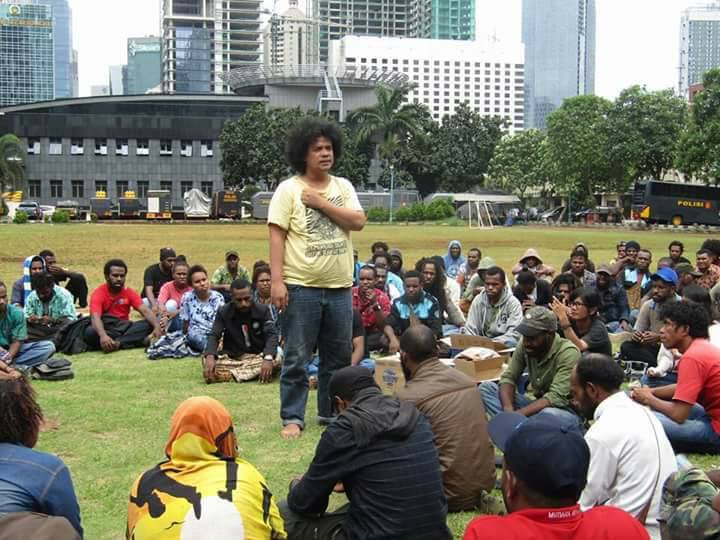
Ribuan Rakyat Pro Referendum Papua Duduki Halaman DPRD WAMENA, JAYAWIJAYA, SATUHARAPAN.COM – Ribuan rakyat pro penentuan nasib sendiri Papua hari ini (10/12) menduduki halaman gedung DPRD Jayawijaya. Para pendukung United Liberation Movement for West Papua (ULMWP) yang oleh pemerintah dicap sebagai gerakan separatis, berkumpul dalam rangka memperingati hari Hak Asasi Manusia (HAM) sedunia yang jatuh pada tanggal 10 Desember.

Menurut laporan para saksi mata yang mengirimkan gambar-gambar kepada satuharapan.com, ribuan orang hendak menduduki kantor DPRD Jayawijaya, dan akhirnya mereka duduk di halaman. Halaman tersebut tidak muat untuk menampung massa, sehingga tumpah ruah di jalan.

Aksi menduduki halaman DPRD itu yang sudah diunggah ke youtube, menunjukkan massa memadati halaman sambil meneriakkan pekik merdeka. Sementara pada gambar lain tampak aparat kepolisian berjaga. Pengunggah video tersebut mengklaim jumlah yang bergabung dalam aksi ini mencapai 6.000 orang.

Menurut Victor Yeimo, Ketua Komite Nasional Papua Barat (KNPB) yang pro penentuan nasib sendiri Papua, ribuan warga ini dimediasi KNPB Wamena. Aksi ini dimaksudkan untuk menyuarakan telah gagalnya pemerintah menjamin HAM Papua. Oleh karena itu, mereka menuntut segera lakukan referendum bagi bangsa Papua.

Pernyataan Politik ULMWP

Dalam kaitan dengan Hari HAM Sedunia ini, ULMWP mengeluarkan pernyataan politik, mewakili korban pelanggaran HAM di Papua. Menurut pernyataan politik itu, hak hidup rakyat Papua (Barat) terancam punah oleh kekerasan negara RI. Oleh karena itu bangsa Papua menuntut hak kedaulatan politik.

“Peringatan hari HAM menjadi momen penting bagi rakyat Papua Barat ras Melanesia untuk melihat kembali pelaksanaan HAM selama ini. Banyak terjadi pelanggaran HAM di bidang Sipil Politik (Sipol) maupun bidang Ekonomi, Sosial, dan Budaya (Ekosob). Secara umum perkembangan HAM di Indonesia khususnya di Papua masih memprihatinkan. Padahal Indonesia sudah meratifikasi 7 (tujuh) kovenan tentang HAM,” demikian pernyataan itu.

Menurut pernyataan ULMWP, kekerasan negara terhadap rakyat Papua tidak penah berhenti semenjak 19 Desember 1961, yaitu apa yang mereka klaim sebagai awal dari aneksasi Ri ke Tanah Papua.

“Dengan dalil melawan kelompok sepataris, pemerintah Indonesia telah dan terus melakukan berbagai operasi militer yang berdampak kepada kematian rakyat Papua Barat. Ribuan rakyat Papua telah menjadi korban pembunuhan, penyiksaan, penangkapan dan penahanan sewenang-wenang,” demikian pernyataan itu.

ULMWP menilai kekerasan negara terus terjadi sejak Orde Lama, Orde Baru, Orde Reformasi hingga di masa Otsus. “Rakyat Papua setiap hari menjadi minoritas di atas tanahnya sendiri, terjadinya kriminalisasi ruang demokrasi dan nilai-nilai kemanusiaan bagi rakyat Papua, dengan menjustifikasi “Gerakan separatis, Gerakan Pengacau Keamanan (GPK), Kelompok sipil bersenjata (KSB) menjadi pembenaran oleh negara untuk melakukan tindakan represif,” kata pernyataan itu.

Di bagian akhir pernyataannya, ULMWP menyatakan menolak dengan tegas Tim pencari fakta pelanggaran HAM yang dibuat Presiden Republik Indonesia Joko Widodo melalui Menkopolhukam,  termasuk dengan rencana penyelesaian kasus pelanggaran HAM Papau dengan membayar kompensasi atau bayar kepala kepada korban.

Selain itu ULMWP mendesak Presiden Republik Indonesia Ir. Joko Widodo, secara terbuka memenuhi dan memfasilitasi Tim Pencari Fakta dari PBB datang ke Papua Barat, sesuai hasil rekomendasi sidang Umum PBB yang 71 dan Sidang Dewan HAM PBB tahun 2016.

ULMWP mendesak PBB mengambil langkah intervensi kemanusiaan, dengan membentuk resolusi kemanusian dan menunjuk Tim pencari Fakta atau Utusan Khusus datang ke Papua Barat, sesuai dengan hasil rekomendasi sidang Umum PBB yang ke-70.

Hari HAM Momen Evaluasi

Menurut Aktivis Hak Asasi Manusia di Papua yang juga direktur Lembaga Lembaga Penelitian, Pengkajian dan Pengembangan (LP3BH) Manokwari, Yan Christian Warinussy, Hari HAM Dunia selalu diperingati sebagai momen untuk melakukan evaluasi terhadap perkembangan situasi dan kondisi HAM. Evaluasi itu diharapkan memberi jalan bagi  negara-negara anggota PBB melakukan upaya-upaya mempromosikan HAM dalam konteks kebijakan domestik dan internasional.

“Indonesia, sebagai salah satu negara anggota PBB juga berkewajiban setiap saat menunjukkan rekam jejaknya kepada dunia internasional mengenai seberapa jauh pemerintah negara ini mampu menggunakan dan atau mendaya-gunakan instrumen-instrumen dan prinsip-prinsip HAM dalam kerangka penerapan kebijakan nasionalnya terhadap masyarakatnya sendiri,” kata Yan.

Yan mendesak negara di bawah pimpinan Presiden Joko Widodo segera memberikan dukungan politik dan hukum yang maksimal kepada Komisi Nasional Hak Asasi Manusia (KOMNAS HAM) sebagai lembaga yang memiliki kewenangan secara hukum dalam menyelidiki dan mengungkap dugaan pelanggaran HAM Berat.

Apabila ada kekurangan-kekurangan dalam konteks aspek formal dan material dalam berkas penyelidikan kasus-kasus dugaan pelanggaran HAM tersebut, Komnas HAM memiliki kewenangan untuk melengkapinya sesuai petunjuk Jaksa Agung RI.

“Seharusnya tidak boleh ada upaya intervensi atau apapun namanya yang dilakukan oleh institusi lain di dalam negara ini, selain Komnas HAM dan Kejaksaan Agung dalam mengungkapkan dan melengkapi serta menyeret para terduga/tersangka kasus-kasus pelanggaraan HAM Berat di Tanah Papua itu ke Pengadilan HAM yang transparan, kredibel, independen dan adil serta imparsial sesuai amanat aturan perundangan yang berlaku,” kata dia.

Surya Anta: Kami, orang Indonesia, memberi hormat dan permintaan maaf terhadap kawan-kawan Papua …

https://papuapost.news.blog/wp-content/uploads/2016/12/e0d29-surya2banta.jpg
Surya Anta saat berorasi di hadapan massa aksi FRI-West Papua dan AMP, di lapangan Polda Metro Jaya, Jakarta (1/12)

PembebasanBandung, 4 Desember 2016 — Pada 1 Desember 2016, Front Rakyat Indonesia untuk West Papua (FRI-West Papua) dan Aliansi Mahasiswa Papua (AMP) hendak melakukan aksi menyuarakan Hak Menentukan Nasib Sendiri bagi Rakyat Papua di Bunderan Hotel Indonesia, Jakarta. Namun, baru tiba di perempatan Graha Mandiri, massa aksi yang berjumlah 200 lebih itu dihadang barisan polisi bersenjata lengkap, berpakaian sipil, dan jumlahnya berkali-kali lipat dari massa aksi. FRI-West Papua dan  AMP dilarang berunjuk rasa di Bunderan HI. Hanya karena mengenakan ikat kepala bintang kejora, polisi kemudian merangsek ke barisan massa aksi, mengambil atribut tersebut sembari memukul massa aksi. Dalam situasi chaos itu, sepuluh kawan kami diciduk, dipukuli, ditendang, lalu dibawa ke markas Polda Metro Jaya.

Menuntut 10 kawan kami dibebaskan, seluruh massa aksi menyerahkan diri. Di lapangan Sabhara Polda Metro Jaya, tempat massa aksi menunggu pembebasan 10 kawan yang ditangkap, akhirnya kawan kami dibebaskan. Di sana tampak kawan-kawan kami babak belur menghampiri massa aksi. Di sana pula, Surya Anta menyampaikan orasinya yang kemudian ditranskrip oleh salah satu anggota Pembebasan KK Bandung, Uga Kumito. Berikut transkrip orasi Surya Anta:

Wa.. wa.. wa.. wa.. wa.. wa.. wa..

Kami, orang-orang Indonesia, memberi hormat dan permintaan maaf terhadap kawan-kawan Papua dan Rakyat dan bangsa Papua. Kami meminta maaf karena banyak tentara kami, polisi kami, telah membunuhi orang-orang hitam rambut keriting. Kami meminta maaf, tapi bukan berarti kami akan duduk dan diam saja. Kami akan tetap bersama kalian.

Kenapa? Karena dalam konstitusi kami, sudah termaktub bahwa kemerdekaan ialah? HAK SEGALA BANGSA. Kemerdekaan adalah? HAK SEGALA BANGSA. Dan sesungguhnya, bangsa Indonesia adalah bangsa yang lahir karena melawan kolonialisme, karena melawan fasisme Jepang, karena melawan rasisme kulit putih.

Kami sekarang sedang belajar lagi apa itu demokrasi. Kami sekarang sedang belajar lagi apa itu kemanusiaan. Kami sekarang sedang belajar lagi apa itu artinya militansi dan pengorbanan.

Hari ini kita dipukul, orang-orang Indonesia yang ada di sini. Tapi bagi kami, sumbangsih kami tidak lebih dari seujung kuku. Kenapa? Penderitaan orang-orang Papua sudah begitu dalam! Setiap hari dibunuhi, setiap hari diculik, setiap hari ditabrak lari, setiap hari ada yang dibuat gantung diri, ada yang diperkosa.

Masih ingat kawan Yawan Wayeni? Ususnya terburai tapi ia masih saja berlari dan tentara langsung menembaknya. Masih ingat kawan Yustinus Mulebu? Masih ingat kawan Kelik Kwalik? Ia diserahkan ke polisi tapi setelah itu [brimob] menembaknya.

Kami dipukul, saya dipukul. Tapi bagaimanapun, dipukuli, ditendang, tapi bagaimanapun, itu belum seujung kuku pengorbanan Rakyat Papua.

Orang-orang Indonesia harus belajar lagi demokrasi. Orang-orang Indonesia harus belajar lagi semangat melawan kolonialisasi. Orang-orang Indonesia harus belajar lagi bagaimana melawan situasi dalam ketakutan. Kami sedang belajar dari kawan-kawan Papua. Terima kasih atas pelajarannya.

Hormat!

Hidup Papua! Hidup Papua! Hidup bangsa Papua! Hidup bangsa West Papua! Terima kasih. Hormat diberi.

Wa.. wa.. wa.. wa.. wa.. wa.. wa..

Magnitude 7.8 quake strikes Solomon Islands – tsunami warning eases

Pacific countries on tsunami alert following a 7.8 magnitude earthquake off Solomon Islands. Image: USGS

A tsunami warning has been issued for several Pacific countries – including Papua New Guinea, Nauru, Solomon Islands and Vanuatu – following an earthquake with magnitude 7.8 about 68km off the coast of Kirakira in the Solomon Islands early today.

The US Geological Survey (USGS) initially reported the quake at 4.18am local time as 8.0, but later downgraded it to 7.8.

“Hazardous tsunami waves from this earthquake are possible within the next three hours along some coasts of Solomon Islands, Vanuatu, Papua New Guinea, Nauru, New Caledonia, Tuvalu and Kosrae,” stated the warning issued by the Pacific Tsunami Warning Centre.

The centre called on government agencies responsible for dealing with emergency situations to “take action to inform and instruct any coastal populations at risk in accordance with their own evaluation”.

The epicentre of the quake was registered at a depth of 48.7km, according to USGS.

There were no immediate reports of damage to homes in the capital, Honiara.

Tsunami warnings with ETA just hours after the quake struck was issued by the USGS for Kirakira, Auki, Honiara and parts of the Central and Isabel Provinces, but has since passed.

No evacuation was planned for the national referral hospital located on the coast of Honiara, sources said.

Preliminary reports from Kirakira said that while the quake was perhaps the biggest felt in recent times, there was no damage to homes and no immediate reports of casualties.

Sope praises Fidel Castro over Cuban backing for Vanuatu independence

By Godwin Ligo in Port Vila
Late President Fidel Castro ... a champion of Vanuatu independence. Image: Vanuatu Daily Post
Late President Fidel Castro … a champion of Vanuatu independence. Image: Vanuatu Daily Post

Former Vanuatu Prime Minister and the country’s first Roving Ambassador, Barak Sope, has expressed his personal tribute to the late Fidel Castro of Cuba who died late last week.

Speaking from his home on Ifira in a telephone interview with the Daily Post, Barak Sope, who was one of the young political activists for Vanuatu independence during the New Hebrides colonial era, related how Cuba was the first country in the world to support political freedom from the two colonial powers, Britain and France.

“In 1977, [founding prime minister] Father Walter Lini and I were present during a UN Committee of 24 on Decolonisation in New York.

“This was the first time that the Vanuatu cry for political independence was heard by the UN Committee.

“It was through the Cuban President Fidel Castro at the time that Cuba became the first country in the world to sponsor the then New Hebrides application to the UN 24 Committee in 1977.

“So, Father Walter Lini, who was the president of the Vanua’aku Party, and I made a trip to New York to be present during the UN Committee of 24 on Decolonization to listen to the debate for our freedom,” Sope recalled.

“It was timely too, because Cuba did not only sponsor Vanuatu’s application to the UN Committee, but it so happened that at the time Cuba chaired the committee, and so we knew with hope that our political freedom was eminent, with the Cuban Ambassador appointed by President Fidel Castro to chair the UN Committee,” he said.

Two roles
Sope said it was through the two roles that Cuba played at the time that the UN Committee of 24 on Decolonisation shepherded Vanuatu’s application through.

Sope said other countries that supported the then New Hebrides in its initial stages for political freedom through the UN were Algeria and Tanzania.

“After Independence in 1980, I was appointed by Vanuatu’s first Prime Minister, Father Walter Lini, as Vanuatu’s first Roving Ambassador and Secretary for Foreign Affairs, because Foreign Affairs at the time was under the Prime Minister’s portfolio.

“In August 1981, Prime Minister Father Walter Lini appointed me as a Special Envoy to travel to Havana, Cuba, to deliver Vanuatu’s Special Message of ‘thank you and appreciation’ to President Castro, and at the same time formalised diplomatic relations with Cuba that saw Vanuatu flag raised in Havana.

“I could not travel through the US at the time, so I had to make a long trip via UK and Canada and then to Havana, Cuba where I was accorded a high level welcome personally by President Castro in his Presidential Palace.

“I extended to him on behalf of the government and the people of Vanuatu, deep appreciation for the support that President Fidel Castro and his country paving the way from Havana to the corridors of the United Nations and finally to the Committee of 24 on Decolonisation that released our colonised country and people from Britain and France to become the independent state and the new Republic of Vanuatu,” Sope said.

“Port Vila tied diplomatic relations with Havana in August 1981 before becoming a full member of the United Nations (UN) in September of 1981 – the same year, but we recognised Cuba first because without Cuba and President Fidel Castro, it may have taken longer or never for this country to become an independent state from Britain and France,” Sope recalled.

Independent state
“In 1977, Father Walter Lini and I attended the UN Decolonisation Committee in informal clothing but in 1981 we attended the UN General Assembly for the first time after independence where Father Walter Lini as the first Vanuatu Prime Minister addressed the UN General Assembly for the first time as an independent state and as the UN welcomed Vanuatu as its full member.

fidel-castro
A younger Fidel Castro …medical scholarships for Vanuatu. Image: Vanuatu Daily Post

“Today, I am sad to say that Vanuatu has lost its first political pillar of our political freedom, the late President Fidel Castro.

“Personally, and of course the country has lost a man that stood up for the right of the political freedom of our nation and people in international forum and the United Nations. We truly miss him,” Sope said.

The former Cuban President Fidel Castro handed over his responsibilities in 2006 to his brother Raul.

He died at the age of 90 last Friday.

Relations with Cuba were enhanced further when the country provided scholarships for ni-Vanuatu to attend medical school to become doctors.

Godwin Ligo is a senior journalist on the Vanuatu Daily Post. This article has been republished with permission.

Indonesia’s Jokowi still owes resolution of past rights abuses

A nun observes photographs of victims of past human rights abuses in front of the State Palace in Jakarta during a weekly rally that is locally known as Kamisan. This rally was the 417th since 2007 and it demanded demanding the government resolve the cases. (Seto Wardhana )

After two years of running the country, President Joko “Jokowi” Widodo has still not fulfilled his campaign promise to address long-unresolved human rights abuse cases in Indonesia, a promise that is thought to have sealed his victory against his former contender Prabowo Subianto, who is implicated in the forced disappearances of pro-democracy activists in 1998.

“The government must fulfill its obligation to solve all cases of gross human rights violations that occurred in the past,” prominent human rights lawyer Todung Mulya Lubis said at a discussion yesterday.

“The President will forever owe us that promise unless he keeps his word.”

The unresolved cases that Jokowi promised to address consist of the 1989 Talangsari massacre, the forced disappearance of anti-Soeharto activists in 1997 and 1998, the Trisakti University shootings, the Semanggi I and Semanggi II student shootings in 1998 and 1999, the mysterious killing of alleged criminals in the 1980s, the anticommunist massacres of 1965 and various abuses that took place in Wasior and Wamena in Papua in 2001 and 2003, respectively.

Activist Al Araf from the Jakarta-based human rights watchdog Imparsial cited a lack of political will to prioritise human rights among Jokowi’s administration as a core reason behind the lagging attempts to address the issues during Jokowi’s two-year presidency.

As the world will commemorate International Human Rights Day today, Al Araf called for Jokowi and his subordinates to make the resolution of human rights abuse cases one of the government’s priority programs.

“Otherwise Jokowi’s regime will be no different to his predecessors,” he said.

Regional meeting eyes Pacific climate migration and displacement

By Debbie Singh in Suva

Tuvalu Prime Minister Enele Sosene Sopoaga delivers the keynote address at the opening of the regional meeting on climate change and displacement at the Pacific Islands Forum in Suva tonight. Image: UNESCAP

A regional meeting to consider key Pacific priorities and responsibilities for advancing commitments under international and regional policy frameworks on climate change migration and displacement opened in Suva today.

Senior Pacific island government officials from Fiji, Kiribati, Nauru, Republic of the Marshall Islands, Samoa, Solomon Islands, Tonga, Tuvalu and Vanuatu, as well as representatives of development partners and various experts will be discussing issues at the three-day meeting such as:

  • development-migration nexus in the context of the Sustainable Development Goals (SDGs);
  • building resilience through labour mobility;
  • migration and displacement as they relate to loss and damage under the Warsaw International Mechanism on Loss and Damage;
  • and regional mechanisms to address the needs of migrants and displaced persons.

The meeting is a key activity of the European Union funded PCCM project which aims to develop the capacity of Pacific Island countries to address the impacts of climate change on migration through well-managed, rights-based migration schemes and policy frameworks, supported by comprehensive research and knowledge building.

It is a joint collaboration between the European Union funded Pacific Climate Change Migration Project (PCCM) implemented by the United Nations Economic and Social Commission for Asia and the Pacific (UNESCAP), the International Labour Organisation (ILO), the United Nations Development Program (UNDP) and the Pacific Islands Forum Secretariat (PIFS) with support from International Organisation for Migration (IOM) and the United Nations University (UNU).

‘Highly disruptive’
Delivering the keynote address at the opening of the meeting, Tuvalu Prime Minister Enele Sosene Sopoaga said: “Climate change displacement and unplanned relocation are highly disruptive to livelihoods, culture and society and require proper, well-planned interventions to support people in their efforts to adapt to the challenges, particularly in securing access to decent livelihoods.

“Maintaining sovereignty, self-determination, cultural identity and territorial rights are of primary concern to Pacific Islanders in any form of climate change-related migration.

“The international response must also include adequate strategies to deal with persons displaced because of climate change, and their human rights must be protected.”

Speaking on behalf of the European Union, Christoph Wagner said: “It is clear that climate change, and the impact climate change has on the environment, will become an increasingly important driver of migration from rural to urban areas within Pacific island countries and to other countries.

“The European Union is supporting the PCCM project to help prepare our partner countries for migration. Those who are going to be leaving their countries, either temporarily or on a permanent basis, need assistance from their governments, Pacific regional organisations and development partners.

“We also want to help those Pacific island countries who are going to be receiving migrants to maximise the opportunities that the additional labour, expertise and experience can offer.”

Collective strategy
Dame Meg Taylor, Secretary-General of the Pacific Islands Forum Secretariat, said: “The movement of people in the Pacific due to the effects of climate change is sadly a growing issue that needs our collective attention.

“The region must come together and work out a strategy for how to best ensure that the rights and wellbeing of our Pacific sisters and brothers who are facing displacement and relocation are protected and nurtured. This must include those who do not want to move”

The UN Resident Coordinator for the Pacific based in Fiji, Osnat Lubrani said the UN considers this complex issue requires greater attention in the context of the Pacific region’s journey to achieve the 2030 Sustainable Development Agenda.

The head of UNESCAP Pacific Office, Iosefa Maiava, noted that the need to address climate change and mobility issues is recognised in the newly-adopted Framework for Resilient Development in the Pacific (FRDP) by Pacific leaders.

The regional meeting will build on existing global and regional policy directions to promote alignment and coherence, including the FRDP, the Paris Agreement, the Warsaw International Mechanism on Loss and Damage (WIM), the Samoa Pathway and the 2030 Agenda for Sustainable Development.

Debbie Singh is Pacific communications specialist for the UNESCAP Pacific Climate Change and Migration Project.

UNESCAP Regional Meeting: Keynote Address by the Tuvalu Prime Minister, Hon. Enele Sosene Sopoaga

Tuvalu Prime Minister, Hon. Enele Sosene Sopoaga

“It is a great honour to speak at this Regional Meeting on Climate Change and Migration in the Pacific. I am particularly pleased to be invited to speak at this Meeting, as the issue of climate change and migration is very present in our minds.

At the World Humanitarian Summit in Turkey earlier this year, I called for a UN General Assembly resolution to commence work to develop a legal regime to protect people displaced by the impacts of climate change. The problem of people displaced by climate change is a growing global problem. Recent studies suggest that over the last 7 years, an average of 62,000 people have been displaced by climate related events, every day. These people are not refugees as defined under the 1951 UN Convention on Refugees as they have not suffered political persecution.

So we need to find a way of guaranteeing climate change displaced people basic rights under international law. The Tuvalu government has drafted a UN General Assembly resolution and I hope copies can be made available at this meeting so that we can receive feedback on this proposal.

I have no doubt that this will not be an easy campaign; but it has to be done. I believe that with your support; the team work and navigating together through the regional and United Nations forest of processes would no doubt will result in a good outcome.

At this juncture I would like to make it very clear that it is very important that we differentiate between migration due to employment and economic opportunities and migration due to the effects of climate change, as these are totally different issues altogether and require different approaches to address them. I believe that today’s meeting will provide more concrete understanding on migration and climate change.

As people in this region know very well, the issue of migration, refugees and displaced people touches on very sensitive issues. In this context we are very aware of the tragedy and suffering that surrounds the migration policies of some of our regional neighbours.

For this reason alone, this regional meeting is very timely. I understand that it is the culmination of activities and lessons learned from the Pacific Climate Change and Migration Project. I want congratulate the European Union for taking up this initiative in the Pacific region. I also want to thank UNESCAP and the International Labour Organisation for their role in implementing this initiative.

I understand that this meeting will build on existing work under the Paris Agreement on Climate Change, the Warsaw International Mechanism on Loss and Damage, the Pacific Island Forum Leaders Communiques, the Framework for Pacific Regionalism and other international and regional initiatives. Its purpose is to identify key priorities and responsibilities for advancing commitments under key international and regional policy frameworks concerning climate change migration and displacement.

It’s very important that we have this discussion on migration and climate change in a sensible and forward thinking manner. Climate change displacement and unplanned relocation are highly disruptive to livelihoods, culture and society; and require proper, well-planned interventions to support people in their efforts to adapt to the challenges.

While we talk of migration, we should not give the impression that people want to leave their homelands. Maintaining sovereignty, self-determination, cultural identity and territorial rights are of primary concern to Pacific Islanders in any form of climate change-related. Forced displacement is a last option.

There is no chance that I as a Leader of an Atoll nation who is at the fore front of climate change, could accept a tag or a label of a climate change refugee. All of us gathered here today should strive to do all we can to protect and save our atoll islands from drowning due to the effects of climate change and sea level rise.

Nevertheless migration is an option for many Pacific islanders. Many Pacific island countries have a proud history of labour mobility. In Tuvalu’s case this labour mobility issue is always focusing on providing employment and economic opportunities, hence we have merchant seamen working on ships all over the world. We have students studying in Cuba to become doctors and others studying in Taiwan and Morocco to become engineers. We live in a truly globalised world. So we need to plan for migration as an economic option and at the same time, plan to address climate change displacement.

I certainly hope that this meeting will come forward with a clear set of strategies to address migration issues. As a start, we must develop regional arrangements for greater labour mobility. We should also be expanding the Pacific Access category visa system. I understand the World Bank released a report earlier this year calling on Australia to introduce an Australian Pacific Access category visa. I certainly hope that Australia carefully considers this. While we welcome the system of temporary visas for fruit pickers, it is no substitute for a more permanent arrangement.
Saying that, guaranteeing a safe future for our citizens must be our first priority. We must build strategies to adapt to the impacts of climate change and find ways of building back better after climate related disasters have struck.

In Tuvalu’s case, my government has enacted legislation to create a climate change and disaster survival fund as a means of ensuring that funds are set aside for when they are needed. The 36 million US Dollars GCF approved project on Coastal Adaptation, contributes to our efforts in holistically building Tuvalu resilience against the effects of climate change.

My government has also proposed a Pacific Climate Change Insurance Facility as a means of providing support to countries in our region after a climate related disasters. This is a further step to building our own resilience and I hope that all of you will support this long-needed initiative.

One last point, there is a dire need for effective coordination at all levels. You will agree with me the sudden plethora of interests in climate change, which is inundating SIDS/SIS. So let us also coordinate better internally, regionally, and globally.

So I look forward to hearing about the outcomes of this meeting. I certainly hope that it comes forward with a regional action plan that will deliver concrete option to address climate change and migration.

Finally I wish to reiterate my gratitude to the European Union for supporting this initiative and certainly hope that the EU will continue to engage in this critical issue.”

I thank you. Tuvalu Mo Te Atua.

Peringati hari HAM, KNPB Sorong : Indonesia tak akan bisa mengindonesiakan OAP

Aktifis KNPB Sorong Raya yang menggelar ibadah dalam rangka peringatan hari HAM di Sekretariat KNPB Malanu Kampung - Jubi/Niko MB
Aktifis KNPB Sorong Raya yang menggelar ibadah dalam rangka peringatan hari HAM di Sekretariat KNPB Malanu Kampung – Jubi/Niko MB

Sorong,Jubi – Komite Nasional Papua Barat [KNPB] Wilayah Sorong Raya, Sabtu (10/12/2016) dalam rangka memperingati hari HAM sedunia, mengenang penculikan dan pembunuhan Alm. Marthinus Yohame, Ketua Umum KNPB Sorong Raya tiga tahun lalu.

“Hari HAM ini moment penting buat kami Rakyat Papua untuk mengangkat semua pembunuhan dan penculikan para pejuang Bangsa Papua Barat selama 55 tahun penjajahan kolonial Indonesia yang terus menerus melakukan tindakan tidak manusiawi pada rakyat Papua,” kata Jubir KNPB Sorong Raya, Agustinus Aud kepada Jubi, Sabtu (10/12/2016).

Lanjutnya, rakyat Papua tidak mendapat kebebasan hidup sebagai manusia yang punya derajat sama dihadapan Tuhan dalam Negara Kesatuan Republik Indonesia (NKRI) sehingga ia mendesak rakyat Papua bersatu untuk menentukan nasib sendiri.

“Sudah cukup 55 tahun kita menangis air mata darah,”katanya

Sementara Ketua KNPB Sorong Raya Arnoldus Kocu menilai rezim militer Order Baru masih ada di tanah Papua sampai saat ini,

“TNI/Polri sampai saat ini seenaknya membunuh Rakyat Papua. Apakah TNI/Polri itu Tuhan sehingga seenaknya mencabut nyawa manusia Papua?” tanyanya.

Pemerintah Indonesia, menurutnya harus sadar telah merusak tatanan hidup orang Papua dengan memanipulasi PEPERA 1969 dan memaksa Rakyat Papua dibawah tekanan rezim militer untuk bergabung dengan Indonesia.

“Negara Indonesia tidak akan bisa mengindonesiakan Orang Asli Papua karena ideologi Bintang Fajar sudah mendarah daging dalam jiwa kami,” kata Kocu tegas. (*)

West Papuan Liberation Movement lobbies at the UN

RadioNZ – United Liberation Movement for West Papua leaders have been in New York this week, lobbying at the United Nations about their self-determination struggle in Indonesia.

United Nations, New York.
United Liberation Movement for West Papua leaders have been lobbying at the United Nations in New York. Photo: RNZ / Alexander Robertson

The Liberation Movement’s secretary-general Octo Mote and spokesman Benny Wenda said they have been meeting with officials from several UN departments and various embassies.

They have been talking about their hopes for a new internationally-supervised self-determination vote for the indigenous people of Indonesia’s Papua region.

Mr Wenda said the lobbying gives them an opportunity to correct misinformation spread internationally about Papua by Jakarta and people within the UN system appreciate the discussions.

“We’re also updating the current situation (on the ground in Papua) and this is like… that West Papua has been neglected for the last fifty years, so they’re surprised that this has been going on. So there’s a number of diplomats we met in New York.”

Mr Wenda said that taking the matter to the UN is part of the new phase of their struggle.

He said the combined issues of human rights abuses in West Papua, and Papuans’ self-determination struggle, are considered an issue for the whole Pacific islands region, and that Pacific countries are increasingly supportive.

Jakarta said Papua’s incorporation into Indonesia is final and that human rights abuses in the region are being addressed.

It also said it is devoting significant resources into creating better conditions for economic development at grassroots levels in West Papuan communities.

However, despite Jakarta’s sensitivity to it, there have been various diplomatic gains made this year in advancing West Papua as an issue for the UN to address.

This includes the call by the International Parliamentarians for West Papua for an independence referendum in Papua, and the rise of the Pacific Coalition for West Papua.

It is still unclear if the melanesian Spearhead Group will accept the Liberation Movement’s bid to be a full member in the group – a decision could be made before Christmas, according to the MSG secretariat.

However Mr Wenda said Papuans were greatly encouraged by the unprecedented call by seven Pacific states at the UN General Assembly in September for the world community to take action about alleged historical and current injustices in Papua.

Kenya backs Saharawi self-determination

Foreign Affairs and International Trade cabinet secretary Amina Mohamed. PHOTO | DIANA NGILA

Kenya has expressed support for the Saharawi Arab Democratic Republic’s (SADR) self-determination as part of the campaign by Foreign Affairs Cabinet Secretary Amina Mohamed for the chairperson of the African Union Commission.

Speaking when she made a historic visit to the Western Sahara country, Ms Mohamed said that Kenya supports the SADR quest for full self-determination and its membership to the African Union (AU).

“Kenya fought for its self-determination and supports the people of Saharawi whose land is still occupied. The suffering the people of this country have undergone should come to an end,” she said.

Morocco considers Saharawi as part of its territory.

Ms Mohamed met and held discussions with SADR Prime Minister Abdelkader Taleb.

She also presented a special message from President Uhuru Kenyatta, on her nomination for the AU Commission seat and requested for support.

Drum up support

The development could go against the rapport Kenya recently struck with Morocco that saw President Kenyatta travel to Rabat to drum up support for Ms Mohammed.

Morocco—that is seeking a comeback to AU since withdrawing from the continental body in 1981—has been lobbying for the expulsion of the SADR from AU before it is reinstated.

It is going to be one of the major issues to be discussed at the sidelines of the January 2017 AU heads of state summit in Addis Ababa.

Morocco withdraw from the then Organisation of African Unity (OAU) in 1981 because of the admission of SADR, which it believes it part of its territory.

Most of the citizens of SADR live in camps administered by Algeria and UNHCR.

Up ↑

Wantok Coffee

Melanesia Single Origin Coffee

MAMA Minimart

MAMA Stap, na Yumi Stap!

PT Kimarek Aruwam Agorik

Just another WordPress.com site

Wantok Coffee News

Melanesia Foods and Beverages News

Perempuan Papua

Melahirkan, Merawat dan Menyambut

UUDS ULMWP

for a Free and Independent West Papua

UUDS ULMWP 2020

Memagari untuk Membebaskan Tanah dan Bangsa Papua!

Melanesia Spirit & Nature News

Promoting the Melanesian Way Conservation

Kotokay

The Roof of the Melanesian Elders

Eight Plus One Ministry

To Spread the Gospel, from Melanesia to Indonesia!

Koteka

This is My Origin and My Destiny