West Papua: Australia’s Neighbour Under Siege


Indonesian police arrested 106 West Papuans praying in a park in the coastal city of Sorong in West Papua last Saturday. The group was celebrating the eighth anniversary of the West Papua Committee (KNPB): a non-violent organisation campaigning for self-determination.

Authorities said the activists were taken to the Sorong police station as they’d been calling out pro-independence slogans. After questioning, most were released, but seven were detained – accused of treason and provocation.

West Papuan independence leader Benny Wenda (pictured) said it was no surprise Indonesian police targeted peaceful protesters as it’s a common occurrence in the region.

Mass arrests

“Over 4,000 West Papuan people have been unlawfully arrested this year alone just for peacefully protesting,” Mr Wenda told Sydney Criminal Lawyers. He added that the government is trying to prevent the world from finding out about “the secret genocide and illegal occupation in West Papua.”

Thousands of people were arrested in early May this year, when Indonesian security forces cracked down on rallies held across West Papua.

The protests were in support of the United Liberation Movement for West Papua – a coalition of independence movements formed in December 2014 – and their bid to gain full membership in the Melanesian Spearhead Group.

The Indonesian occupation

Since Indonesia began its occupation of the restive region 53 years ago, an estimated 500,000 local people have been killed under harsh military and police repression.

Indonesian president Joko Widodo had promised improvements in West Papua at the time of his election in July 2014. But Indonesia’s leading human rights organisation announced in May this year that human rights abuses are as rampant as they were under previous governments.

“We are kept like prisoners in our own land, unable to freely express our identity or make choices over our own future,” said Wenda, international lobbyist for the Free West Papua Campaign. He describes the Indigenous people as living in constant fear of being “the next ones to be killed.”

Transmigration

And West Papuans are fast becoming a minority in their own land. The government’s decades-old transmigration program – that resettles people from highly populated islands like Java to low-density areas – is marginalising the local people, both socially and economically.

Wenda has pointed out that in 1971 West Papuans made up 96 percent of the population, but today they only make up 49 percent of the people living in the region.

And despite claims by a government official earlier this year that the policy was stopped three years ago, this isn’t the case.

In October 2014, then Indonesian minister of villages and transmigration, Marwan Jafar, announced the government’s transmigration program would be continuing and further stated in June last year that because of its success, it would be expanding.

And it’s clear the boats are still arriving.

International recognition

However, the West Papuan campaign has been gaining traction in the international arena over recent months.

At the 71st UN General Assembly held in New York in September this year, seven Pacific Island nations called for immediate global attention to human rights abuses in West Papua.

As Wenda put it, “this signals a major turning point as it is the first time that we have had so much international support at a UN level for our struggle since the 1960s.”

And the United Liberation Movement for West Papua (ULMWP) could be given full membership into the Melanesian Spearhead Group (MSG) in December this year. The MSG is an intergovernmental organisation of Melanesian states promoting economic growth.

The ULMWP has had observer status in the group since 2014, but full membership would see West Papua recognised as a political identity by foreign nations.

This prospect rattles Jakarta. Indonesia has been recognised as an associate member of MSG since June last year.

At the Indian Ocean Rim Association ministerial meeting in Bali last month, Indonesian defence minister Ryamizard Ryacudu asked Australian foreign minister Julie Bishop to caution MSG member countries against allowing the West Papua coalition membership into their group.

The defence minister warned Ms Bishop that the West Papua issue could pose a “stumbling block” to closer bilateral ties between the two nations.

The Act of NO Choice

In 1962 the New York Agreement resulted in the United Nations assuming administration of West Papua – then known as West New Guinea – after former coloniser the Netherlands left.

The agreement allowed Indonesia to assume occupation of the territory in 1963 on the proviso that a referendum was carried out to give West Papuan people a choice between remaining part of Indonesia or becoming an independent nation.

Following widespread resistance to Indonesian rule, the UN brokered Act of Free Choice referendum was held in 1969. However, the Indonesian military selected only 1,062 West Papuan representatives to vote and under threat of death, all of them voted to stay with Indonesia.

Calls for a just vote

Wenda refers to the referendum as the Act of NO Choice. And today, he’s calling for an internationally supervised vote on independence. “We have the fundamental right to self-determination that was promised to us by the UN, but stolen by Indonesia,” he outlined.

On May 3 this year, he hosted a meeting of the International Parliamentarians for West Papua at the Houses of Parliament in London. The Westminster Declaration for an internationally supervised vote for self-determination in West Papua was signed.

Those present at the meeting included the Tongan prime minister Akilisi Pōhiva and leader of the British Labour Party Jeremy Corbyn.

The independence leader

A Nobel Peace Prize nominee, Benny Wenda fled West Papua after being imprisoned by Indonesian authorities on charges he states were politically motivated because of his involvement in the independence movement. He was granted political asylum by the British government in 2003.

“As the indigenous Melanesian people in a Melanesian country our right to sovereignty is guaranteed to us,” said Wenda, who now lives in Oxford. “We call upon the world to please not forget us, but to help us in our campaign to be free people at last.”

Although the Indonesian government split West Papua into two provinces in 2002, this article refers to the whole region as West Papua, as the indigenous people do.

Papua Terancam Lepas !

Papua terancam memisahkan diri dari Indonesia. Pimpinan gerakan Papua Barat, Benny Wenda, menyampaikan kembali tuntutan untuk pemungutan suara bagi masa depan politik Papua.Kali ini dia menyampaikannya lewat konferensi pers di sebuah hotel berbintang empat di pusat kota London, menjelang pertemuan dengan beberapa anggota parlemen Inggris, Selasa (03/05).

Lewat pernyataan persnya, Wenda mengatakan selain penegakan hak asasi manusia di Papua Barat, Gerakan Bersatu Pembebasan Papua Barat (ULMWP) juga menuntut penentuan nasib sendiri untuk masa depan politik.”Gerakan kami yakin satu-satunya cara untuk mencapainya dengan damai adalah melalui proses penentuan nasib sendiri yang melibatkan pemungutan suara yang diawasi secara internasional.”

Staf khusus presiden soal Papua, Lenis Kogoya, mengaku tidak tahu soal pertemuan internasional tentang kemerdekaan Papua yang diselenggarakan Parlemen Internasional untuk Papua Barat (IPWP) di London, Selasa (03/05). “Aku baru tahu informasi hari ini jadi berkomentar juga tidak tahu nanti malah saya disalahin. Lebih baik nanti dulu,” kata Lenis kepada BBC Indonesia, Selasa kemarin.

Humanitarian intervention sebagai lagu lama untuk alasan AS dan sekutunya untuk merampok setiap negara target, melakukan agresi terhadap negara lain dengan atau tanpa persetujuan DK PBB. Agenda utamanya sesungguhnya adalah penguasaan sumber daya alam. Dalam bahasa sederhana, humanitarian intervention adalah cara “legal” negara agresor melakukan invasi militer untuk menumbangkan rezim suatu negara karena negara tersebut dianggap telah mengusik kepentingannya. Papua dipandang sebagai wilayah yang memiliki potensi ekonomi bagi kantong negara-negara Agresor dan zionis, seperti Amerika Serikat dan sekutunya. Propaganda-propaganda dan penggiringan politik atas dasar sentimen etnis, agama, dan ideologi menjadi andalan AS dan antek-anteknya untuk merealisasikan tujuan intervensinya.

Bagian dari skenario AS dan Uni Eropa untuk mencaplok Papua dari Indonesia, Parlemen Internasional untuk Papua Barat atau International Parliamentarians for West Papua (IPWP) menggelar  pertemuan di London, Inggris, pada Selasa 3 Mei 2016. IPWP mendukung disintegrasi Papua. Sejumlah anggota parlemen dari beberapa negara Pasifik dan Inggris telah membuat deklarasi di London yang menyerukan kepada dunia internasional untuk mengawasi pemilihan pada kemerdekaan Papua Barat. Menurut kelompok Pembebasan Papua Barat, pemimpin oposisi Inggris, Jeremy Corbyn, yang kembali memberikan dukungannya untuk perjuangan Papua Barat untuk pembebasan dan mengatakan bahwa ia ingin menuliskannya menjadi bagian dari kebijakan Partai Buruh, seperti dikutip dari Radio New Zealand, Rabu, 4 Mei 2016.

Menelaah internasionalisasi isu Papua di tahun 2016 yang makin agresif dengan munculnya desakan Parlemen Nasional West Papua (PNWP) kepada Pemerintah Indonesia, International Parliamentarians for West Papua (IPWP), International Lawyers for West Papua (ILWP), dan United Liberation Movement for West Papua (ULMWP), agar mengakui ULMWP sebagai badan koordinasi dan persatuan yang mewakili seluruh kepentingan bangsa Papua yang bertempat tinggal di wilayah Papua dan Papua Barat.  Keberadaan IPWP dan ILWP sendiri tidak lepas dari peran sejumlah anggota parlemen dan pengacara asing seperti Richard di Natale maupun Jennifer Robinson yang memberikan dukungan Benny Wenda, pada aktivis OPM yang mendapat suaka di Australia. Jennifer Robinson (pengacara Australia simpatisan OPM) sendiri aktif menggalang konferensi sejumlah pengacara di Oxford, Inggris dalam International Lawyers for West Papua (ILWP) yang mendorong agar persoalan Papua dibawa ke Mahkamah Internasional.

Tak luput juga, pressure politic kelompok seperti PRD, KNPB, ULMWP dan organ simpatisannya tentu saja harus diwaspadai sebagai bentuk ancaman terhadap kepentingan nasional Indonesia untuk menjaga kedaulatan dan eksistensi Papua.  Kelompok ini tidak lebih dari kelompok elitis yang tidak memiliki basis massa yang jelas, ahistoris terhadap persoalan Papua dan tidak memahami aspirasi masyarakat Papua secara luas.  Bahkan, sangat terbuka kemungkinan bahwa kelompok ini bekerja untuk kepentingan asing dengan mengeksploitasi isu-isu Papua untuk menutupi kepentingan tersembunyi atau hidden agenda menguasai sumber daya strategis di Papua.

Aksi propaganda yang kontra dengan aspirasi mayoritas masyarakat Papua ini dapat dilihat dari seruan organ Parlemen Rakyat Daerah/PRD wilayah Merauke pada 11 April 2016 di Distrik Merauke, Papua.  PRD secara aktif membujuk masyarakat Papua untuk mendukung kelompok yang menyebut dirinya sebagai Persatuan Gerakan Pembebasan Papua Barat atau United Liberation Movement for West Papua (ULMWP) menjadi anggota tetap Melanesian Spearhead Group (MSG), dan menuntut diadakannya referendum bagi West Papua yang akan dibahas pada pertemuan International Parliamentarians for West Papua (IPWP) di London-Inggris pada 3 Mei 2016.

Aksi dukungan serupa juga dilakukan oleh kelompok yang menyebut dirinya sebagai Komite Nasional Papua Barat (KNPB) dengan menggelar unjuk rasa pada 13 April 2016.  Bahkan, KNPB secara aktif melakukan tindakan yang mengarah pada provokasi dengan menstigma Indonesia sebagai penjajah kolonial dan meski menyatakan menentang setiap bentuk upaya penegakan hukum yang dapat saja berimplikasi pada penggunaan kekuatan paksa, sulit untuk dipungkiri bahwa propaganda KNPB dapat menjadi sumber inspirasi radikalisme dan tindak kekerasan massa.

Segelintir orang ini mengorganisir diri melalui sejumlah komite aksi yang bergerak melalui jalur diplomasi politik, baik dalam negeri maupun internasional.  Mereka diikat dengan tujuan yang sama yakni menggalang dukungan untuk memisahkan diri dari NKRI dengan segala macam upaya, baik yang moderat melalui referendum dan diplomasi politik, maupun garis keras dengan gerakan separatis bersenjata.  Kelompok yang bergerak dalam negeri mendomplengi isu-isu demokrasi, kebebasan, dan Hak Asasi Manusia (HAM).  Mereka secara intensif melakukan aksi-aksi ekstra parlementer dengan menggelar rally, unjuk rasa, forum diskusi, seminar, advokasi, propaganda dan membentuk opini untuk mendiskreditkan pemerintah dan menggalang dukungan referendum yang muaranya pemisahan diri dari Indonesia.

Taktik pendekatan agama oleh Mossad, lembaga intelijen Israel adalah dengan menawarkan berbagai investasi bagi organisasi-Organisasi Kristen dan katolik serta bekerja sama dengan pemerintah daerah Papua. Di Papua Barat, ada Jaringan Doa Sahabat Sion Papua (JDSSP) yang dibentuk dibawah pengawasan PGGP (Persatuan Gereja-Gereja Papua), semua wakil dari denominasi gereja ada disitu dalam misi khusus mendoakan bangsa Israel.

Selain CIA, mengapa AS menggunakan juga Mossad untuk mengacak-acak Papua? Bisa terbaca, AS dalam struktur ekonomi-politik kebijakan dalam dan luar negerinya tidak terlepas dari pengaruh organisasi-organisasi seperti: Federal Reserve, CFR, Bilderbelger, Club of Roma, Trilateral, dsb. Yang tidak lain tujuan organisasi-organisasi ini merealisasikan protokol Zionis.

Fakta lain, kedok Mossad tampak dalam agitasi propaganda di Papua Barat. Tidak perlu heran bila gerakan zionis melakukan provokasi di basis-basis Kristen. di Jayapura dikenal dengan gerakan Zion Kids, gerakan yang kini berhasil menghimpun seperempat umat Kristen di Tanah Papua. Sebagian dari aktivis Papua Merdeka dan lebih banyak dari kaum moralis, Pdt/Pastor. Sementara di kubu Aktivis Papua Merdeka, mereka yakin hanya Israel yang mampu mengibarkan bintang Kejora di Papua Barat pada tahun 2010. karenanya, Mossad melalui agen intelijen dari Israel yang akhir-akhir ini massif melakukan kampanye sekaligus konsolidasi massa melalui agen-agennya yang sudah terekrut di Papua dalam format KKR dan Pelayanan Rohani dan lain-lain. Isu yang mereka suarakan mereka bahwa bila Papua Mau Merdeka, orang Papua Barat dan lebih khusus TPN/OPM harus memaafkan TNI/POLRI serta Pemerintah RI yang menindas rakyat Papua Barat.

Propaganda dan pemutarbalikan fakta menjadi strategi untuk mendiskreditkan pemerintah.  Isu pelanggaran HAM, represi atas kebebasan berserikat dan politik, stigma pemerintah Indonesia sebagai penjajah kolonial, dan integrasi Papua sebagai wilayah sah dan berdaulat NKRI merupakan bentuk aneksasi, ditebarkan untuk meraih simpati dalam negeri maupun komunitas internasional.  Kelompok ini mencitrakan diri seolah civil society yang berjuang untuk kemanusiaan dan HAM, padahal di balik itu tak lebih adalah para aktivis yang menyebarluaskan kebencian terhadap NKRI dan baik langsung maupun tidak langsung dapat dikategorisasikan sebagai bentuk dukungan upaya subversif dan separatisme. pemerintah harus melawan upaya pembebasan Papua Barat. Merebaknya disintegrasi tidak bias dilepaskan dari ketidakadilan ekonomi akibat kapitalisme yang terus merongrong negeri ini.

AS dan sekutunya yang berdalih melindungi HAM, hingga kini sedang menunggu-nunggu kesempatan melakukan operasi militer di Indonesia atas nama humanitarian intervention. Bukan tidak mungkin tentara dari negeri Cina (mencuri kesempatan di tikungan) juga datang dengan alasan ingin melindungi warga negaranya yang bekerja di Indonesia. Perlu dipahami, Cina sejak beberapa bulan lalu mulai mengirim banyak tenaga kerjanya ke Indonesia. Bayangkan, tentara AS (plus sekutunya) dan tentara dari negeri Cina melakukan operasi militer di Indonesia, akan seperti apa di bumi Islam yang kita cintai ini.

[Kaonak Mendek]

Revolutionary Fidel Alejandro Castro Ruz Dies: General Mathias Wenda Expresses Condolences

Castro lights a cigar with Che Guevara
Castro in the mid-1950s with another leading revolutionary – Che Guevara. http://www.bbc.co.uk/news/world-latin-america-38114953

From the jungles of New Guinea, I am, Gen. Mathias Wenda, with all my militari officers and Commanders, from our Central Command of West Papua Revolutionary Army, we would like to send our


DEEP CONDOLENCES


and our military SALUTE to the late

Fidel Alejandro Castro Ruz


  1. as a military commanders in a revolution who had helped Cuba out from dictatorship and imperialism, to a fair and just society, based on local wisdom and reality of the surrounding environment and
  2. for what he had contributed to our humanity, and to world revolutions against global powers and influences that destroy our society.

Fidel Alejandro Castro Ruz is a great example for revolution everywhere in the World, and also in West Papua as well as in Melanesia.

Melanesia does need a revolution, it dearly waiting for revolutionary leaders to come out and speak for the truth, and according the will of the Melanesian peoples, not surrendering to the orders from colonial masters who live in Canberra, Wellington, New York, London, etc.

We understand, that many approaches and tactics that the Late Castro took do not perfectly match to our West Papua Revolution against Indonesian military invasion and occupation during the last 53 years, we do share the same mission to accomplish, that is, to free our people from colonialism, and from foreign interventions purely for the sake of financial profits.

Yes, Comrade Fidel Castro, Ia m Gen. Mathias Wenda, your Comrade from the Pacific is with you in our spirits all the way along, until West Papua is free, until Melanesia faces the revolution, until the world is revolutionized, just as Jesus Christ did to triger and continuously support revolutions in the whole world.

We are with you, and you are with us, Salute!!

Rest in Peace, we will continue the revolution you started.


Issued in West Papua Revolutionary Army Headquarters

On Date: 27 November 2016

West Papua Revolutionary Army,

Commander in Chief


Mathias Wenda, Gen. PRA
NBP:A.001076

CSO Pasifik tetap berkomitmen mendukung dekolonisasi Papua

Jayapura, Jubi – Pertemuan Dewan ke delapan Asosiasi Organisasi Non-Pemerintah Kepulauan Pasifik (PIANGO) pekan lalu dilakukan untuk menyusun Rencana Strategis organisasi 2016-2020.

Dengan tema ‘Membentuk kembali Pasifik untuk generasi masa depan kita’, rencana strategis yang baru ini difokuskan pada lima bidang utama yaitu, penguatan platform Organisasi Masyarakat Sipil (CSO) di Pasifik; efektivitas pembangunan; advokasi kebijakan berbasis bukti; mengembangkan kepemimpinan Pasifik dan penguatan kapasitas CSO. Ketua Dewan PIANGO yang digantikan, Siotame Drew Havea mengatakan dalam rencana mereka berikutnya untuk 2016-2020, PIANGO telah mempertimbangkan bahwa visi, misi dan fokus wilayah masih relevan.

“Tapi kita masih perlu mengedepankan penguatan kapasitas CSO; akuntabilitas OMS dan pengembangan Pedoman Standar Minimum, program kepemimpinan generasi selanjutnya dan menanggapi kebutuhan untuk bantuan kemanusiaan, “katanya.

Ia juga menekankan pentingnya advokasi dekolonisasi.

“Kami juga telah menjadi lebih vokal tentang advokasi untuk dekolonisasi dan penentuan nasib sendiri, khususnya dalam mendukung Papua Barat,” kata Havea.

Tanggung jawab PIANGO, lanjutnya adalah untuk melihat PIANGO relevan di Pasifik selama 25 tahun ke depan. PIANGO dapat melakukan ini dengan dukungan yang inklusif dari anggotanya, dan menetapkan agenda efektivitas pembangunan; terlibat dengan SAMOA Pathway, Deklarasi Suva yang didukung oleh para pemimpin Pasifik dan memperjuangkan Tujuan Pembangunan Berkelanjutan dan Agenda 2030 di semua tingkatan.

Ketua dewan PIANGO yang baru, Sarah Thomas Nededog yang berasal dari Guam mengatakan apa yang disampaikan oleh Havea masih relevan untuk PIANGO.

“Advokasi kolonisasi perlu untuk terus dilakukan. Pasifik harus bebas dari kolonisasi. Kami tetap mendukung proses dekolonisasi di Pasifik, termasuk West Papua,” kata Nedegog kepada Jubi, Sabtu (26/11/2016).

Anggota dewan PIANGO yang baru, lanjut Nedegog berasal dari CSO Kepulauan Cook, Fiji, Nauru, Republik Kepulauan Marshall, Samoa dan Kepulauan Solomon.

“PIANGO telah memasuki era baru dan tidak ada yang mungkin terjadi tanpa dukungan dari semua anggota PIANGO ini, Dewan Direksi, sekretariat dan Direktur Eksekutif,” lanjutnya.

Pertemuan Dewan PIANGO ke delapan ini dihadiri oleh Liaison Unit Nasional (NLUs) dari Aotearoa, Australia , Kepulauan Cook, Kepulauan Mariana Utara, Negara Federasi Mikronesia, Fiji, Guam, Kanaky, Kiribati, Nauru, Samoa, Tonga, Tuvalu, Papua Nugini, Kepulauan Solomon dan Vanuatu serta perwakilan dari Papua, Bougainville, CIVICUS dan organisasi regional dan internasional. (*)

Komite MSG Bertemu Bahas Keanggotaan ULMWP

PORT VILA, SATUHARAPAN.COM – Sebuah komite Melanesian Spearhead Group (MSG) mengadakan pertemuan di Port Vila, Vanuatu, untuk membahas pedoman mengenai keanggotaan di organisasi regional itu.

Sub komite Hukum dan Isu Institusional merupakan komite yang ditugaskan oleh para pemimpin MSG pada KTT Juli lalu, untuk menjelaskan panduan dan kriteria bagi tingkatan keanggotaan seperti peninjau (observer), associate dan anggota penuh.

MSG adalah organisasi negara-negara di Pasifik Selatan, terdiri dari Solomon Islands, Vanuatu, Fiji, Papua Nugini dan gerakan kemerdekaan Kanak (FLKNS) Kaledonia Baru. Indonesia menjadi anggota associate sedangkan United Liberation Movement for West Papua (ULMWP) menjadi peninjau.

Perlu diperjelasnya perihal kriteria keanggotaan itu dikarenakan lima anggota penuh selama ini berselisih paham dalam mempertimbangkan permohonan ULMWP untuk menjadi anggota. Indonesia menolak keanggotaan ULMWP karena menganggap rakyat Melanesia di Indonesia diwakili sendiri oleh Indonesia. Sedangkan ULMWP yang selama ini berjuang menentukan hak menentukan nasib sendiri, menganggap mereka merupakan perwakilan dari Melanesia di Indonesia. Papua Nugini dan Fiji mendukung sikap Indonesia sementara Vanuatu, Solomon Islands dan FLKNS mendukung ULMWP.

ULMWP mendapat status peninjau pada KTT MSG tahun lalu namun permohonan untuk menjadi anggota penuh terus tertunda karena belum jelasnya kriteria keanggotaan.

Dalam pertemuan selama dua hari itu, seorang pejabat luar negeri Solomon Islands, William Soaki mengatakan pedoman keanggotaan itu diperlukan agar kriteria tersebut memberikan kontribusi pada tujuan keseluruhan kelompok.

Ia memperkuat pendapat yang baru-baru ini dilontarkan oleh Perdana Menteri Vanuatu, Charlot Salwai, bahwa sejak tahun lalu kriteria keanggotaan MSG telah dikembangkan dengan tidak mencerminkan prinsip-prinsip awal pendirian kelompok itu, yang berkisar di seputar upaya dekolonisasi Melanesia.

Soaki mengatakan pedoman diperlukan untuk memberikan ruang lingkup yang lebih ramping dan jelas bagi para pemimpin untuk digunakan dalam menilai ekspresi kepentingan atas berbagai bentuk keanggotaan dalam MSG.

Direktur Jenderal Sekretariat MSG, Amena Yauvoli, mendorong komite untuk memberikan “resolusi yang bisa diterapkan ke depan”.

Ia mengatakan pembahasan panitia adalah “sangat penting bagi masa depan organisasi” karena isu keanggotaan Papua bisa membuat atau menghancurkan organisasi.

Belum jelas kapan KTT MSG akan dilangsungkan kembali, setelah selama ini sempat tertunda  untuk mengambil keputusan atas permohonan keanggotaan ULMWP. Beberapa waktu lalu, sekretariat MSG mengusulkan KTT MSG dilakukan pada 20 Desember ini, namun belum ada tanggapan atas usulan tersebut.

Former Cuban leader Fidel Castro dies aged 90

Fidel Castro, the Cuban revolutionary leader who built a communist state on the doorstep of the United States and for five decades defied U.S. efforts to topple him, died on Friday. He was 90.

A towering figure of the second half of the 20th Century, Castro stuck to his ideology beyond the collapse of Soviet communism and remained widely respected in parts of the world that had struggled against colonial rule.

He had been in poor health since an intestinal ailment nearly killed him in 2006. He formally ceded power to his younger brother Raul Castro two years later.

Wearing a green military uniform, a somber Raul Castro, 85, appeared on state television on Friday night to announce his brother’s death.

“At 10.29 at night, the chief commander of the Cuban revolution, Fidel Castro Ruz, died,” he said, without giving a cause of death.

“Ever onward, to victory,” he said, using the slogan of the Cuban revolution.

Tributes came in from allies, including Indian Prime Minister Narendra Modi and Venezuela’s socialist President Nicolas Maduro, who said “revolutionaries of the world must follow his legacy.”

Although Raul Castro always glorified his older brother, he has changed Cuba since taking over by introducing market-style economic reforms and agreeing with the United States in December 2014 to re-establish diplomatic ties and end decades of hostility.

Fidel Castro offered only lukewarm support for the deal, raising questions about whether he approved of ending hostilities with his longtime enemy. Some analysts believed his mere presence kept Raul from moving further and faster, while others saw him as either quietly supportive or increasingly irrelevant.

He did not meet Barack Obama when he visited Havana earlier this year, the first time a U.S. president had stepped foot on Cuban soil since 1928.

Days later, Castro wrote a scathing newspaper column condemning Obama’s “honey-coated” words and reminding Cubans of the many U.S. efforts to overthrow and weaken the Communist government.

The news of Castro’s death spread slowly among Friday night revelers on the streets of Havana. One famous club that was still open when word came in quickly closed.

Some residents reacted with sadness to the news.

“I’m very upset. Whatever you want to say, he is a public figure that the whole world respected and loved,” said Havana student Sariel Valdespino.

But in Miami, where many exiles from Castro’s Communist government live, a large crowd waving Cuban flags cheered, danced and banged on pots and pans.

Castro’s body will be cremated, according to his wishes. Cuba declared nine days of mourning, during which time the ashes will be taken to different parts of the country. A burial ceremony will be held on Dec. 4.

The bearded Fidel Castro took power in a 1959 revolution and ruled Cuba for 49 years with a mix of charisma and iron will, creating a one-party state and becoming a central figure in the Cold War.

He was demonized by the United States and its allies but admired by many leftists around the world, especially socialist revolutionaries in Latin America and Africa.

Nelson Mandela, once freed from prison in 1990, repeatedly thanked Castro for his firm efforts in helping to weaken apartheid.

In April, in a rare public appearance at the Communist Party conference, Fidel Castro shocked party apparatchiks by referring to his own imminent mortality.

“Soon I will be like all the rest. Our turn comes to all of us, but the ideas of the Cuban communists will remain,” he said.

Castro was last seen by ordinary Cubans in photos showing him engaged in conversation with Vietnamese President Tran Dai Quang earlier this month.

Transforming Cuba from a playground for rich Americans into a symbol of resistance to Washington, Castro crossed swords with 10 U.S. presidents while in power, and outlasted nine of them.

He fended off a CIA-backed invasion at the Bay of Pigs in 1961 as well as countless assassination attempts.

His alliance with Moscow helped trigger the Cuban Missile Crisis in 1962, a 13-day showdown with the United States that brought the world the closest it has been to nuclear war.


Selamat Merayakan HUT Kebangkitan Bangsa Papua I ke-55, 1 Desember 2016

Dari Markas Pusat Pertahanan Tentara Revolusi West Papua (TRWP), segenap Perwira dan Pasukan TRWP dengan ini mengucapkan.

Selamat Merayakan

HARI KEBANGKITAN BANGSA PAPUA I

yang telah terjadi pada tanggal 1 Desember 1961

di mana dinyatakan secara resmi, dan diumumkan kepada dunia bahwa

  1. nama bangsa: Papua
  2. nama negara: West Papua
  3. Lagu kebangsaan: Hai Anahku Papua
  4. Lambang Negara: Burung Mambruk
  5. Bendera Nasional: Bintang Kejora

lengkap dengan batas wilayah dan disertai manifesto politik.

Pada peringatan ke-55 tahun ini, kami dari MPP TRWP Menyerukan:

  1. Agar hari ini dirayakan dalam bentuk Ibadah dan Doa
  2. Agar tidak terjadi pengibaran Bendera Negara yang berwibawa dan bermartabat, yang haruws dikibarkan hanya pada upacara-upacara kenegaraan, bukan di waktu sembarangan.
  3. Agar Doa-Doa kita berbunyi: “NKRI Bubar! NKRI Keluar! Papua Merdeka! Melanesia Jaya!”, jadikan kata-kata dan ungkapan seperti ini sebagai mantera dalam doa dan dalam bernafas sehari-hari.
  4. Dukung terus ULMWP agar ULMWP membentuk Pemerintahan Transisi Republik West Papua, menyusul pengesahan UURWP oleh PNWP baru-baru ini.
  5. Berdoa kepada nenek-moyang, para pahlawan perjuangan Papua Merdeka, segala makhluk penghuni Tanah Papua, dan kepada Tuhan Pencipta bangsa Papua di pulau New Guinea, dengan doa-doa khusus dan doa-doa puasa.

Perjuangan Papua Merdeka sudah menjadi isu internasional, jawaban atas doa-doa kita sudah mulai nampak. Sudah ssaatnya kita samakan persepsi, bahasa, dan langkah dalam mengusir penjajah keluar dari tanah leluhur. Mendukung ULMWP adalah satu-satunya jalan, di luar itu maka kita tahu dengan pasti mereka atau dia adalah bagian dari penjajah.


Dikeluarkan di: Markas Pusat Pertahanan TRWP

Pada tanggal: 25 November 2016


Amunggut Tabi, Lt. Gen. TRWP 
BRN: A.DF 018676

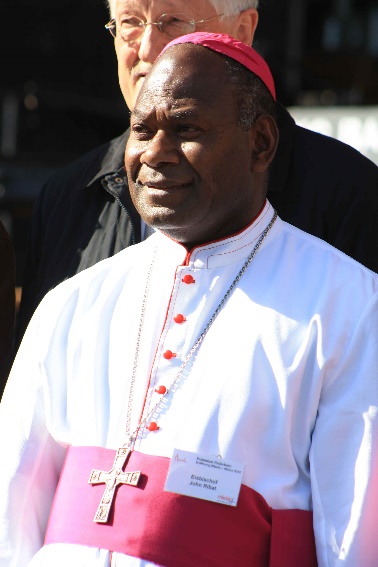
Jhon Ribat, Kardinal Pertama Orang Melanesia

Kardinal Jhon Ribat menjabat Uskup Agung Port Moresby (PNG) di Malanesia/doc Misacor Org.
Roma (KM) –Paus Fransiskus telah mentabiskan 17 kardinal baru dari seluruh dunia, banyak dari mereka telah memilih untuk membantu penggantinya, ditahbiskan pada (20/11/2016) lalu dari gereja Katolik St.Petrus di Roma
Para kardinal baru berasal dari lima benua, dan termasuk utusan Vatikan untuk Suriah. Mereka berasal dari berbagai latar belakang ” adat istiadat”.
Salah – satu yang diangkat kardinal adalah Jhon Ribat dari Negara Papua New Guiena di Melanesia. Selain ini, para kardinal baru datang dari negara-negara termasuk Republik Afrika Tengah, Bangladesh dan Mauritius.
Jhon Ribat MSC, Uskup Agung Port Moresby, berjanji akan menciptakan Gereja adalah momen sukacita yang besar. Dia adalah kardinal MSC pertama dan kardinal pertama dari Papua Nugini. Pengangkatannya menggarisbawahi pelayanan sendiri Gereja di PNG dan kepemimpinannya pada sejumlah isu-isu moral dan sosial.
Dia tegas menentang hukuman mati dan merupakan pendukung gaya hidup sederhana untuk melindungi lingkungan. Pengangkatannya membawa karisma dan spiritualitas kita kepada pemerintah Gereja Universal.
Pada saat yang sama, janji Kardinal Ribat adalah kesaksian untuk kerja tak kenal lelah dari begitu banyak orang  dan saudara kita sendiri selama 135 tahun terakhir; imam agama dan lainnya; banyak orang awam, maka memberitakan Injil di Pasifik dan untuk menjadi saksi kasih Allah penuh belas kasihan di mana-mana dan untuk semua orang.
Kita bisa adil bangga dengan apa yang kami buat untuk “umat” dan seluruh keluarga di PNG dan seluruh Pasifik Selatan.
Admin/KM

Pemuda Gereja Kingmi Katakan “Kami Dukung ULMWP Masuk di MSG

Ketua Pemuda Klasis  Kota Jayapura Naftali Yogi. (Foto: Hendrik T/KM)
Ketua Pemuda Klasis Kota Jayapura Naftali Yogi. (Foto: Hendrik T/KM)
Timika, (KM)—Tokoh Pemuda Gereja Kemah Injil (Kingmi) di Tanah Papua, mendukung penuh ULMWP agar diterima Menjadi Full Members di MSG.
Ketua Pemuda Gereja Kemah Injil (Kingmi) di Tanah Papua, Klasis Kota Jayapura, Naftali Magay, mengatakan, Kami sebagai pemuda dan pemudi  Gereja, pada pertemuan yang akan diselenggarakan di Honiara, sangat mendukung ULMWP agar diterima di MSG. Tapi, diingatkan juga membahas pelanggaran Hak Asasi Manusia (HAM) yang terjadi di Papua.
“Seluruh Pemuda Gereja Kingmi di Tanah Papua, kami sanggat sport pertemuan para pemimpin negara-negara MSG di Honiara Ibu kota Solomon Island yang akan menjadi pembahasan ras Melanesia tertanggal 14-16 Juli 2016 Melalui KTT MSG, ULMWP agar diterima menjadi Status keanggotaan Penuh di MSG,”Kata Yogi Kepada kabarmapegaa.com, Kamis, (14/07/16) dari Jayapura.
Dalam pembahasan itu, ia menambahkan sekaligus diharapkan, para Pemimpin MSG, musti jelih melihat semua Pelanggaran HAM berat di Papua yang terjadi Sejak 1969 hingga kini
“Seperti, peristiwa penembakan kilat, yang terjadi di Paniai, 8 Desember 2014, Biak-Sorong-Wamena-Timika-Yaukimo dan Jayapura sekaligus Penculikan toko, Perjuangan (Theis H Eluai) hingga kini,”bebernya.
Sementara itu, Ketua Yayasan Lembaga Swadaya Masyarkat (YLSM) Wilayah Meepago, Servius Kedepa, menyatakan, pada prinsipnya rakyat Papua sangat mendukung penuh ULMWP agar diterima sebagai Anggota penuh di MSG.
Pewarta    : Hendrikus Tobai
Editor        : Alexander Gobai

How mining and militarisation led to an HIV epidemic in Indonesia’s Papua

Martina Wanago was sick. In fact, she was sure she would die. She had contracted HIV, which has reached epidemic proportions here in Indonesia’s remote and restive province of Papua. And like many of those infected, she didn’t know what was wrong with her.
“All I could do was just wait for God to call me,” Wanago said, closing her eyes as firelight flickered on her face in a traditional roundhouse in Kambele, a remote artisanal mining village deep in cloud-shrouded mountains.
But it was here, in this unlikely spot, that she found salvation. Or rather, she found treatment – at the Waa Waa Hospital in the nearby community of Banti.
The hospital was built by Freeport McMoRan, one of the world’s largest mining companies, based in Phoenix, Arizona. It is one of very few positive developments that the industry has brought to indigenous Papuans.
In fact, Papua’s resource wealth is intimately connected to its tortuous past half-century, which has included a foiled attempt at independence followed by an armed rebellion in which Indonesian security forces have killed tens of thousands of indigenous people.
A more recent consequence of mining and militarisation is that – along with an underfunded healthcare system – they have contributed to an HIV epidemic in Papua.
Timika, near the Grasberg mine, which is majority owned by Freeport, was a village of less than 1,000 indigenous Kamoro people in the 1950s. It boomed throughout the 1990s, becoming a city of 120,000 people, including men who had migrated to work at the mine and who created a market that attracted sex workers from other parts of Indonesia. Among newly-arrived female sex workers, HIV rates jumped from zero to 1.4 percent between 1997 and 2002, according to a study published in the journal Sexual Health. From mining towns, HIV has spread even to remote villages with no access to healthcare.
It is “one of the few national epidemics that continues to spread”, according to a 2013 study conducted by Indonesia’s health ministry. In Papua Province, reported AIDS cases [320 per 100,000 people] are almost 20 times the national average, researchers found. And the study indicated that 88 percent of HIV-positive people in Papua and neighbouring West Papua provinces were unaware that they had contracted the virus.

Mining, military and HIV

Wanago and her husband had walked for three days from their ancestral village to get to Kambele. They came to pan gold from as much as 230,000 tonnes of untreated mine waste dumped daily into the river by Grasberg, which is one of the world’s largest goldmines.
They had come to find opportunity, a way to make a living to support their children. Instead, they found HIV.
Like so many others, Wanago’s husband contracted the virus from a sex worker in one of the brothels that cater to mining communities. And then he passed it on to his wife.

papua_2.jpg

Artisanal miners extract gold out of waste from the Grasberg mine dumped into the Aiwa River
The Indonesian government has designated the Grasberg mine a “strategic industry”, which allows the military to hold exclusive contracts over its security. In Papua and the wider West Papua region, some officers are involved in an illegal but booming business on the side – the sex trade.
A Papua provincial government official, speaking to IRIN on condition of anonymity, provided specifics of one brothel operation, which includes 57 “houses” and about 180 sex workers.
“These are the owners: the oldest, retired military man – he owns more than one house – one active military [officer] who works in the military hospital, one active police officer, and civilian migrants including Chinese descent, backed by security,” said the official.
*The Catholic Justice and Peace Commission of the Archdiocese of Brisbane recieved similar information during a recent fact-finding mission. “Church workers and gatherings of a number of Catholic congregations in a number of locations told our delegation that the HIV problem is worsened by infected sex workers being brought in, often by the military,” it said in a May report.
**The Indonesian health ministry’s 2013 study found that 3.5 percent of women in Papua and West Papua provinces who engaged in commercial sex were HIV positive.
Over the past decade, health authorities have carried out prevention programmes in both provinces, which “contributed to halting the growth of the epidemic”, according to a report published by the Burnet Institute, an Australian medical research organisation. Between 2006 and 2013, the HIV rate stayed at high but stable rate of 2.9 percent among indigenous Papuans, the institute said.
However, the health ministry’s study found that more than 85 percent of those who tested positive for HIV while participating in the survey did not know their status beforehand, “thus indicating a huge need for increased targeted HIV testing programs”.

papua_3.jpg

Sex workers from Java relax at a brothel in Timika, Papua Province

Decimated population

Of course, mining is not the only reason the military is in Papua – although the two are historically intertwined.
In 1960, Freeport McMoRan was known as Freeport Sulphur and its executives became interested in gold deposits that had been discovered high in the mountains of what was then known as Dutch New Guinea. (The region now consists of West Papua Province and Papua Province, which borders the independent nation of Papua New Guinea to the east. Somewhat confusingly, the Indonesian provinces are often referred to collectively as West Papua)
At that point, indigenous Papuans who had been living under Dutch rule were three years into a 10-year process leading up to independence. An Indonesian General named Suharto – who was later to become president after a bloody coup – hijacked that process and began secret negotiations with Freeport, which granted the company mining exploration rights.
With so much mineral wealth at stake, as well as an expansionist Indonesian military, Dutch New Guinea became a battleground, and Indonesian soldiers were sent in to maintain control over the political situation.
Rather than a plebiscite as specified by a 1962 agreement under UN auspices, the 1969 vote included only about 1,000 Papuan leaders selected by Indonesia, who cast ballots under the threat of violence. Despite such obvious coercion, the UN accepted the results and Indonesia annexed the region.
Thus began a rebellion that continues to this day.

papua_4.jpg

The Grasberg mine, one of the biggest gold and copper mines in the world, is carved out of the mountains at 4,200 meters
Indonesia strictly limits media and researchers’ access to Papua, and local civil society groups are under constant surveillance and threats of arrest. So independent statistics on the number of casualties are hard to come by, and they vary widely.
“In aggregate, many tens if not hundreds of thousands of West Papuan people have been killed under Indonesian rule as the direct result of explicit government policies,” according to 2013 article in the Griffith Journal of Law.
The activist group, Free West Papua, says the Indonesian regime has killed or disappeared 100,000 people since 1962. In addition: “During the mid-1990s the Indonesian military systematically destroyed village gardens, causing widespread famine.”
The election of President Joko Widodo in 2014 brought new hope for Papuans. He publicly stated his commitment to human rights, met with Papuan religious and political leaders during his first year in office, and last year ordered the release of five political prisoners. Yet, little has been done to rein in the security forces.
Today, Papua remains by far the most militarised province in the country, according to Made Supriamata, a PHD candidate at New York State’s Cornell University who researches Indonesian security forces. He told IRIN that there are three times as many soldiers in Papua than in any other province.
As Papua’s indigenous people were being decimated over decades of conflict, they came under another even more powerful demographic threat: Indonesia began encouraging migration from other parts of the country into the province. According to a 2010 study by the University of Sydney, indigenous people made up 96 percent of the population of West Papua (including both provinces) in 1971; by 2010 that figure had fallen to only about 48 percent.
And now, Papuans are dying of HIV.


AIDS activism

Many countries around the world have, of course, shown that HIV does not have to be fatal. But that requires a healthcare system that functions to at least a minimum standard of providing access to a large portion of the population.
Indonesian health ministry reports show that in an area of 53,000 square kilometers – bigger than Croatia – a population of 400,000 is served by only one 70-bed hospital, and 15 health centres, two of which don’t even have a doctor.
The best hospital in the province, and the only one in the highlands region, is the Waa Waa Hospital in Banti where Martina Wanago and others receive treatment as part of its HIV programme. The hospital receives between 100 and 120 patients a day from three nearby villages. But the majority of Papuans live in remote areas, far from this hospital, and are left without access to modern medicine.
“We worry about the other villages,” said Dr. Milke, who runs the programme.
“In those villages, they rely on supernatural healers and beliefs,” she told IRIN. “We only know what happens there if someone comes here sick and they tell us their wife or husband has died and so have many others.”

papua_5.jpg

The Waa Waa Hospital in Banti
The HIV epidemic has fed into theories that the Indonesian government is trying to wipe out the indigenous population.
“Papuans believe HIV was intentionally introduced into Papua by Indonesians in order to kill us,” one Papuan confided to IRIN. “And that the government intentionally leaves the disease to spread widely without taking serious measures to overcome the problem.”
There is no evidence the theory is true, but some Papuans have reached the conclusion given that government policies have reduced them to a minority in their homeland. And security forces continue to arrest, abuse, and sometimes kill those who speak out, according to advocacy groups like Human Rights Watch. Despite those pressures, Papuan activists continue to campaign for independence.
“Under international law and practice, we have a right to self-determination,” one told IRIN, on condition of anonymity. “It is our land.”
Wanago has turned to activism too, although it’s of a different kind – she’s drawing on her own experience to encourage people to use condoms.
ss/jf/ag
*(This story has been updated to include comment from the Catholic Justice and Peace Commission of the Archdiocese of Brisbane.)
**(An earlier version of this story included figures from two sources that suggested inflated rates of HIV among sex workers.)

Up ↑

Wantok Coffee

Melanesia Single Origin Coffee

MAMA Minimart

MAMA Stap, na Yumi Stap!

PT Kimarek Aruwam Agorik

Just another WordPress.com site

Wantok Coffee News

Melanesia Foods and Beverages News

Perempuan Papua

Melahirkan, Merawat dan Menyambut

UUDS ULMWP

for a Free and Independent West Papua

UUDS ULMWP 2020

Memagari untuk Membebaskan Tanah dan Bangsa Papua!

Melanesia Spirit & Nature News

Promoting the Melanesian Way Conservation

Kotokay

The Roof of the Melanesian Elders

Eight Plus One Ministry

To Spread the Gospel, from Melanesia to Indonesia!

Koteka

This is My Origin and My Destiny