Anthony Craig: I am told to ease off. Never.

To all my West Papuan friends and Supporters

I made a commitment to your people when i visited west Papua in Aug 15. The doors remain shut on the truth about the ongoing extermination of the west papuan people. Its being covered up by both the indonesian and Australian governments.

I plan to use a hammer to knock down the door.

I cannot sit back and continue to see photos of woman being raped and murdered, children torture and mass murder.

I am told to ease off. Never.

As bishop belo once said over the slaughter of East timorese by the Indonesian military.

When I see my people suffering I am not going to be silent. Sometimes you have to speak up loudy and forcefully.

Anthony craig national leader Free west papua party Australia established because the indonesian military is exterminating the west papuan people covered up by both the indonesian and Australian governments

United West Papuan people launch the manual petition for an Internationally Supervised Vote

STATEMENT

5th April, 2017


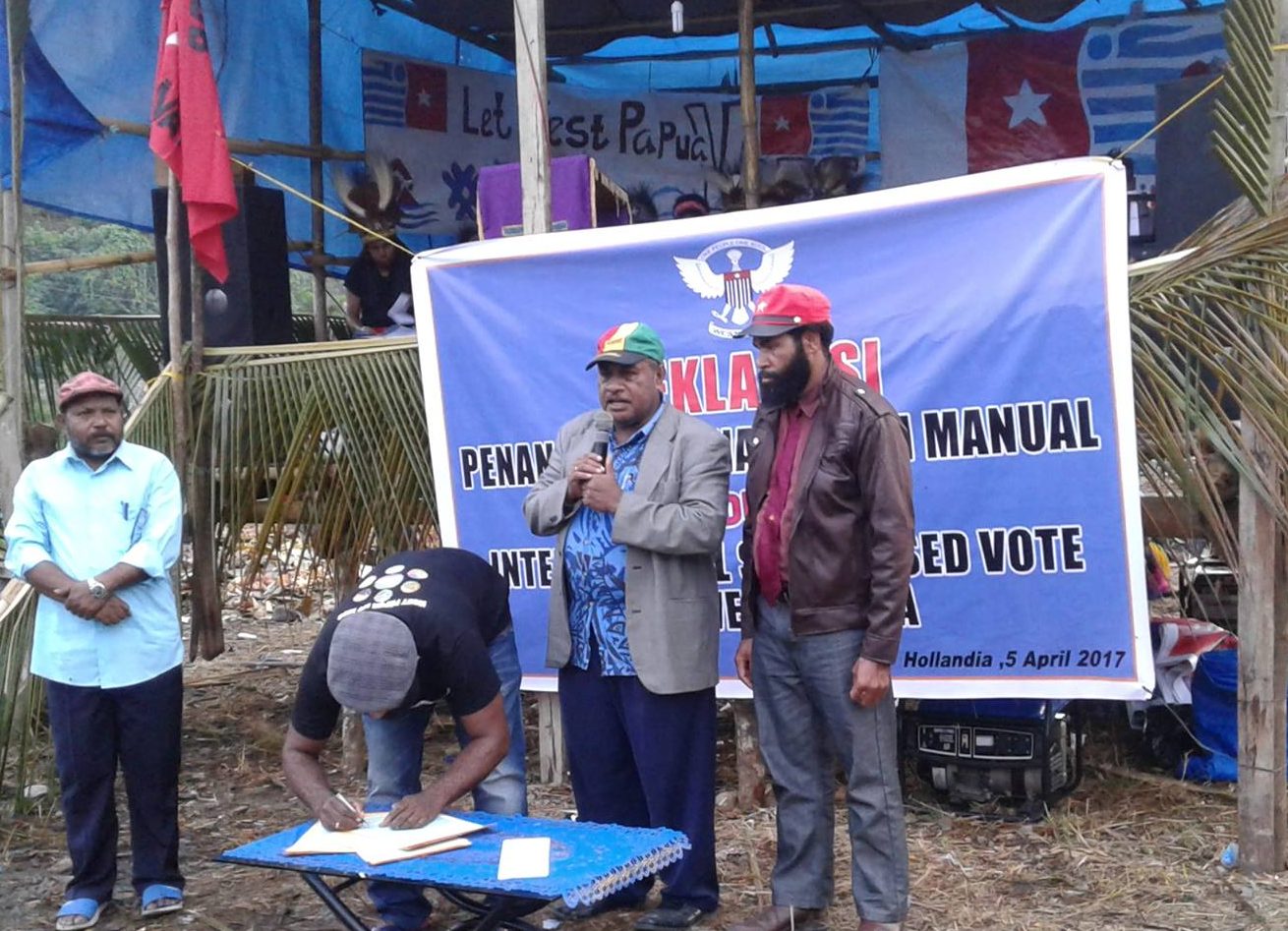
United West Papuan people launch the manual petition for an Internationally Supervised Vote

Today 5th April 2017 marks exactly 56 years to the day that the Nieuw Guinea Raad or New Guinea Council first met in West Papua and affirmed the fundamental right to self-determination of the West Papuan people. This council was the first parliament of the West Papuan people and it was tasked to help ensure a peaceful path to a decolonised and Independent West Papua.

In commemoration of the Nieuw Guinea Raad, today the people of West Papua reaffirmed our fundamental right to self-determination. A gathering attended by around 1000 people was held in Waena to launch the manual petition for an Internationally Supervised Vote for West Papua.

Representatives of the West Papua National Coalition for Liberation (WPNCL), the Federated Republic of West Papua (NRFPB) and the West Papua National Parliament (PNWP).

The three main Independence organisations within West Papua: the West Papua National Coalition for Liberation (WPNCL), the Federated Republic of West Papua (NRFPB) and the West Papua National Parliament (PNWP), were all represented under the umbrella of the United Liberation Movement for West Papua (ULMWP). All three organisations stood together to declare their support for this petition, thereby supporting the Westminster Declaration for an Internationally Supervised Vote for West Papua. The vote itself is to be held in accordance with UN General Assembly Resolutions 1514 and 1541 (XV)).

This global petition which was originally launched at the UK Parliament in Westminster has gone around the world collecting tens of thousands of signatures in both manual and digital format. Speaking on the launching of the manual petition in West Papua today, ULMWP Spokesperson Benny Wenda said “This is a truly historic and important moment for the people of West Papua as it is the first time the three main Independence organisations have signed the petition calling for an Internationally Supervised Vote in West Papua. I emphasise the need for unity among all West Papuan people and organisations to support this petition. We are united as one in our struggle for our fundamental right to self-determination.”

Benny Wenda went on to say “We hope that this will also encourage further international solidarity for West Papua, at a parliamentary and grassroots level. The time is now. I appeal to everyone around the world to support the West Papuan people’s campaign for self-determination. Let West Papua Vote.”

After collecting many more signatures from around the world, in August the petition will be taken by a team of swimmers across Lake Geneva and into the United Nations. More information about the movement to Back The Swim can be found on the Swim for West Papua website www.swimforwestpapua.com

Ends//

Benny Wenda
Spokesperson for the United Liberation Movement for West Papua (ULMWP)
Email: office@bennywenda.org

www.ulmwp.org

Amunggut Tabi: West Papua Independence is NOT Limited to Peace, Stability and Security in the South Pacific

In response to Indonesia’s strategy approaching the governments in Melanesian countries by providing what it calls “security assistance to poor Melanesian nation-states”, Amunggut Tabi from the West Papua Revolutionary Army says

West Papua independence is not limited to peace, stability and security in the South Pacific region.

Please tell the world, this independence has more to do with wider issues, more lasting aspect, and it has universal benefits to the world. It has to do with the life on this planet Earth and to the life after life, rather than just limited modern nation-state anthropocentric sentiment of peace, security, and economic development in the South Pacific.

When Papua Merdeka News (PMNews) asked to clarify what Gen. Tabi means by his statement above, he says

All human biengs in the world know that New Guinea is the second largest Island on Earth after the Greenland. And all human beings also know that New Guinea is the home to the third largest rain-forests on Earth after the Amazon and Congo rain-forests. All human beings on planet Earth also know that New Guinea is home to the Second Tropical Glacier on Earth. It is home to the worlds species of flora, fauna and human bio-cultural diversity.

Of course, all these have nothing to do with economic growth and gross domestic products and mass production of the modern nation-states in this planet Earth. But one should note, that these facts have things to do with “life” and “death”.

New Guinea is not just full of natural resources to be exploited, as modern people know, but New Guinea has things to offer beyond economy, beyond money, beyond security beyond wealth, beyond prosperity.

Those who ignore or undermine the cause of West Papua independence are the ones who do not understand the real meaning this struggle. Those who support this struggle right now, we believe, receive blessings in their hearts and minds, in their life, because this life and this planet Earth knows that New Guinea is important for our survival.

Gen. Tabi also mentions that New Guinea is the home of all Melanesians.

All Melanesians come from New Guinea, we spread across the island countries from West Papua to Fiji, and all Melanesians have full right to come back to this Island when anything at all happens to the small islands across the South Pacific. We should not put hope on Australia, but New Guinea is our original home and out future home. Imagine when all small islands are threatened to be under water, and New Guinea is fully occupied by Malay-Indos, when will Australia host Melanesians? No, impossible because Australia today is occupied by Europeans, not our brother-Aborigines.

We all Melanesians are fighting in defending our race, and in protecting our home-land from being occupied by foreigners. We are protecting our future, the future of a grandchildren to come.

Gen. WPRA Mathias Wenda: Let All Beings Sing, Praise the Lord for PCWP Support in Geneva Last Night

In the morning of Thursday, March 2, 10`7, I woke up from my sleep, wandering why this morning, the birds and other beings on the ground, were making a lot and a lot of noise, not as usual. I was also visited by many guests during my sleep: all troops who dies in the fight against Indonesia came, having a big party all night; including my younger brothers the Late Gen. Kelly Kwalik and Brig. Gen. Hans Bomay were there.

I wanted to talk to them, but they all just waved and said, “celebrate, celebrate, celebrate, ….. so many times.”

When I reconnect back to the morning dancing and singing I was having in the West Papua Revolutionary Army (WPRA) Central Headquarters in the Jungle Of New Guinea this morning, I am then told that “We are also telling you, “celebrate, celebrate, celebrate…”

I did not wait, I went out and sing songs, dancing and singing and dancing for some 30 minutes, until all other troops woke up. Most of them joined into my songs, others were confused. They thought, “How come this old man is now drunk? He is a priest, carries the Bible on the right hand, and his gun on the left hand, but now he is drunk?” They thought “No, he is not drunk”.

I praise you the Lord, Almighty God, for your creation of this New Guinea Island, for the people of Melanesia, for our culture, for wisdom and understanding that you gave us, that make us unique in this planet Earth, that glorify your own power and presence. Today I praise you the Lord, for what you have done to me and to my struggle to free my people from the colonialism of Indonesia.

You have created us Melanesians and given us our places, starting from Raja Ampat of West Papua to Fiji, from Biak and Manus Islands to New Caledonia, this is what we humans ended up calling ourselves as Melanesian peoples, the peoples of the Black Archipelago, to pair with the Black Continent of Africa.

This morning I have a vision, that singing and dancing is the key towards victory, and together with the spirits of those who have died during this struggle, I now wake up, stand up, dance and sing, to praise you alone.

I pray that God bless West Papua governor, my Son Lukas Enembe, PNG Prime Minister my Son Peter O’Neill, Solomon Islands Prime Minister Manasseh Sogavare Vanuatu Prime Minister Mr. Charlot Salwai, Kanak LeaderVictor Tutugoro, Fiji Prime Minister Josaia Voreqe (Frank) Bainimarama so that they stand up united, strong and one voice, for the sake of their own Melanesian Identity and Integrity, for the sake of our unity and sovereignty, as we all came out from one father, and one mother, our father is Melanesia, our mother is Melanesia.

After praying all these, Gen. Wenda quickly went to lay down and slept for about 30 minutes, then he asked one of his staff to go to connect to the Internet and read if there is anything coming out.

He then realised, that just a few hours before his dancing and praying, Seven Pacific Leaders were speaking at the UN Human Rights Commission Meeting in Geneva, on behalf of the Pacific Coalition on West Papua (PCWP).

He then asked all his staff members to clap their hands, and again praise the Lord. He then bowed his head down to the Earth, and said,

Let All Beings Sing, Praise the Lord for PCWP Support in Geneva Last Night

Why Western-style democracy is not suitable for Africa

In the West, the basic economic and social unit is the individual; in Africa, it is the extended family or the collective. –George Ayittey

(CNN) — Western-style multi-party democracy is possible but not suitable for Africa.

There are two forms of democracy. Democratic decisions can be taken by majority vote, which is the Western form. It has the advantage of being transparent, fast and efficient. But the downside is that it ignores minority positions.

The alternative is to take decisions by consensus. This has the advantage of taking all minority positions into account.

However, the demerit is that it can take an awfully long time to reach a consensus the larger the number of people involved. Nevertheless, the Nobel Peace Committee and the World Trade Organization (WTO) all take decisions by consensus.

So too do many traditional African societies. Just because a group does not take its decisions by voting does not mean they have no understanding of the essence of democracy.

In the early 1990s, following the collapse of the former Soviet Union, the winds of change swept across Africa, toppling long-standing autocrats.

In our haste to democratize — and also as a condition for Western aid — we copied and adopted the Western form of democracy and neglected to build upon our own democratic tradition.

The Western model allowed an elected leader to use power and the state machinery to advance the economic interests of his ethnic group and exclude all others: Kenyatta of Kenya and the Gikuyu, Moi of Kenya and the Kalenjin, Biya of Cameroon and the Beti, Eyadema of Togo and the Kabye, to name a few.

Virtually all of Africa’s civil wars were started by politically marginalized or excluded groups.

At Africa’s traditional village level, a chief is chosen by the Queen Mother of the royal family to rule for life. His appointment must be ratified by the Council of Elders, which consists of heads of extended families in the village.

In governance, the chief must consult with the Council on all important matters. Without this council, the chief is powerless. If the chief and the Council cannot reach unanimous decision on an important issue, a village meeting is called and the issue put before the people, who will debate it until they reach a consensus.

The village assemblies exist among various African tribes including: the Ashanti of Ghana, the Igbo of Nigeria, the Somali, the Tswana of Botswana, the Shona of Zimbabwe, the Xhosa and the Zulu of South Africa.

If the chief is “bad” he can be recalled by the Queen Mother, removed by the Council of Elders, or abandoned by the people, who will vote with their feet to settle somewhere else.

Traditionally, African kings had no political function. Their role was spiritual or supernatural — to mediate between the cosmological forces: the sky, the earth and the world, each of which is represented by a god.

The king’s role is to propitiate these gods and maintain harmony among them. If the sky god is “angry” there will be thunder, heavy downpour, floods, etc. That would mean the king had failed to perform his function and off went his head (regicide).

Africans could have built upon this system. In the West, the basic economic and social unit is the individual; in Africa, it is the extended family or the collective.

The American says, “I am because I am.” The African says, “I am because we are.” The “we” denotes the community.

So let each group choose their leaders and place them in a National Assembly. Next, let each province or state choose their leaders and place them in a National Council.

Choose the president from this National Council and avoid the huge expenditures on election campaigning that comes with Western-style democracy. Those resources can be better put to development in poor African countries.

Next, let the president and National Council take their decisions by consensus. If there is a deadlock, refer the issue to the National Assembly. This type of democracy is in consonance with our own African heritage.

The opinions expressed in this commentary are solely those of George Ayittey’s.

Other Links:

  1. http://papuapost.com/
  2. http://monthlyreview.org/
  3. facebook.com Tribal Models of Democracy 1
  4. facebook.com Tribal Models of Democracy 2

Indonesia’s West Papua: Settlers Dominate Coastal Regions, Highlands Still Overwhelmingly Papuan

By Jim Elmslie, Global Research, January 20, 2017, The Asia-Pacific Journal 15 January 2017

This paper will reconsider previous work on the demographic transition under way in West Papua (the Indonesian provinces of Papua and Papua Barat) in the light of documents received from the Indonesian Statistics Office (Badan Pusat Statistic BPS) that give an ethnic breakdown across the 29 regencies that comprise Papua province and the eleven regencies in Papua Barat. They show that, while the proportion of Papuan people as a percentage of the entire population continues to decline, this process varies widely between different regencies. While some have a strong majority of non-Papuan people other regencies are still overwhelmingly Papuan.

Complete Paper read here


If You Cared About Standing Rock, You Need To Know About West Papua

This week, activists across the world celebrated as the Army Corps of Engineers announced that it would not grant the permit for the Dakota Access pipeline to drill under the Missouri river. This followed campaigning efforts from local Standing Rock Sioux tribe and thousands of Native American supporters from across North America and further afield, who argued that if the pipeline was approved, their spiritual lands would be compromised and local waters would be contaminated, threatening their livelihood. With a message that resonated with indigenous rights activists and environmentalists everywhere, campaigners were successful in forcing officials to back down.

The announcement was, however, met with scepticism from some first-nation Americans. With a heavy awareness that the DAPL would appeal the decision, many tribe members were cautious about celebrating too soon. After all, exploitation of indigenous groups, particularly in excavation projects, is common place: in Australia, historically aboriginal lands have been named as the preferred site for a nuclear waste dump, and in Nigeria, the indigenous Ogoni people have, according to numerous reports, been subjected to ethnic cleansing in the course of mishandled oil extraction projects.

It’s clear then that the exploitation of indigenous peoples is commonplace. So what set Standing Rock aside from the cases of groups in Australia, Nigeria and so many more? The answer is clear: a global coalition of activists. And no case study demonstrates more clearly the importance of activism in the struggle for indigenous rights than the situation in West Papua.

West Papua forms half of the Papua island, to the west of Papua New Guinea in South-East Asia. The island itself is split in half. The indigenous people of West Papua have Melanesian roots, and culturally and ethnically enjoy many similarities to the people of Papua New Guinea. However, the region’s fraught history and decades of political turmoil have left it without international recognition. It was formally colonised by the Dutch in 1898, and while the Netherlands began a process of decolonising the region following the Second World War, this was co-opted when Indonesia asserted a claim over the territory. Papuans fought back, declaring independence in 1961, but Indonesia soon retaliated by invading, backed by the Soviet Union. The situation was exacerbated when the US, prompted by fears of spreading Communist influence, interfered, brokering a deal with Indonesia to grant her control over West Papua. This was in theory meant to be followed by a referendum with the end goal of self-determination, but this never happened.

Since then, the military occupation of West Papua has resulted in over 500,000 deaths. The occupation has devastated indigenous people and scarred West Papuan communities: the Biak massacre of 1998 is a particularly haunting example of this. On the anniversary of the unsuccessful Papuan declaration of independence, over 200 independence demonstrators were forced by the army into two Indonesian naval vessels and taken to two different locations to be thrown into the ocean. In the following days, the protesters’ bodies washed up on Biak’s shores, or were snarled in fishing nets.

The Biak tragedy is just the tip of the iceberg. Aside from the scores of unlawful deaths, there are widespread reports of violence, including sexual violence, against civilians. In a public report to the U.N. Commission on Human Rights in 1999, the Special Rapporteur on Violence Against Women concluded that the Indonesian security forces used rape “as an instrument of torture and intimidation” in West Papua, and “torture of women detained by the Indonesian security forces was widespread”. Political prisoners engaged in peaceful demonstration are routinely convicted in unfair trials, and large numbers have yet to be released. The depth of suffering in West Papua is such that, in 2004, a groundbreaking report from Yale Law School referred to the Indonesian policy in West Papua as “genocide”- a label which was, apparently, taken lightly by the international communiyu.

It has been clear for a while now that the situation in West Papua has reached, and remained at, crisis point. So how do we explain the lack of public awareness and concerted policy responses? The problem is that most campaigns and activist movements are catalysed by news stories that shock us and compel us to take action, but there is a distinct lack of reporting on the West Papua situation. West Papua is effectively off limits to international journalists, and the penalties for flouting the region’s restrictive laws are severe: if discovered without permission they are arrested and deported by the Indonesian authorities. Some have even been attacked and imprisoned. Indonesian President Joko Widodo announced earlier this year that Papua would be open to foreign journalists, but this does not reflect the reality on the ground.

This is worsened by the fact that Indonesian authorities have made it near impossible for many NGOs to operate in West Papua: organisations such as the International Red Cross, Amnesty International and Human Rights Watch have all been denied access, and their vital services denied along with it.

West Papua represents one of the most atrocious systems of repression of indigenous peoples that we see in the world today. But the Standing Rock victory shows us that the will, manpower and resources do exist to mount an effective opposition tothreats to indigenous peoples’ rights. Even if it isn’t possible to go to West Papua and prevent these atrocities from happening directly, there is still a lot that each of us can do: you can support the fundraising efforts of the few NGOs that are allowed to operate in West Papua, you can write to your Member of Parliament, you can share resources and information with friends, family and colleagues, and you can help increase the public awareness that is so sorely needed to effect change.

Standing Rock taught us that persistent efforts can succeed- this lesson must not be forgotten, especially when it comes to groups that need protection the most.

Indonesia feared Australia would ‘recruit’ its best soldiers, General says

Special forces near Nusakambangan
ndonesian Kopassus special forces soldiers patrol near the prison island of Nusakambangan in Cilacap, Central Java. (Reuters: Beawiharta)

Indonesia stopped sending its best soldiers for training in Australia because of fears they would be “recruited” by the Australian military.

Indonesia’s military chief General Gatot Nurmantyo said he stopped the training program before suspending all military relations between the two nations.

In a speech from late November uncovered by the ABC, he made his feelings clear:

“Every time there is a training programme — like recently — the best five or 10 students would be sent to Australia. That happened before I was chief so I let that happen,” he said.

“Once I became chief commander of the national forces, it did not happen again. They will certainly be recruited. They will certainly be recruited.”

The general used the language of the Cold War, talking about the soldiers being cultivated as sources or agents of influence.

It was revealed yesterday that Indonesia suspended all military cooperation between the two nations after an instructor with the Indonesian Special Forces [Kopassus] was offended by material that was part of a training course in Perth.

The material related to perhaps Indonesia’s most sensitive topic — independence for West Papua.

“My officers were told to be assigned over there, to teach Indonesian,” General Nurmantyo protested.

“It was taught there that Papua is a nation that is going to get their independence because they’re not Indonesia. Like that. So clearly they will recruit them.”

‘A deeply offensive phrase’

Iwan Ong Santoso, an Indonesian author and journalist with Kompas newspaper, broke the story about Indonesia suspending its military relations with Australia.

He said the West Papua element was only part of the reason for the breakdown.

Mr Santoso said that when the Kopassus officer went to complain about the West Papua commentary, he discovered a document mocking Indonesia’s key principle of Pancasila.

“We believe that our basic philosophy to build our nation is Pancasila, the five principles, and there was this writing of ‘Pancagila’,” Mr Santoso said.

“Pancagila is very insulting words of ‘madness, insanity’, saying like our nation has five kinds of insanity.”

Pancasila is a statement of Indonesian unity, while a broad translation of Pancagila would be “crazy Indonesians”.

It is a deeply extremely offensive phrase to an Indonesian.

Indonesia’s Defence Minister Ryamizard Ryacudu said Australia had punished the person responsible.

“He’s only a lieutenant,” said Mr Ryacudu.

He said the Australian military and Government did not have the intention to insult or humiliate Indonesia.

He described those responsible as “curut” — which translates as mice. In other words, they are insignificant.

Mr Ryacudu said he would discuss the incident when he met with Australia’s Defence Minister Marise Payne.

Indonesian defence minister plays down diplomatic rift with Australia

Indonesia’s defence minister has sought to play down a suspension of military ties between Australia and Indonesia, stressing it was important to keep a good relationship between the two countries.

Defence Minister Ryamizard Ryacudu stressed that Indonesia’s relationship with Australia was “fine” after the shock announcement that defence co-operation had been halted after an Indonesian military officer was offended by material at an Australian military base in Perth.

The offensive material is understood to include homework that suggested West Papua was part of Melanesia and should be given independence and material that ridiculed Indonesia’s national ideology, Pancasila.

Mr Ryamizard said he was yet to speak to Defence Minister Marise Payne about the issue but planned to visit Australia at the end of the month.

“The point is to keep a good relationship between the countries. Don’t let insignificant rats disrupt the relationship between countries. That’s not good.”

Meanwhile a spokesman for Indonesian President Joko Widodo told Reuters: “This was not a decision of the president”.

Several hours after the story broke, Senator Payne released a carefully worded statement saying that Indonesia had informed Australia that defence cooperation would be suspended after “serious concerns” were raised.

“As a result some interaction between the two defence organisations has been postponed until the matter is resolved,” she said.

Indonesia’s chief military commander Gatot Nurmantyo told a public lecture late last month that an Indonesian language teacher from special forces had been given homework that said Papua was part of Melanesia and should be given independence.

“I pulled the teacher. The (Australian) commander apologised to me,” he said at the headquarters of Muhammadiyah, Indonesia’s second largest civil organisation. Commander Gatot’s comments were greeted with applause.

A source told Fairfax Media that the issue was supposed to have been dealt with quietly but “Gatot jumped the gun”.

Commander Gatot has been critical of Australia in the past, suggesting in March 2015 that East Timor’s seceding from Indonesia was part of a proxy war for Australia to secure oil.

The Indonesian military officer was understood to have been deeply shocked after reading an essay about West Papua independence.

Mr Ryamizard said the Australian lieutenant who had been studying Indonesian had been reprimanded.

“West Papua is absolutely the red hot issue – the problem is the extraordinary parallel with East Timor from their perspective,” said John Blaxland, a Professor of International Security and Intelligence at Australian National University.

“There is a sense of Australia being untrustworthy – in 1975 they did a deal with Indonesia that they would respect its sovereignty over East Timor and in 1999 they stabbed it in the back.”

He said the only way Australia and Indonesia were able to sign the Lombok treaty for security cooperation in 2006 was by Australia officially recognising Indonesian sovereignty over West Papua.

“So this essay would be seen as treasonous,” Professor Blaxland said.

According to information circulated on a messaging app, the officer also heard offensive material in class including that the late Indonesian military leader Sarwo Edhie Wibowo was a mass murderer and that a TNI police officer murdered his friend while drunk.

He also reportedly saw a laminated piece of paper inscribed with the word, Pancagila, an offensive mockery of Indonesia’s state ideology, Pancasila, which basically translates as “five crazy principles”.

“After he returned to Indonesia, he immediately made a report,” the messaging app circular says.

The executive director of the Institute for Defence, Security and Peace Studies in Indonesia, Mufti Makarim, told Fairfax Media he heard the offensive material was related to Sarwo Edhie Wibowo being a mass murderer, West Papua and East Timor.

“It should not have been something the Australian army was discussing,” Mr Mufti said.

“Given the sensitivity, Australia has been very careful not to talk about (West Papua) in other forums. So why the double standard in internal army discussions? Their foreign policy is as if they are supporting Indonesian sovereignty but on the other hand they are discussing the disintegration of Indonesia with Papua being part of Melanesia.”

Mr Mufti said if Australia was consistent, its foreign policy should be reflected in other bodies, including the military.”

Fairfax Media

WPRA Extends Condolences for the Death of Our Hero: George Junus Aditjondro

Hari-hari Terakhir George Junus Aditjondro
George Junus Aditjondro

From the Central Command of West Papua Revolutionary Army, the Officers of the WPRA would like to officially

Extend Our Condolences


for the death of Our Great Hero from Indonesia, hero of freedom and truth.


All West Papuan fighters in the jungle of New Guinea hereby acknowledge the great work he had done during his lifetime, especially for the oppressed and marginalised communities in Indonesia.

His death on December 10, 2016, the Day all humanity on Earth celebrate the Day for Human Rights in the world, he has completed his journey on this same day indicating how the Late George Junus Aditjondro and human rights cannot be separated from one another.

Since the rise of open support from Indonesia, led by Indonesian Young Democrat Surya Anta Ginting, the head of FRI West Papua, all heroes of West Papua independence movement, and all who are alive today, as well as those to come, are very happy that the Late George Junus Aditjondro is resting in peace after knowing that Young Indonesians are now lining up on his side, supporting the marginalised and coloniased peoples.

May he Rest In Peace, may his examples become our model in fight for justice and truth, in our lives.

Issued in: Central Command of West Papua Revolutionary Army

On Date: 11 December 2016


Secretariat-General


Amunggut Tabi, Lt. Gen
BRN: A.DF 018676


Up ↑

Wantok COFFEE

Organic Arabica - Papua Single Origins

MAMA Minimart

MAMA Stap, na Yumi Stap!

PT Kimarek Aruwam Agorik

Just another WordPress.com site

Wantok Coffee News

Melanesia Foods and Beverages News

Perempuan Papua

Melahirkan, Merawat dan Menyambut

UUDS ULMWP

for a Free and Independent West Papua

UUDS ULMWP 2020

Memagari untuk Membebaskan Tanah dan Bangsa Papua!

Melanesia Spirit & Nature News

Promoting the Melanesian Way Conservation

Kotokay

The Roof of the Melanesian Elders

Eight Plus One Ministry

To Spread the Gospel, from Melanesia to Indonesia!

Koteka

This is My Origin and My Destiny