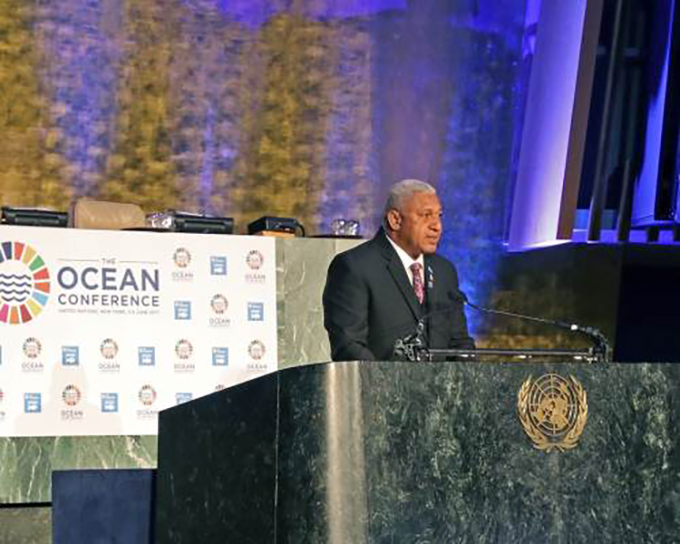
Fiji’s Prime Minister Voreqe Bainimarama closing UN Oceans Conference… “Paris Agreement not enough to save us”. Image: The Ocean Conference
Current national contributions by countries to the Paris Agreement on climate change are not enough to save the Pacific, says Fiji’s Prime Minister Voreqe Bainimarama.
“We have to try to persuade the rest of the world to embrace even more ambitious action in the years to come, because we all know that even the current national contributions to the Paris Agreement are not enough to save us,”
he said, addressing Pacific leaders as the UN Oceans Conference came to a close in New York last week.
As the incoming president of COP23, Bainimarama called on the Pacific and its leaders to stand by him and demand decisive action, as climate change was an issue of critical importance to the region’s collective future.
“I want your input. I need your input. And I want every Pacific leader beside me as we demand decisive action to protect the security of our people and those in other vulnerable parts of the world.”
Bainimarama also outlined his worry that America’s decision to abandon the Paris Agreement may also encourage other nations to either back away from the commitments they have made or not implement them with the same resolve.
“We are all, quite naturally, bitterly disappointed by the decision of the Trump Administration to abandon the Paris Agreement,” he said.
“Not only because of the loss of American leadership on this issue of critical importance to the whole world, but because it may also encourage other nations to either back away from the commitments they have made or not implement them with the same resolve.
“But something wonderful is also happening. The American decision is galvanising opinion around the world in support of decisive climate action.
‘Widespread rebellion’ “Other nations and blocs like China, the European Union and India are stepping forward to assume the leadership that Donald Trump has abandoned. And within America itself, there is a widespread rebellion against the decision the President has taken.”
Bainimarama said dozens of American state governors and city mayors were banding together with leaders of the private sector, civil society and ordinary citizens to redouble their efforts to meet this challenge.
“So while the Trump Administration may have abandoned its leadership on climate change, the American people haven’t.
“Next week, I will go to California to meet the Democrat Governor Jerry Brown and sign up to the climate action initiative that he is spearheading. I am also in contact with his Republican predecessor, Arnold Schwarzenegger, who shares Governor Brown’s commitment.
“The point is that on both sides of American politics, we have friends who are standing with us in this struggle. And I am inviting both Governor Brown and the famous ‘Terminator’ to come to our pre-COP gathering in Fiji in October, where we hope they will join us in a gesture of solidarity with the vulnerable just before COP23 itself in Bonn the following month.”
The Paris Agreement, which Fiji has ratified, sets out a global action plan to put the world on track to avoid dangerous climate change by limiting global warming to well below 2 degrees Celsius.
In response to Indonesia’s strategy approaching the governments in Melanesian countries by providing what it calls “security assistance to poor Melanesian nation-states”, Amunggut Tabi from the West Papua Revolutionary Army says
West Papua independence is not limited to peace, stability and security in the South Pacific region.
Please tell the world, this independence has more to do with wider issues, more lasting aspect, and it has universal benefits to the world. It has to do with the life on this planet Earth and to the life after life, rather than just limited modern nation-state anthropocentric sentiment of peace, security, and economic development in the South Pacific.
When Papua Merdeka News (PMNews) asked to clarify what Gen. Tabi means by his statement above, he says
All human biengs in the world know that New Guinea is the second largest Island on Earth after the Greenland. And all human beings also know that New Guinea is the home to the third largest rain-forests on Earth after the Amazon and Congo rain-forests. All human beings on planet Earth also know that New Guinea is home to the Second Tropical Glacier on Earth. It is home to the worlds species of flora, fauna and human bio-cultural diversity.
Of course, all these have nothing to do with economic growth and gross domestic products and mass production of the modern nation-states in this planet Earth. But one should note, that these facts have things to do with “life” and “death”.
New Guinea is not just full of natural resources to be exploited, as modern people know, but New Guinea has things to offer beyond economy, beyond money, beyond security beyond wealth, beyond prosperity.
Those who ignore or undermine the cause of West Papua independence are the ones who do not understand the real meaning this struggle. Those who support this struggle right now, we believe, receive blessings in their hearts and minds, in their life, because this life and this planet Earth knows that New Guinea is important for our survival.
Gen. Tabi also mentions that New Guinea is the home of all Melanesians.
All Melanesians come from New Guinea, we spread across the island countries from West Papua to Fiji, and all Melanesians have full right to come back to this Island when anything at all happens to the small islands across the South Pacific. We should not put hope on Australia, but New Guinea is our original home and out future home. Imagine when all small islands are threatened to be under water, and New Guinea is fully occupied by Malay-Indos, when will Australia host Melanesians? No, impossible because Australia today is occupied by Europeans, not our brother-Aborigines.
We all Melanesians are fighting in defending our race, and in protecting our home-land from being occupied by foreigners. We are protecting our future, the future of a grandchildren to come.
Tuvalu Prime Minister Enele Sosene Sopoaga delivers the keynote address at the opening of the regional meeting on climate change and displacement at the Pacific Islands Forum in Suva tonight. Image: UNESCAP
A regional meeting to consider key Pacific priorities and responsibilities for advancing commitments under international and regional policy frameworks on climate change migration and displacement opened in Suva today.
Senior Pacific island government officials from Fiji, Kiribati, Nauru, Republic of the Marshall Islands, Samoa, Solomon Islands, Tonga, Tuvalu and Vanuatu, as well as representatives of development partners and various experts will be discussing issues at the three-day meeting such as:
development-migration nexus in the context of the Sustainable Development Goals (SDGs);
building resilience through labour mobility;
migration and displacement as they relate to loss and damage under the Warsaw International Mechanism on Loss and Damage;
and regional mechanisms to address the needs of migrants and displaced persons.
The meeting is a key activity of the European Union funded PCCM project which aims to develop the capacity of Pacific Island countries to address the impacts of climate change on migration through well-managed, rights-based migration schemes and policy frameworks, supported by comprehensive research and knowledge building.
It is a joint collaboration between the European Union funded Pacific Climate Change Migration Project (PCCM) implemented by the United Nations Economic and Social Commission for Asia and the Pacific (UNESCAP), the International Labour Organisation (ILO), the United Nations Development Program (UNDP) and the Pacific Islands Forum Secretariat (PIFS) with support from International Organisation for Migration (IOM) and the United Nations University (UNU).
‘Highly disruptive’
Delivering the keynote address at the opening of the meeting, Tuvalu Prime Minister Enele Sosene Sopoaga said: “Climate change displacement and unplanned relocation are highly disruptive to livelihoods, culture and society and require proper, well-planned interventions to support people in their efforts to adapt to the challenges, particularly in securing access to decent livelihoods.
“Maintaining sovereignty, self-determination, cultural identity and territorial rights are of primary concern to Pacific Islanders in any form of climate change-related migration.
“The international response must also include adequate strategies to deal with persons displaced because of climate change, and their human rights must be protected.”
Speaking on behalf of the European Union, Christoph Wagner said: “It is clear that climate change, and the impact climate change has on the environment, will become an increasingly important driver of migration from rural to urban areas within Pacific island countries and to other countries.
“The European Union is supporting the PCCM project to help prepare our partner countries for migration. Those who are going to be leaving their countries, either temporarily or on a permanent basis, need assistance from their governments, Pacific regional organisations and development partners.
“We also want to help those Pacific island countries who are going to be receiving migrants to maximise the opportunities that the additional labour, expertise and experience can offer.”
Collective strategy
Dame Meg Taylor, Secretary-General of the Pacific Islands Forum Secretariat, said: “The movement of people in the Pacific due to the effects of climate change is sadly a growing issue that needs our collective attention.
“The region must come together and work out a strategy for how to best ensure that the rights and wellbeing of our Pacific sisters and brothers who are facing displacement and relocation are protected and nurtured. This must include those who do not want to move”
The UN Resident Coordinator for the Pacific based in Fiji, Osnat Lubrani said the UN considers this complex issue requires greater attention in the context of the Pacific region’s journey to achieve the 2030 Sustainable Development Agenda.
The head of UNESCAP Pacific Office, Iosefa Maiava, noted that the need to address climate change and mobility issues is recognised in the newly-adopted Framework for Resilient Development in the Pacific (FRDP) by Pacific leaders.
The regional meeting will build on existing global and regional policy directions to promote alignment and coherence, including the FRDP, the Paris Agreement, the Warsaw International Mechanism on Loss and Damage (WIM), the Samoa Pathway and the 2030 Agenda for Sustainable Development.
Debbie Singh is Pacific communications specialist for the UNESCAP Pacific Climate Change and Migration Project.
“It is a great honour to speak at this Regional Meeting on Climate Change and Migration in the Pacific. I am particularly pleased to be invited to speak at this Meeting, as the issue of climate change and migration is very present in our minds.
At the World Humanitarian Summit in Turkey earlier this year, I called for a UN General Assembly resolution to commence work to develop a legal regime to protect people displaced by the impacts of climate change. The problem of people displaced by climate change is a growing global problem. Recent studies suggest that over the last 7 years, an average of 62,000 people have been displaced by climate related events, every day. These people are not refugees as defined under the 1951 UN Convention on Refugees as they have not suffered political persecution.
So we need to find a way of guaranteeing climate change displaced people basic rights under international law. The Tuvalu government has drafted a UN General Assembly resolution and I hope copies can be made available at this meeting so that we can receive feedback on this proposal.
I have no doubt that this will not be an easy campaign; but it has to be done. I believe that with your support; the team work and navigating together through the regional and United Nations forest of processes would no doubt will result in a good outcome.
At this juncture I would like to make it very clear that it is very important that we differentiate between migration due to employment and economic opportunities and migration due to the effects of climate change, as these are totally different issues altogether and require different approaches to address them. I believe that today’s meeting will provide more concrete understanding on migration and climate change.
As people in this region know very well, the issue of migration, refugees and displaced people touches on very sensitive issues. In this context we are very aware of the tragedy and suffering that surrounds the migration policies of some of our regional neighbours.
For this reason alone, this regional meeting is very timely. I understand that it is the culmination of activities and lessons learned from the Pacific Climate Change and Migration Project. I want congratulate the European Union for taking up this initiative in the Pacific region. I also want to thank UNESCAP and the International Labour Organisation for their role in implementing this initiative.
I understand that this meeting will build on existing work under the Paris Agreement on Climate Change, the Warsaw International Mechanism on Loss and Damage, the Pacific Island Forum Leaders Communiques, the Framework for Pacific Regionalism and other international and regional initiatives. Its purpose is to identify key priorities and responsibilities for advancing commitments under key international and regional policy frameworks concerning climate change migration and displacement.
It’s very important that we have this discussion on migration and climate change in a sensible and forward thinking manner. Climate change displacement and unplanned relocation are highly disruptive to livelihoods, culture and society; and require proper, well-planned interventions to support people in their efforts to adapt to the challenges.
While we talk of migration, we should not give the impression that people want to leave their homelands. Maintaining sovereignty, self-determination, cultural identity and territorial rights are of primary concern to Pacific Islanders in any form of climate change-related. Forced displacement is a last option.
There is no chance that I as a Leader of an Atoll nation who is at the fore front of climate change, could accept a tag or a label of a climate change refugee. All of us gathered here today should strive to do all we can to protect and save our atoll islands from drowning due to the effects of climate change and sea level rise.
Nevertheless migration is an option for many Pacific islanders. Many Pacific island countries have a proud history of labour mobility. In Tuvalu’s case this labour mobility issue is always focusing on providing employment and economic opportunities, hence we have merchant seamen working on ships all over the world. We have students studying in Cuba to become doctors and others studying in Taiwan and Morocco to become engineers. We live in a truly globalised world. So we need to plan for migration as an economic option and at the same time, plan to address climate change displacement.
I certainly hope that this meeting will come forward with a clear set of strategies to address migration issues. As a start, we must develop regional arrangements for greater labour mobility. We should also be expanding the Pacific Access category visa system. I understand the World Bank released a report earlier this year calling on Australia to introduce an Australian Pacific Access category visa. I certainly hope that Australia carefully considers this. While we welcome the system of temporary visas for fruit pickers, it is no substitute for a more permanent arrangement.
Saying that, guaranteeing a safe future for our citizens must be our first priority. We must build strategies to adapt to the impacts of climate change and find ways of building back better after climate related disasters have struck.
In Tuvalu’s case, my government has enacted legislation to create a climate change and disaster survival fund as a means of ensuring that funds are set aside for when they are needed. The 36 million US Dollars GCF approved project on Coastal Adaptation, contributes to our efforts in holistically building Tuvalu resilience against the effects of climate change.
My government has also proposed a Pacific Climate Change Insurance Facility as a means of providing support to countries in our region after a climate related disasters. This is a further step to building our own resilience and I hope that all of you will support this long-needed initiative.
One last point, there is a dire need for effective coordination at all levels. You will agree with me the sudden plethora of interests in climate change, which is inundating SIDS/SIS. So let us also coordinate better internally, regionally, and globally.
So I look forward to hearing about the outcomes of this meeting. I certainly hope that it comes forward with a regional action plan that will deliver concrete option to address climate change and migration.
Finally I wish to reiterate my gratitude to the European Union for supporting this initiative and certainly hope that the EU will continue to engage in this critical issue.”
RadioNZ – A conference getting underway in Sydney today looks to address two major areas of concern to people in the Pacific region in the same sitting.
‘At the Intersection: Pacific Climate Change and Resource Exploitation in West Papua’ runs for two days, hosted by Western Sydney University and the University of Sydney’s West Papua Project.
Deforestation is rife across New Guinea. Photo: RNZI / Johnny Blades
The keynote speaker is Vanuatu’s Minister of Lands and Natural Resources, Ralph Regenvanu. Others attending include climate change scientists and West Papuan analysts.
The conference has been organised by Dr Cammi Webb-Gannon from Western Sydney University who said climate change and pernicious resource extraction in West Papua had a deep connection.
She said there was a need to find common strands of the two problems, and how it might it be useful to address them together.
“The Indonesian colonisation of West Papua is what has led to this gross resource exploitation, and the flow-on effects of human rights violations and environmental destruction in West Papua. So the two are very related,” she explained.
“They’ve never been discussed in tandem, but that’s the point of this conference, to do so.”
Dr Webb-Gannon said there were various critical issues that required attention.
She noted how the impacts of climate change throughout the Pacific Islands region highlight the importance of preserving West Papua’s rainforests from rampant logging and forest clearance.
“We want to question in this conference whether if we can halt or even stop some of the resource exploitation – whether that’s mining at Freeeport, gas mining along the coast of West Papua or even looking at reducing the land clearing in Merauke – then maybe this can help slow down Pacific climate change which is also quite alarming.”
The conference will utilise Open Space Technology to elicit creative strategies and policy advice from expert participants.
The PIDF Chair, Prime Minister Hon Manasseh Sogavare of Solomon Islands.
The new Chair of the Pacific Islands Development Forum (PIDF), Prime Minister Hon Manasseh Sogavare of Solomon Islands has called on all delegates at the 4th PIDF Leaders’ Summit to make maximum use of the meeting to make decisions that will save the ocean for the good of their countries.
He made the call at the summit opening ceremony at the Lawson Tama Stadium in Honiara this morning.
“Our two-day deliberation on this theme is watched by the peoples and governments that we represent in the region so I therefore urge all of you to make maximum use of the opportunity that we now have to save our ocean for the good of our peoples and thegovernments and countries that we represent.”
The PIDF Chair and Solomon Islands Prime Minister said it is an honour for Solomon Islands to host the summit for the first time and be the first nation to host the annual two-day event apart from Fiji- the home of PIDF.
“It is indeed an honour to host the event in Solomon Islands and Iam glad to say that it is not the first time that we hold a regional high-level meeting of this nature but this one is special to us.
“I say it is special because it is the first time for the PIDF Leaders’ Summit to move out of its home base (Fiji).”
Turning to the theme of the event, the PIDF Chair said this year’s summit focuses on the theme of ‘Stewardship for Healthy Oceans and Healthy Nations.’
“This theme recognises the fact that the health, wealth, history, culture and identity of the peoples’ of the Pacific Islands are vast and diverse.
“This theme underpins the role oceans play to the biological diversity of our people. It reinforces the fact that the geographical vastness of our oceans is immeasurable.
“We cannot deny the fact that we are the oceans people. We live by the ocean and we are big ocean states.
“Furthermore, we can easily co-relate the aspirations of the (United Nations) Sustainable Development Goals to the health and welfare of the ocean that we share amongst us.
“Oceans cover approximately 70.8 percent or 361 million square kilometers of the earth’s surface with a volume of about 1,370 million cubic kilometres. The oceans contain 97 percent of our planets available water. In our Pacific region, we can say that careful management of our ocean is key to our sustainable future,” he added.
He further added that the theme of Stewardship for Healthy Oceans and Healthy Nations is also meant to stimulate the intellectual thinking capacities of leaders present at the summit. “Let us have this intellectual stimulation to save the health of our ocean and safeguard the identity of our nations.
“That said, On behalf of every Solomon Islander, I applaud your stewardship for healthy ocean and healthy nations.
The PIDF Chair and Solomon Islands Prime Minister said the summit is made even more significant by the presence of PIDF’s Charter Members, Foundational Members and Technical Partners as well as regional and international organisations.
“In this regard, amongst others, I would like to acknowledge the presence of representatives of the state of Kuwait, People’s Republic of China, Indonesia, Timor Leste, New Caledonia, Papua New Guinea, Republic of Pakistan, United States of America, Pitcairn Islands and the (French) Territory of Wallis and Futuna.”
The PIDF Chair and Solomon Islands Prime Minister also acknowledged the participation of Solomon Islands nongovernment organisations, civil society groups, Solomon Games’ Participating teams, youth groups and students from schools around Honiara in the opening ceremony.
“The diversity at this stadium is the very nature that makes the PIDF different from other organisations. This is the unique system of the PIDF that we now cherish and shall preserve in the long run.
“On top of this uniqueness, the PIDF also favours gender, social mix and plural thinking as the basis of a new equality in the format of a tripod.”
PRIME Minister Manasseh Sogavare said, the theme of the 4th Leaders’ Summit do recognises the fact that the health, wealth, history, culture and identity of the peoples of the Pacific Islands are vast and diverse.
Speaking at the official opening of the Pacific Islands Development Forum (PIDF) Leaders’ Summit, at the Lawson Tama stadium on Tuesday, Mr Sogavare said the theme underpins the role oceans play to the biological diversity of the people within the Pacific realm.
The theme of the current Leaders’ Summit is ‘Stewardship for Healthy Oceans & Nations’.
“It reinforces hat fact that the geographical vastness of our nations is immeasurable.
“We cannot deny the fact that we are oceans people; we live by the ocean and we are big ocean states,” he said.
He added, we as Pacific Islanders can easily correlate the aspirations of the Sustainable Development Goals to the health and welfare of the ocean that we share among us.
“Oceans cover approximately 70.8% or 361 million square kilometres of earth’s surface with a volume of about 1,370 million cubic kilometres. The oceans contain 97% of our planet’s available water.
“In our Pacific region, we can say that careful management of our ocean is key to our sustainable future”.
The Prime Minister said, the theme of stewardship for Healthy Oceans and Healthy Nations is also meant to stimulate the intellectual thinking capacities of the Pacific Island leaders who are part of the current PIDF summit, in Honiara.
“Let us have this intellectual stimulation to save the health of our ocean and safeguard the identity of our nations.
“That said, on behalf of every Solomon Islanders, I applaud your stewardship for a healthy ocean and healthy nations”.
Pacific appeal to the world’s conscience is the theme that all Melanesian leaders should agree and promote. From West Papua, sharing with Papua New Guinea as the Second Largest Island on Earth, supports the efforts on limiting (global) temperature rise to 1.5 Degrees Centigrade as stated in ‘Suva Declaration on Climate Change’ which became a Pacific appeal to the world’s conscience.
From the Office of Gen. TRWP Mathias Wenda, as the Commander in Chief of the West Papua Revolutionary Army (WPRA), the Secretary-General Lt. Gen. Amunggut Tabi says,
West Papua issue is not just about human rights and security, regional stability and peace, it is more about out Melanesian future, the future of the South Pacific. We need to question ‘Where will we go, what are we Melanesians going to do when the sea level arises, when Western half of our Melaneisan-Island (New Guinea) is already occupied and taken over by Malayo-Indonesia?‘ and we need to be clever, speak for our own future generations. We have our independent nation-states, but our small-island states are under threat of global warming. We need to secure the Isle of New Guinea as our Island for our future generations.
Gen. Tabi also reiterates Gen. Wenda’s message that nobody from out there will become our day-time or night-time or morning-time saviors. We must stand-up for ourselves and for our future generations, and we must stand up together, united as One Melanesian Family, under the umbrella of the ‘Pacific Islands Development Forum (PIDF)’. Gen. Tabi continues,
We cannot wait, and if we do, there will never be anybody from heavens or earth come to Melanesia to speak on our behalf and on behalf of our future generations. It is our own, primary duty as the parents to begin thinking and acting upon the call for world conscience.
This is why, the Draft Constitution of the Republic of West Papua says the primary goal of West Papua independence is not economic, social nor political one, but it is environmental, holistic one for the sake of Papuans and Melanesians as human society with all other beings that share our islands, waters and skies.
The two WPRA generals also calls on all Melanesian leaders to think more based on Melanesian Wisdom, Melanesian Philosophy and Melanesian Way of Dealing with life issues. They said,
We are rigt now dragged into thinking, talking and acting more for the sake of economic goals. We are dragged into the global modernisation project that sacrifices our own way of living, way of thinking and way of doing things for our own survival and progress.
With the statement of the Fiji Prime Minister, Gen. Tabi expresses his gratitude, on behalf of West Papuan peoples and all communities of beings in the Isle of New Guinea, that this Melanesian wisdom should be fully supported by all Melanesian leaders, be guarded and promoted, not only for our Melanesia future, but also for the sake of life on this planet. Tabi says, Fiji Prime Minister already said we should,
“be an example for the world. Ironically, our efforts and our leadership will not just be for our benefit in the future, they will be for the benefit for the entire planet.”
Judul Asli: Cycle of War Source: Princeton Economics
Undully Free Translation by PMNews
Pada konferensi kami di seluruh dunia kami telah mendiskusikan Sikus Perang dan bagaimana ini begitu akurat mendemonstrasikan bahwa nampaknya sepertinya begitu acak, ternyata merupakan chaos yang sangat beraturan.
Dalam bukunya Siklus (New York, 1971) Edward Dewey memberikan satu pasal kepada “Pola-Pola Perang”. Penelitiannya diinspirasi oleh sebuah index internasional “War Battles” dan Perang Sipil (Cicil War Battles), yang telah dibuat oleh Raymond Wheeler pada tahun 1930-an. Wheeler menjadi profesor psikologi dari Universitas Kansas dan presiden “Kansas Acedemoy if Scienses”, dan menjadi terkenal karena studi-studinya tentang siklus perubahan iklim. Menurut Dewey,
“…Index perang dipakai oleh Professor Wheeler untuk menunjukkan hubungan antara perubahan suhu dalam iklim bumi dan kegiatan-kegiatan perang manusia. Periode-periode panas, menurut catatannya, ialah waktu-waktu kediktatoran terjadi dan ada perang-perang internasional, sementara periode-periode dingin menghasilkan pemberontakan dan demokrasi. Kompilasinya dibuat tanpa konsep siklus, tetapi ia memang mencatat bahwa ada perulangan kejadian kekeringan dan perang sipil dalam tempo waktu sekitar selang waktu 170 tahun dan setiap sepertiga dari periode kekeringan-perang sipil ini lebih ditampilkan, sehingga menciptakan siklus yang lebih panjang, 150 tahun..”
(Dikutip dalam artikel dan diterjemahkan PMNews)
Siklus Perang akan Tiba pada tahun 2014
Ini kemungkinan besar akan diawali dengan seperatisme dan kerusuhan sosial secara internal. Tidak dapat diragukan lagi meningkatkan gerakan-gerakan separis hampir di seluruh negara di Eropa. Akan tetapi para politisi sedang mengancam anggota-anggotanya yang sedang berpikir untuk meninggalkan mereka.
Benar, model in menunjukkan PD I, PD II dan perang Vietnam semuanya “spot on.” Kali ini, fokus utamannya ialah di Barat/ Timur Tengah daripada Asia. Rusia masih menjadi resiko uama. Ada nampak sejumlah hal yang mengagetkan ke depan. Perang sudah begitu regular dalam kehidupan manusia, tetapi ini SELALU dikaitkan dengan hal-hal ekonomi. Untuk memperbaiki rekor ini, sejauh ini nampaknya tidak ada PERANG DUNIA yang akan terjadi. Yang akan tampil ialah separatisme dan kerusuhan sosial yang sedang muncul.
Selalu diperdebatkan tentang “the chicken or egg” dan siapa yang datang pertama. Dalam hal ini invasi barbarian benar-benar telah mulai pada puncaknya pada Kekaisaran Romawi di mana Marcus Aurelius (161-180AD) sedang berperang di perbatasan dengan Jerman di mana ia tulis Meditasinya. Itulah puncak dari Kekaisaran Romawi dan awal dari keruntuhannya dan dimulai dengan kejatuhan kepalanya sendiri. Begitu ekonomi runtuh, kaum barbarian mulai mencium bau darah. Itu pada saat kaum barbarian ada di gerbang kota.
Kaum barbarian “sacked” (memecat) Roma pada 410AD. Istilah “vandalize” menunjukkan kepada Vandals dari Utara Afrika yang men-“sacked” Roma. Mereka merobek-robek “Copper” lepas dari atap dari setiap rumah ibadah. Apa yang mereka lakukan terhadap Roma ialah pemerkosaan nilai-nilainya. Dari sinilah istilah ini lahir dan kini masih ada berabad-abad lamanya sehingga kita sebut “vandalisme” dalam merusak. Orang-orang Vandals akan selalu diingat atas apa yang tlah mereka lakukan terhadap Roma, apa yang mereka lakukan TIDAK AKAN PERNAH terjadi tetapi untuk keruntungan ekonomi itu terjadi. Ini resiko dari sejarah yang sayangnya kita tidak pernah belajar.
Banyak orang telah tulis dan bertanya “Political-Economy Model” berdiri bagus bagi pihak Barat saat ini. Jawaban atas pernyataan itu ialah bahwa pembelokkan bersejarah nampaknya jatuh pada 2016. Bretton Woods terjadi pada tahun 1944. Ditambahkan 72 tahun menibakan kita ke tahun 2016. Model in tidak begitu menyenangkan dalam memprediksi perubahan politik dengan votalitas frekuensi yang sama.
Revolusi Rusia pada 1917 terjadi tepat pada targetnya dengan keruntuhan Tembok Berlin 72 thaun kemudian yaitu tahun 1989. Ini begitu sangat mengingatkan bahwa gelombang Model Keyakinan Ekonomi (Economic Confidence Model) akan mencapai “peak” (titik puncak) pada 2015.75, akan begitu penting. Ini kerangka waktu yang selama ini kami cari selama 30 tahun terakhir untuk melihat Krisis “Sovereign Debt”. Kecenderungan-kecenderungan tertentu tidak dapat bertahun melampaui 72 tahun tanpa berubah. Kali ini perubahan akan datang dengan menyeret politisi dari gua-gua kursi mereka. …
Siklus sebelumnya mulai 1872 dan itu berujung kepada apa yang dikenal sekarang sebagai “depresi panjang” abad ke-19 semua orang menyatakan depresi ini berlangsung selama 26 tahun. Itulah sebabnya model estat yang sesungguhnya ialah 78 tahun. Begitu dekat hubungannya dengan goncangan politik yang selalu membawa perubahan struktural. Konsekuensinya, kami melihat ke tahun 2014 sebagai awal dari kebangkitan separatisme dan kerusuhan sosial di seluruh barat. Lalu kita akan lihat tahun 2016 dan mulailah keruntuhan ekonomi yang begitu jahat. Kami akan dapat melihat hal-hal menjadi begitu buruh selama fase 2016-2010. Ini mungkin menjadi dasar dari kehancuran ekonomi Eropa.



 Papua Merdeka News