West Papua diplomatic cause advances in Brussels

A coalition of Pacific Island nations has called on the African, Caribbean and Pacific group of states to back West Papuan self-determination.

Vanuatu, Solomon Islands, Tonga, Tuvalu, Nauru, Palau and the Marshall Islands gave a joint statement at the group’s Council of Ministers in Brussels.

Johnny Blades has been following developments.


Transcript

JOHNNY BLADES: In Brussels the other day, this  African, Caribbean and Pacific bloc heard from a Vanuatu government MP who was representing this Pacific coalition of seven countries which also is a network of NGO, civil society and church groups as well, who are saying that the world community has to act now on human rights abuses in Papua, but specifically to push Indonesia to have a legitimate self-determination process for the West Papuans, because questions about the legitimacy of the self-determination process by which Papua was incorporated into Indonesia back in the 1960s, questions over that are really gaining momentum at the moment. This follows on from the Coalition’s two recent representations at the UN level on Papua: that is, last September at the UN General Assembly, and then in March at the UN Human Rights Council in Geneva.

BEN ROBINSON-DRAWBRIDGE: So how did the other countries in this group react to this call from their Pacific members?

JB: The Caribbean and African countries were signalling strong support for this, to have a resolution urging a proper self-determination process for the Papuans. But the Papua New Guinea ambassador at the meeting in Brussels spoke out against it. He actually said that the group shouldn;t push too hard at this. He suggested that a fact-finding mission to Papua is necessary for the African, Caribbean and Pacific group to conduct first in order to get a clearer picture of the situation. Remember PNG of course is right next door to West Papua and its proximity to this huge Asian country is a point of great sensitivity.

BRD: Have other Pacific groups like the Melanesian Spearhead Group or even the Pacific Forum, have they made similar representations on West Papua?

JB: They have attempted to, really. This issue has been brought up at both of those bodies many years ago, and particularly for the Melanesian Spearhead Group it was a huge issue because Melanesians in these countries feel strongly about West Papuan self-determination. It’s just that their leadership have not been able to find a unified position on it. And for instance since Indonesia has come in to the MSG as an observer and now an associate member, this issue has not advanced. So they haven’t been able to take it up at UN or ACP levels. And it’s much the same with the Forum: there’s not a unified stance on it. So the group of seven Pacific countries here who took up the issue in Brussels have really just thought ‘we’ll go ahead and do what we have to on our own’ because the Forum and the MSG, they seem to be saying, have failed on the West Papua issue.

BRD: Do any of the other countries in this (ACP) group, do they have significant political clout to be able to make a difference on this issue?

JB: They aren’t powerhouses on the world stage, most of these countries. But I think if there was to be this bloc of 79 countries suddenly taking it up at the UN General Assembly, that is significant in itself, and it would really add to the international pressure on Jakarta to maybe look for a new kind of solution to this simmering discontent in Papua.

Amunggut Tabi: West Papua Independence is NOT Limited to Peace, Stability and Security in the South Pacific

In response to Indonesia’s strategy approaching the governments in Melanesian countries by providing what it calls “security assistance to poor Melanesian nation-states”, Amunggut Tabi from the West Papua Revolutionary Army says

West Papua independence is not limited to peace, stability and security in the South Pacific region.

Please tell the world, this independence has more to do with wider issues, more lasting aspect, and it has universal benefits to the world. It has to do with the life on this planet Earth and to the life after life, rather than just limited modern nation-state anthropocentric sentiment of peace, security, and economic development in the South Pacific.

When Papua Merdeka News (PMNews) asked to clarify what Gen. Tabi means by his statement above, he says

All human biengs in the world know that New Guinea is the second largest Island on Earth after the Greenland. And all human beings also know that New Guinea is the home to the third largest rain-forests on Earth after the Amazon and Congo rain-forests. All human beings on planet Earth also know that New Guinea is home to the Second Tropical Glacier on Earth. It is home to the worlds species of flora, fauna and human bio-cultural diversity.

Of course, all these have nothing to do with economic growth and gross domestic products and mass production of the modern nation-states in this planet Earth. But one should note, that these facts have things to do with “life” and “death”.

New Guinea is not just full of natural resources to be exploited, as modern people know, but New Guinea has things to offer beyond economy, beyond money, beyond security beyond wealth, beyond prosperity.

Those who ignore or undermine the cause of West Papua independence are the ones who do not understand the real meaning this struggle. Those who support this struggle right now, we believe, receive blessings in their hearts and minds, in their life, because this life and this planet Earth knows that New Guinea is important for our survival.

Gen. Tabi also mentions that New Guinea is the home of all Melanesians.

All Melanesians come from New Guinea, we spread across the island countries from West Papua to Fiji, and all Melanesians have full right to come back to this Island when anything at all happens to the small islands across the South Pacific. We should not put hope on Australia, but New Guinea is our original home and out future home. Imagine when all small islands are threatened to be under water, and New Guinea is fully occupied by Malay-Indos, when will Australia host Melanesians? No, impossible because Australia today is occupied by Europeans, not our brother-Aborigines.

We all Melanesians are fighting in defending our race, and in protecting our home-land from being occupied by foreigners. We are protecting our future, the future of a grandchildren to come.

Jakarta urges Pacific to recognise Palestine

Indonesia has called on Pacific island countries to immediately recognise Palestine.

The Antara news agency was reporting comments by the country’s foreign minister Retno Marsudi on Thursday.

Ms Marsudi said Indonesia always discussed Palestine’s independence in its bilateral talks with Pacific island countries and with those yet to recognise Palestine as a state.

Vanuatu recognised Palestine in 1989 soon after its Declaration of Independence in 1988.

Papua New Guinea followed in 1995.

The two countries are the only Pacific island countries listed among 137 states at the UN which recognise the State of Palestine.

Antara reports Retno Marsudi earlier said Indonesia would not backtrack on its stance of supporting Palestine.

She stressed Indonesia would continue to mobilise international pressure to achieve a two state solution to the decades-old conflict between Israelis and Palestinians.

The Jakarta Post reported last week Palestinian leader Mahmoud Abbas had asked Indonesia to rally backing for Palestine among Pacific island countries, most of which are usually supporters of Israel.

The Marshall Islands, Palau, Nauru and Micronesia were among nine countries which voted against admitting Palestine as an observer at the UN in 2012.

The Solomon Islands and Tuvalu voted in favour, while Fiji, Samoa and Tonga abstained from voting.

Source: http://www.radionz.co.nz/

Regional meeting eyes Pacific climate migration and displacement

By Debbie Singh in Suva

Tuvalu Prime Minister Enele Sosene Sopoaga delivers the keynote address at the opening of the regional meeting on climate change and displacement at the Pacific Islands Forum in Suva tonight. Image: UNESCAP

A regional meeting to consider key Pacific priorities and responsibilities for advancing commitments under international and regional policy frameworks on climate change migration and displacement opened in Suva today.

Senior Pacific island government officials from Fiji, Kiribati, Nauru, Republic of the Marshall Islands, Samoa, Solomon Islands, Tonga, Tuvalu and Vanuatu, as well as representatives of development partners and various experts will be discussing issues at the three-day meeting such as:

  • development-migration nexus in the context of the Sustainable Development Goals (SDGs);
  • building resilience through labour mobility;
  • migration and displacement as they relate to loss and damage under the Warsaw International Mechanism on Loss and Damage;
  • and regional mechanisms to address the needs of migrants and displaced persons.

The meeting is a key activity of the European Union funded PCCM project which aims to develop the capacity of Pacific Island countries to address the impacts of climate change on migration through well-managed, rights-based migration schemes and policy frameworks, supported by comprehensive research and knowledge building.

It is a joint collaboration between the European Union funded Pacific Climate Change Migration Project (PCCM) implemented by the United Nations Economic and Social Commission for Asia and the Pacific (UNESCAP), the International Labour Organisation (ILO), the United Nations Development Program (UNDP) and the Pacific Islands Forum Secretariat (PIFS) with support from International Organisation for Migration (IOM) and the United Nations University (UNU).

‘Highly disruptive’
Delivering the keynote address at the opening of the meeting, Tuvalu Prime Minister Enele Sosene Sopoaga said: “Climate change displacement and unplanned relocation are highly disruptive to livelihoods, culture and society and require proper, well-planned interventions to support people in their efforts to adapt to the challenges, particularly in securing access to decent livelihoods.

“Maintaining sovereignty, self-determination, cultural identity and territorial rights are of primary concern to Pacific Islanders in any form of climate change-related migration.

“The international response must also include adequate strategies to deal with persons displaced because of climate change, and their human rights must be protected.”

Speaking on behalf of the European Union, Christoph Wagner said: “It is clear that climate change, and the impact climate change has on the environment, will become an increasingly important driver of migration from rural to urban areas within Pacific island countries and to other countries.

“The European Union is supporting the PCCM project to help prepare our partner countries for migration. Those who are going to be leaving their countries, either temporarily or on a permanent basis, need assistance from their governments, Pacific regional organisations and development partners.

“We also want to help those Pacific island countries who are going to be receiving migrants to maximise the opportunities that the additional labour, expertise and experience can offer.”

Collective strategy
Dame Meg Taylor, Secretary-General of the Pacific Islands Forum Secretariat, said: “The movement of people in the Pacific due to the effects of climate change is sadly a growing issue that needs our collective attention.

“The region must come together and work out a strategy for how to best ensure that the rights and wellbeing of our Pacific sisters and brothers who are facing displacement and relocation are protected and nurtured. This must include those who do not want to move”

The UN Resident Coordinator for the Pacific based in Fiji, Osnat Lubrani said the UN considers this complex issue requires greater attention in the context of the Pacific region’s journey to achieve the 2030 Sustainable Development Agenda.

The head of UNESCAP Pacific Office, Iosefa Maiava, noted that the need to address climate change and mobility issues is recognised in the newly-adopted Framework for Resilient Development in the Pacific (FRDP) by Pacific leaders.

The regional meeting will build on existing global and regional policy directions to promote alignment and coherence, including the FRDP, the Paris Agreement, the Warsaw International Mechanism on Loss and Damage (WIM), the Samoa Pathway and the 2030 Agenda for Sustainable Development.

Debbie Singh is Pacific communications specialist for the UNESCAP Pacific Climate Change and Migration Project.

UNESCAP Regional Meeting: Keynote Address by the Tuvalu Prime Minister, Hon. Enele Sosene Sopoaga

Tuvalu Prime Minister, Hon. Enele Sosene Sopoaga

“It is a great honour to speak at this Regional Meeting on Climate Change and Migration in the Pacific. I am particularly pleased to be invited to speak at this Meeting, as the issue of climate change and migration is very present in our minds.

At the World Humanitarian Summit in Turkey earlier this year, I called for a UN General Assembly resolution to commence work to develop a legal regime to protect people displaced by the impacts of climate change. The problem of people displaced by climate change is a growing global problem. Recent studies suggest that over the last 7 years, an average of 62,000 people have been displaced by climate related events, every day. These people are not refugees as defined under the 1951 UN Convention on Refugees as they have not suffered political persecution.

So we need to find a way of guaranteeing climate change displaced people basic rights under international law. The Tuvalu government has drafted a UN General Assembly resolution and I hope copies can be made available at this meeting so that we can receive feedback on this proposal.

I have no doubt that this will not be an easy campaign; but it has to be done. I believe that with your support; the team work and navigating together through the regional and United Nations forest of processes would no doubt will result in a good outcome.

At this juncture I would like to make it very clear that it is very important that we differentiate between migration due to employment and economic opportunities and migration due to the effects of climate change, as these are totally different issues altogether and require different approaches to address them. I believe that today’s meeting will provide more concrete understanding on migration and climate change.

As people in this region know very well, the issue of migration, refugees and displaced people touches on very sensitive issues. In this context we are very aware of the tragedy and suffering that surrounds the migration policies of some of our regional neighbours.

For this reason alone, this regional meeting is very timely. I understand that it is the culmination of activities and lessons learned from the Pacific Climate Change and Migration Project. I want congratulate the European Union for taking up this initiative in the Pacific region. I also want to thank UNESCAP and the International Labour Organisation for their role in implementing this initiative.

I understand that this meeting will build on existing work under the Paris Agreement on Climate Change, the Warsaw International Mechanism on Loss and Damage, the Pacific Island Forum Leaders Communiques, the Framework for Pacific Regionalism and other international and regional initiatives. Its purpose is to identify key priorities and responsibilities for advancing commitments under key international and regional policy frameworks concerning climate change migration and displacement.

It’s very important that we have this discussion on migration and climate change in a sensible and forward thinking manner. Climate change displacement and unplanned relocation are highly disruptive to livelihoods, culture and society; and require proper, well-planned interventions to support people in their efforts to adapt to the challenges.

While we talk of migration, we should not give the impression that people want to leave their homelands. Maintaining sovereignty, self-determination, cultural identity and territorial rights are of primary concern to Pacific Islanders in any form of climate change-related. Forced displacement is a last option.

There is no chance that I as a Leader of an Atoll nation who is at the fore front of climate change, could accept a tag or a label of a climate change refugee. All of us gathered here today should strive to do all we can to protect and save our atoll islands from drowning due to the effects of climate change and sea level rise.

Nevertheless migration is an option for many Pacific islanders. Many Pacific island countries have a proud history of labour mobility. In Tuvalu’s case this labour mobility issue is always focusing on providing employment and economic opportunities, hence we have merchant seamen working on ships all over the world. We have students studying in Cuba to become doctors and others studying in Taiwan and Morocco to become engineers. We live in a truly globalised world. So we need to plan for migration as an economic option and at the same time, plan to address climate change displacement.

I certainly hope that this meeting will come forward with a clear set of strategies to address migration issues. As a start, we must develop regional arrangements for greater labour mobility. We should also be expanding the Pacific Access category visa system. I understand the World Bank released a report earlier this year calling on Australia to introduce an Australian Pacific Access category visa. I certainly hope that Australia carefully considers this. While we welcome the system of temporary visas for fruit pickers, it is no substitute for a more permanent arrangement.
Saying that, guaranteeing a safe future for our citizens must be our first priority. We must build strategies to adapt to the impacts of climate change and find ways of building back better after climate related disasters have struck.

In Tuvalu’s case, my government has enacted legislation to create a climate change and disaster survival fund as a means of ensuring that funds are set aside for when they are needed. The 36 million US Dollars GCF approved project on Coastal Adaptation, contributes to our efforts in holistically building Tuvalu resilience against the effects of climate change.

My government has also proposed a Pacific Climate Change Insurance Facility as a means of providing support to countries in our region after a climate related disasters. This is a further step to building our own resilience and I hope that all of you will support this long-needed initiative.

One last point, there is a dire need for effective coordination at all levels. You will agree with me the sudden plethora of interests in climate change, which is inundating SIDS/SIS. So let us also coordinate better internally, regionally, and globally.

So I look forward to hearing about the outcomes of this meeting. I certainly hope that it comes forward with a regional action plan that will deliver concrete option to address climate change and migration.

Finally I wish to reiterate my gratitude to the European Union for supporting this initiative and certainly hope that the EU will continue to engage in this critical issue.”

I thank you. Tuvalu Mo Te Atua.

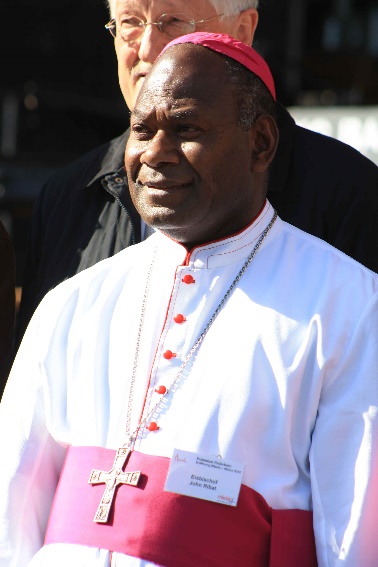
Jhon Ribat, Kardinal Pertama Orang Melanesia

Kardinal Jhon Ribat menjabat Uskup Agung Port Moresby (PNG) di Malanesia/doc Misacor Org.
Roma (KM) –Paus Fransiskus telah mentabiskan 17 kardinal baru dari seluruh dunia, banyak dari mereka telah memilih untuk membantu penggantinya, ditahbiskan pada (20/11/2016) lalu dari gereja Katolik St.Petrus di Roma
Para kardinal baru berasal dari lima benua, dan termasuk utusan Vatikan untuk Suriah. Mereka berasal dari berbagai latar belakang ” adat istiadat”.
Salah – satu yang diangkat kardinal adalah Jhon Ribat dari Negara Papua New Guiena di Melanesia. Selain ini, para kardinal baru datang dari negara-negara termasuk Republik Afrika Tengah, Bangladesh dan Mauritius.
Jhon Ribat MSC, Uskup Agung Port Moresby, berjanji akan menciptakan Gereja adalah momen sukacita yang besar. Dia adalah kardinal MSC pertama dan kardinal pertama dari Papua Nugini. Pengangkatannya menggarisbawahi pelayanan sendiri Gereja di PNG dan kepemimpinannya pada sejumlah isu-isu moral dan sosial.
Dia tegas menentang hukuman mati dan merupakan pendukung gaya hidup sederhana untuk melindungi lingkungan. Pengangkatannya membawa karisma dan spiritualitas kita kepada pemerintah Gereja Universal.
Pada saat yang sama, janji Kardinal Ribat adalah kesaksian untuk kerja tak kenal lelah dari begitu banyak orang  dan saudara kita sendiri selama 135 tahun terakhir; imam agama dan lainnya; banyak orang awam, maka memberitakan Injil di Pasifik dan untuk menjadi saksi kasih Allah penuh belas kasihan di mana-mana dan untuk semua orang.
Kita bisa adil bangga dengan apa yang kami buat untuk “umat” dan seluruh keluarga di PNG dan seluruh Pasifik Selatan.
Admin/KM

Solomons won’t enter media duel with Jakarta

Radio NZ– The Solomon Islands government says it’s not in a position to respond to a warning from Indonesia’s government not to speak out about West Papua.

 The Solomon Islands Special Envoy on West Papua Rex Horoi told the Assembly that Indonesia should allow UN Special Rapporteurs into West Papua.
The Solomon Islands Special Envoy on West Papua Rex Horoi told the Assembly that Indonesia should allow UN Special Rapporteurs into West Papua. Photo: UN Video


Indonesia’s Defence Minister Ryamizard Ryacudu has urged Australia to pass on a message to Pacific Island governments to not interfere in Indonesian domestic affairs.

In media comments in the past week, he pressed Canberra to rebuke Pacific states, in particular Solomon Islands, for raising Papua in global forums and inviting Papuans to join the Melanesian Spearhead Group.

no caption

Photo: AFP

The Solomons’ envoy on West Papua, Rex Horoi, said his government won’t respond to what is effectively a media statement.

“Due to the fact that we have not received any formal communication (on the matter) either from Jakarta or from Canberra, why should we respond at this stage? Therefore we will not respond until we receive such communication through diplomatic channels,” he said.

Mr Ryacudu also told Australian media that it is better if Canberra delivers the warning to Pacific governments, because if it was left to him he would ‘twist their ears’ and described Indonesia as a sleeping tiger that can attack if disturbed.

However Mr Horoi said Pacific countries raised Papua in global fora because West Papuans lives matter.

“We speak collectively on abuse and human rights violations in West Papua because we have received reliable sources of information,” he explained, “and therefore that is the collective concern of the civil society, public and governments of the region.”

Australia’s Foreign Minister Julie Bishop has confirmed having discussed West Papua last week with the Indonesian Defence Minister, but wouldn’t be pressed on whether Canberra will pass the warning on.

Jakarta urges Canberra to deliver regional warning on Papua

RadioNZ – Indonesia’s Defence Minister has urged Australia to rebuke Pacific Island states who raise issues relating to West Papua in global fora.

Indonesian Defence Minister Ryamizard Ryacudu.

Indonesian Defence Minister Ryamizard Ryacudu looks on during the third Trilateral Defence Minister’s Meeting in Nusa Dua on Indonesia’s resort island of Bali on August 2, 2016. Photo: SONNY TUMBELAKA / AFP

Ryamizard Ryacudu met with Australian government representatives including Foreign Minister Julie Bishop in a meeting in Bali where the two countries reaffirmed security ties.

He pressed Australia to pass a message to Solomon Islands that it should refrain from interferring in the internal affairs of Indonesia, including the issue of West Papua.

World Humanitarian Summit Pacific Consultation. Hon. Julie Bishop, Minister for Foreign Affairs of Australia

World Humanitarian Summit Pacific Consultation. Hon. Julie Bishop, Minister for Foreign Affairs of Australia Photo: RNZ / Diego Opatowski

Solomon Islands’ Prime Minister Manasseh Sogavare, in his role as chairman of the Melanesian Spearhead Group, has been vocal about boosting West Papuan representation in the group.

He was also one of seven leaders of Pacific states who spoke out about rights abuses in Papua and on support for Papuan self-determination at last month’s UN General Assembly session.

The Prime Minister of Solomon Islands Manasseh Sogavare

The Prime Minister of Solomon Islands Manasseh Sogavare has been appointed chair of the Pacific Islands Development Forum. Photo: UN Photo/Kim Haughton

Ryamizard told media that he had implored Canberra to speak to Honiara on the matter because Australia contributes a big aid package in the Solomons.

Detik News reports the Minister saying Australia has accepted the request.

Ryamizard said friendly countries do not disturb each other by interfering in domestic issues.

Indonesian military guard the border with Papua New Guinea

Indonesian military guard the border with Papua New Guinea Photo: RNZ / Johnny Blades

He warned that Indonesia will not stay silent when its sovereignty is compromised. He described Indonesia as a tiger that can attack if disturbed.

The Minister urged Australia to pass on the message to Solomon Islands and other Pacific states that they should not invite West Papua to join the MSG.

A march through the streets of Honiara in support of West Papua's bid to join the MSG.

A march through the streets of Honiara in support of West Papua’s bid to join the MSG. Photo: Supplied

The MSG accepted the United Liberation Movement for West Papua into the group with observer status last year and is considering whether to elevate it to full membership.

An MSG leaders meeting on the matter is due before the end of the year in Vanuatu.

Indonesia has associate member status at the MSG.

What they don’t talk about when they talk about Papua

‘Being a young, female Indonesian myself, I expected myself to celebrate Nara Masista Rakhmatia’s UN General Assembly speech. Instead, I was gravely disappointed.’

Several weeks ago, a young, female diplomat named Nara Masista Rakhmatia made a speech that dazzled the Indonesian public. In a video that went viral, she denied accusations from 7 Pacific country leaders about human rights abuse in Indonesia’s Papua province at the 71st Session of United Nations General Assembly in New York last September.

She further shamed their attempt to interfere with Indonesia’s sovereignty. The video gathered over 188 thousand views on Facebook, along with hundreds of comments from Indonesian citizens expressing how proud they are of Nara’s intelligence and bravery to ‘teach those foreign country leaders about how to respect Indonesia’—especially given her young age.

In their remarks, delegations from Solomon Islands, Vanuatu, Nauru, the Marshall Islands, Tuvalu, and Tonga criticized Indonesia’s human rights records in Papua. Nara in particular argued that these sentiments were largely misplaced, given that the main agenda of the Assembly was Sustainable Development Goals and a global response to climate change.

Furthermore, she claimed, these countries needed to self-reflect upon their own domestic issues before pointing their fingers to how Indonesia handles the province’s push for self-determination.

Being a young, female Indonesian myself, I expected myself to celebrate her speech. I should have been inspired and impressed by how sharp she was. Instead, as someone who studied International Relations and currently a Public Policy student, I was gravely disappointed.

Disappointed

First of all, Nara based her entire rebuttal on the obsolete definition of the sovereignty principle. While sovereignty is a crucial foundation to the United Nations, since 2005, the international community has extended its definition under the ‘Responsibility to Protect’ commitment, which stipulates that absolute sovereignty does not hold when a government fails to protect its people.

PROTEST. An arrested Papuan pro-independence demonstrator gestures from a police truck in Jakarta on December 1, 2015, after police fired tear gas at a hundreds-strong crowd hurling rocks during a protest against Indonesian rule over the eastern region of Papua. File photo by AFP

Although the concept was developed specifically as a framework for humanitarian interventions to prevent atrocity crimes and this situation has arguably not brought us that far, this core principle stands.

In other words, should these allegations stand, it is justifiable for the international community to express their concerns about the possibility of ongoing crimes against humanity.

Therefore, it is more urgent to argue about whether Indonesia has indeed violated human rights in Papua.

The speech failed to address, for example, the progress of President Joko Widodo’s promise to investigate the killing of 4 Papuan high-school students in 2014. No reports have been made available to the public around this and other pressing matters such as killings in Wasior in 2001 and Wamena in 2003. A recent op-ed contended that these were not ordinary crimes but crimes against humanity.

Nara also did not talk about the 4,587 individuals who were arrested by the police for expressing their political views in regards with the Papua issue in 13 cities, as documented by the Jakarta Legal Aid Institute.

On top of that, she spent a lot of air time explaining how Indonesia has been a member of the United Nations Human Rights Council for significantly longer periods compared to these 6 countries. She leveraged that membership status as a validation to the country’s ‘human rights commitment’.

This is a logical fallacy. In reality, Jakarta continues to maintain restrictions for human rights organizations such as Amnesty International and International Committee of the Red Cross from entering Papua. Becoming a member of a certain council hardly proved these allegations wrong. If anything, it should become an additional reason as to why the country needs to feel embarrassed about the hypocrisy at home.

Wrong focus

Some of my friends asked me to give Nara a break. After all, she was only representing her country. If anything, such response is far from surprising and rather predictable. Throwing in phrases like ‘territorial integrity’ and ‘sovereignty’ sounds like something that any other country would do in responding to such accusations at an international stage.

PROTEST HALTED. Papuan pro-independence activists, some in traditional tribal garb, march during a rally in Jayapura. AFP PHOTO

However, the issue goes beyond this. Even if we look past the messenger, the problem in Papua still exists, and the fact that the government of Indonesian preferred not to deal with it should alert us.

Thus what added to my disappointment was how mainstream media in Indonesia covered the issue. Instead of playing its role as the ‘fourth pillar’ that criticizes the government, many news outlets practically made her a heroine by echoing the flattering Facebook comments and further highlightsing how she looks.

It seems like nationalist sentiments—fueled by an ‘external threat’ from these Pacific countries’—distracted them from addressing the elephant in the room. Except for The Jakarta Post, most news seemed to avoid highlighting these allegations and instead talked about how beautiful and brave Nara was. In effect, social media discussions regarding this event rotated primarily around unproductive debates about her physical qualities.

Although concerns regarding Papua were expressed by only 7 small Pacific countries now, how will Indonesia—represented by Nara or anyone else—respond in the future, should they come from other geopolitically more powerful countries?

President Joko Widodo’s administration must know by now that something has to be done in Papua, and it should be done immediately.

Surely, we could not just continue deflecting every question with a ‘sovereignty’ card. – Rappler.com

 Andhyta Firselly Utami graduated from International Relations program at Universitas Indonesia, and is currently a Master of Public Policy candidate at Harvard Kennedy School.

Samoa mo Samoa, mo West Papua. Why?

By Malia Patea-Taylor – October 22, 2016 3:28 PM , http://www.samoaplanet.com/

Samoa mo Samoa!  West Papua!  Why?

Samoa is no stranger to resistance.  As most of us know, the Mau movement was and still is significantly a powerful Samoa, stating and standing in her rightful place of self-determination.  The resistance not only released the colonial power grip – it showed that independence is achievable through unity and solidarity of Ā’iga and Nu’u, in Samoa, in the Pacific.

I ask that today we unite in solidarity with our Pacific Ocean Ā’iga, West Papua.  I ask that Samoa respond in support for her independence and freedom.  I ask this because West Papua is under genocide attack.  This means that as you read this, her people are being tortured and killed, women and children are raped, villages are burnt to the ground and survivors are forcibly removed and displaced from their lands to undergo a military enforced operation of language and cultural assimilation.  West Papua’s perpetrator is the Government of Indonesia and her business partners, the USA, Australia and the U.K

Why are they doing this?  Because West Papua is a land and ocean rich resource in gold and minerals, the government of Indonesia does NOT want you to know of their genocide attack on the people so they can access the gold and minerals.  They want power and control over the people so they can continue to take their land to fulfill the business contracts they have with their business partners.  The Indonesian military is in all ways, the insurance security for these contracts.  On a daily basis they violently remove the voice and action of independence from the people of West Papua. They don’t want us to see the pictures, and the stories of their brutality.  What is happening in West Papua has been labeled the ‘forgotten war – Unwanted people.’  We know the story now because of the brave people who have escaped, so that you and I can assist them to bring these crimes against them to account.  These brave men and women know that they may never enter back into their homeland while Indonesia is still in power.  Their sacrifice means they may never see or hear from their ā’iga again.

So why should Samoa support?  Because we know and understand first hand the struggle for independence is real and it is painful, but that also that it is absolutely achievable.  We know it is West Papua today, it could be us again tomorrow, we would want the world around us to unify and help us.  We know that we cannot turn a blind eye to this kind of evil.  We know we have the power to resist this together as Pacific nations.

We need to continue finding out more about the West Papua struggle.  We need to share the story of West Papua with our ā’iga, village, nu’u, church.  Tell the Government of Samoa to support West Papua resistance, by officiating our solidarity with them (Vanuatu and other smaller island nations have already done so).  We need to be vocal and seen supporters of ‘PAPUA MERDEKA’ (Free West Papua) Talk and Share!  The more we share and reveal, the more pressure on Indonesia and their partners. The links below provide more information about the struggle. Stay informed.  Know that when you do any of the above and more, you are actively resisting the genocide attack on West Papua people.  Know that you are actively helping the people of West Papua to one day soon, become free of oppression, free of violence and be restored their rightful place as indigenous peoples of their lands.  Know that as a Samoan you stand with West Papua mo West Papua!

Tulou lava

Up ↑

Wantok COFFEE

Organic Arabica - Papua Single Origins

MAMA Minimart

MAMA Stap, na Yumi Stap!

PT Kimarek Aruwam Agorik

Just another WordPress.com site

Wantok Coffee News

Melanesia Foods and Beverages News

Perempuan Papua

Melahirkan, Merawat dan Menyambut

UUDS ULMWP

for a Free and Independent West Papua

UUDS ULMWP 2020

Memagari untuk Membebaskan Tanah dan Bangsa Papua!

Melanesia Spirit & Nature News

Promoting the Melanesian Way Conservation

Kotokay

The Roof of the Melanesian Elders

Eight Plus One Ministry

To Spread the Gospel, from Melanesia to Indonesia!

Koteka

This is My Origin and My Destiny