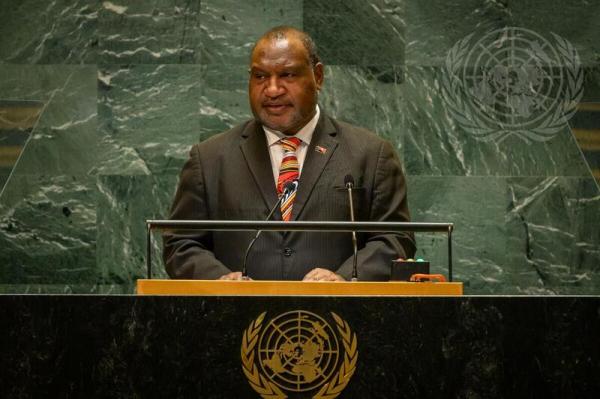
PM James Marape: Tiga Pokok Masalah Menghadapi Manusia Hari ini

Dalam pidatonya mengatasi ancaman kemanusiaan, Perdana Menteri James Marape menekankan komitmen Papua New Guinea untuk memerangi keanekaragaman lingkungan, dan pembangunan berkelanjutan. Dia menyoroti pentingnya toleransi budaya, konservasi keanekaragaman hayati, dan pengelolaan sumber daya alam yang bertanggung jawab dalam membentuk masa depan negara. Login Keanekaragaman budaya dan linguistik yang kaya di Guinea, ditambah dengan sumber daya alam yang melimpah, posisi bangsa sebagai pemimpin global dalam konservasi lingkungan dan toleransi budaya.

Papua New Guinea adalah rumah bagi lebih dari 800 bahasa yang berbeda dan beragam budaya, menjadikannya salah satu negara yang paling beragam di dunia. Kaset budaya yang luas ini telah membentuk identitas negara dan menumbuhkan rasa toleransi yang mendalam dan menghormati tradisi dan kepercayaan yang berbeda. Komitmen pemerintah untuk mempromosikan keanekaragaman budaya tercermin dalam kebijakan yang mendukung pelestarian dan promosi bahasa adat, praktik tradisional, dan situs warisan.

Papua New Guinea terkenal dengan keanekaragaman hayati yang tak tertandingi, dengan berbagai macam flora dan endemic fauna ke daerah. Ekosistem beragam negara adalah sumber kebanggaan nasional dan sangat penting untuk mempertahankan mata hidup dan melestarikan keanekaragaman biologis. Pemerintah telah menerapkan inisiatif konservasi untuk melindungi spesies yang terancam, membangun daerah yang dilindungi laut, dan mempromosikan praktik pertanian dan kehutanan yang berkelanjutan. Upaya ini bertujuan untuk menjaga warisan alam negara untuk generasi mendatang dan berkontribusi terhadap upaya global untuk memerangi perubahan iklim dan kehilangan keanekaragaman hayati.

Pendekatan Papua New Guinea terhadap keselarasan lingkungan dengan Sustainable Development Goals (SDGs) yang ditetapkan oleh PBB, terutama Goal 15 yang berfokus pada melindungi, memulihkan, dan mempromosikan penggunaan ekosistem terestrial yang berkelanjutan. Dengan memprioritaskan konservasi dan pengelolaan sumber daya alam yang berkelanjutan, Papua New Guinea tidak hanya menjaga lingkungannya tetapi juga berkontribusi pada agenda global untuk pembangunan berkelanjutan.

Visi Perdana Menteri Marape untuk Papua New Guinea untuk menjadi bangsa yang lebih tinggi oleh 2045 mencerminkan ambisi pemerintah untuk meningkatkan kualitas hidup bagi warganya dan mencapai kemakmuran ekonomi jangka panjang. Tujuan ini menyelaraskan dengan beberapa SDG, termasuk Tujuan 8 (Ketentuan Kerja dan Pertumbuhan Ekonomi) dan Tujuan 10 (Konten Reduced), yang bertujuan untuk mempromosikan pertumbuhan ekonomi inklusif dan berkelanjutan dan mengurangi kemiskinan dan ketidaksetaraan. Dengan berfokus pada pembangunan berkelanjutan dan kebijakan ekonomi inklusif, Papua New Guinea dapat menciptakan peluang bagi kewirausahaan, penciptaan pekerjaan, dan pemberdayaan sosial, pada akhirnya meningkatkan kesejahteraan masyarakat.

Namun, mencapai aspirasi ini hadir dengan tantangan. Login New Guinea menghadapi ancaman lingkungan seperti deforestasi, penebangan ilegal, dan kegiatan pertambangan yang menimbulkan risiko keanekaragaman hayati dan masyarakat adat. Negara ini juga berminyak dengan isu-isu sosial-ekonomi termasuk kemiskinan, kesetaraan, dan akses terbatas pada layanan dasar seperti kesehatan dan pendidikan. Mengamati tantangan ini membutuhkan pendekatan berwajah yang melibatkan kolaborasi antara pemerintah, masyarakat sipil, dan pemangku kepentingan sektor swasta untuk mempromosikan praktik pembangunan berkelanjutan, memperkuat tata kelola lingkungan, dan meningkatkan kecenderungan sosial.

Meskipun tantangan ini, posisi unik Papua New Guinea sebagai pemimpin global dalam konservasi lingkungan dan toleransi budaya memberikan kesempatan untuk inovasi dan kolaborasi pada skala global. Komitmen negara untuk memerangi keanekaragaman lingkungan, dan pembangunan berkelanjutan menetapkan contoh positif bagi bangsa lain untuk mengikuti, menunjukkan bahwa kemajuan ekonomi dapat dicapai selaras dengan keanekaragaman alam dan budaya.

Kesimpulan, Perdana Menteri James Marape’s pidato menggarisbawahi komitmen Papua Nugini untuk mempromosikan toleransi budaya, lingkungan, dan pembangunan berkelanjutan. Keanekaragaman budaya dan linguistik negara, dedikasi terhadap konservasi keanekaragaman hayati, dan pengelolaan sumber daya alam yang bertanggung jawab memposisikannya sebagai pemimpin global dalam konservasi lingkungan dan toleransi budaya. Dengan menyelaraskan aspirasinya dengan Tujuan Pembangunan Berkelanjutan, Papua New Guinea dapat bekerja untuk mencapai kemakmuran ekonomi jangka panjang sambil menjaga lingkungan dan mempromosikan kecenderungan sosial. Mengamati tantangan lingkungan dan sosial-ekonomi akan membutuhkan upaya yang berkonsentrasi dari semua pemangku kepentingan, tetapi peluang untuk pembangunan berkelanjutan dan kepemimpinan global sangat luas.

Artiker Asli di Sini

PM Papua Nugini, Hon. Mr. James Marape, ingatkan PBB tentang Keputusan PIF tahun 2019 tentang West Papua

“James Marape (Prime Minister of PNG): I would also like to recall the Pacific Islands Leaders Forum decision in 2019 and the outstanding visit by the United Nations human rights mechanism to address the alleged human rights concerns in our regional neighbourhood. This visit is very important to ensure that the greater peoples of the region have peace within their respective sovereignties and their rights and cultural dignities are fully preserved and maintained (New York, 25 September, 2021).

Artinya

“James Marape (Perdana Menteri PNG): Saya juga ingin mengingatkan keputusan Forum Pemimpin Kepulauan Pasifik (PIF) pada tahun 2019 dan kunjungan luar biasa oleh mekanisme Hak Asasi Manusia (HAM) PBB untuk mengatasi dugaan masalah Hak Asasi Manusia di lingkungan regional kami. Kunjungan ini sangat penting untuk memastikan bahwa masyarakat yang lebih besar di kawasan ini memiliki kedamaian dalam kedaulatan masing-masing dan hak serta martabat budaya mereka sepenuhnya dipertahankan dan dirawat (New York, 25 September 2021.”
_____
Sumber YouTube:
(https://m.youtube.com/watch?v=ssyZWLTIijg&feature)

Sumber Facebook:
(https://m.youtube.com/watch?v=ssyZWLTIijg&feature)

#PapuaNewGuinea #PNG #UNGA76 #UnitedNation #WestPapua #PacificIslandForum #PIF

Vanuatu urged to be consistent with foreign policy

Sato Kilman - pictured during a visit to Russia in March 2015
Sato Kilman. Photo: Vladimir Pesnya / RIA Novosti

A Vanuatu opposition MP says the government should be careful to act consistently on foreign policy.

The comment from Sato Kilman, a former prime minister, comes after another call on West Papua by Vanuatu at the United Nations.

Speaking at the UN General Assembly, current prime minister Charlot Salwai called for an investigation into alleged killings and abuses of the indigenous people of Indonesia’s Papua region.

Mr Kilman said the UN was the right place in which to raise concern on Papua.

But he questions whether Vanuatu takes the same stand on similar issues in other parts of the world.

“If Vanuatu has got to be able to show that she has credibility then she must be able to deal with all the issues in a consistent manner. Being members of the United Nations, while we are dealing with these issue, we are making comments, we are raising awareness on these isues, I think it’s only fair that we should be dealing with the others equally well,” he said

Prime Minister of Vanuatu Charlot Salwai
Prime Minister of Vanuatu Charlot Salwai Photo: Supplied


Mr Salwai’s statement in New York last week was the second consecutive year that he raised West Papua at the General Assembly.

He accused world leaders at the UN of turning a deaf ear to more than half a century of atrocities committed by Indonesia on West Papuans.

“We also call on our counterparts throughout the world to support the legal right of West Papua to self-determination and to jointly with Indonesia put an end to all kinds of violence and find common ground to facilitate a process to make their own choice,” said Mr Salwai.

Indonesian representative at the UN General Assembly in New York, September 2017.
Indonesian representative at the UN General Assembly in New York, September 2017. Photo: UNGA

In response to Mr Salwai’s statement, an Indonesian government spokeswoman told the assembly Indonesia categorically denied all allegations levelled against it regarding Papua.

She accused Mr Salwai and other Melanesian leaders concerned about Papua of being misled and of supporting separatism in a sovereign nation.

“These countries were foolishly deceived by individuals with separatist agendas to exploit the issue of human rights,” said the spokeswoman.

“If human rights are at the heart of the issue, why were these concerns not raised in the appropriate forum, namely the 3rd Cycle of the Periodic Review of Indonesia at the United Nations Human Rights Council,” she said.

Sato Kilman admitted the West Papua issue was one that ran deep with ni-Vanuatu, but he cautioned against cherry-picking foreign policy issues from a Vanuatu government perspective.

“Yes, you can raise the issues, but when there are similar problems around the globe, and Vanuatu, it doesn’t matter how small we are, we are one voice at the UN. Our voice is good enough to be heard in the UN about the other issues as well.”

When he was prime minister of Vanuatu in four brief tenures during a period of political volatility in his country between 2010 and 2016, Mr Kilman adopted a controversial policy on Papua.

He departed from standard Vanuatu foreign policy by forging closer ties with Indonesia, in spite of his country’s long-running support for West papuan independence.

He also advocated this softer approach with Jakarta in his various stints as Foreign Minister, although it was unpopular with grassroots communities in Vanuatu.

Ultimately, the Malekula MP advocated keeping communication lines with Jakarta open on the Papua issue.

“I’d be very interested to know those of us who have been advocating for West Papua, or New Caledonia for that matter,” said Mr Kilman.

“How many of us have actually spoken with the Indonesian government or the French government about these issues?”

PBB Setujui Resolusi tentang Hak Menentukan Nasib Sendiri

Duta Besar Pakistan untuk PBB, Maleeha Modi (Foto: Time of Islamabad)

NEW YORK, SATUHARAPAN.COM – Sebuah komite yang bertanggung jawab kepada Majelis Umum PBB pada hari Senin (21/11) dengan suara bulat mengeluarkan resolusi yang disponsori Pakistan yang menegaskan kembali bahwa realisasi universal hak masyarakat untuk menentukan nasib sendiri adalah kondisi mendasar bagi jaminan efektif dan ketaatan pada Hak Asasi Manusia (HAM).

Resolusi itu ikut disponsori oleh 72 dari 193 negara anggota komite, dan diadopsi secara aklamasi tanpa pemungutan suara.

Komite ini disebut juga Komite Ketiga, yang menangani isu-isu kemanusiaan, budaya dan sosial.

Resolusi ini diharapkan akan diajukan dan disahkan pada sidang Majelis Umum PBB bulan depan.

Salah satu bagian dari isi resolusi menyatakan bahwa 193 negara anggota komite dengan tegas menentang intervensi militer, agresi dan pendudukan militer asing karena hal tersebut mengakibatkan  penindasan hak masyarakat untuk menentukan nasib sendiri dan hak asasi manusia di beberapa belahan dunia.

Resolusi tersebut menyerukan kepada negara-negara yang bertanggung jawab agar menghentikan intervensi militernya dan pendudukannya di teritori asing serta mengakhiri semua tindakan eksploitasi, represi, diskriminasi dan penganiayaan.

Menurut laporan geo.tv , ketika menyampaikan draft resolusi tersebut, Duta Besar Pakistan untuk PBB, Maleeha Lodhi, mengatakan hak untuk menentukan nasib sendiri adalah prinsip dasar Piagam PBB dan hukum internasional.

“Melakukan hak ini akan memungkinkan jutaan orang di seluruh dunia bangkit dari  pendudukan kolonial dan asing dan dominasi asing,” kata dia.

Ia menambahkan: “banyak dari kita yang hadir di sini hari ini adalah pewaris dari perjuangan untuk mencapai kehidupan yang bermartabat dan terhormat sebagai warga negara bebas di negara merdeka.”

Majelis Umum PBB telah mendesak Dewan HAM PBB untuk  memberikan perhatian khusus pada pelanggaran HAM terutama yang dikaitkan dengan hak untuk menentukan nasib sendiri, yang diakibatkan oleh intervensi militer dan agresi asing atau pendudukan asing.

Sekretaris Jenderal PBB diminta melaporkannya pada sesi Sidang Umum PBB berikutnya.

Jakarta Diplomacy Odd and Backwards, ULMWP

Radio NZ – 3 November 2016

A warning by Indonesia’s Defence Minister for Pacific countries not to speak out about West Papua has been described as an odd and backward form of diplomacy.

The Minister Ryamizard Ryacudu urged Australia to rebuke Pacific states, in particular Solomon Islands, for raising West Papua in global forums and inviting Papuans to join the Melanesian Spearhead Group (MSG).

Indonesia's Defence Minister for Pacific countries says Indonesia is a sleeping tiger that can attack if disturbed. Photo: AFP
Indonesia’s Defence Minister for Pacific countries says Indonesia is a sleeping tiger that can attack if disturbed. Photo: AFP

He subsequently told Australian media that it’s better if Canberra delivers the warning to Pacific governments, because if it was left to him he would ‘twist their ears’.

The United Liberation Movement for West Papua’s Pacific regional ambassador Akabou Amatus Douw said the minister’s statements in the past week show a militaristic attitude, out of touch with Pacific Islanders.

At September’s UN General Assembly session, leaders of seven Pacific states spoke out about rights abuses in Papua and on support for Papuan self-determination.

Pacific leaders at the UN General Assembly expressed concern about human rights abuses in Papua.

Pacific leaders at the UN General Assembly expressed concern about human rights abuses in Papua. Left to right: Vanuatu Prime Minister Charlot Salwai; Solomon Islands Prime Minsister Manasseh Sogavare; Tonga Prime Minister ‘Akilisi Pohiva; Nauru President Baron Waqa; Marshall Islands President Hilda Heine; Tuvalu Prime Minister Enele Sopoaga Photo: UN Photo

Ryamizard warned that Indonesia would not stay silent when its sovereignty is compromised – he described Indonesia as a sleeping tiger that can attack if disturbed.

Mr Douw said the minister’s sleeping tiger analogy was, in a sense, apt.

“This expression is symbolic,” he explained, “meaning that Indonesia’s sleeping face [will] never wake up to see what [is] their wrongdoing with massive atrocities and genocide to the Papuan minority.”

The ULMWP, which has observer status in the MSG, is pushing for full membership in the group, something opposed by Indonesia which is an associate MSG member.

The United Liberation Movement for West Papua's ambassador for Australia and Pacific countries, Amatus Douw.

The United Liberation Movement for West Papua’s ambassador for Australia and Pacific countries, Amatus Douw. Photo: RNZI

Mr Douw has urged the leaders of Australia and Indonesia to have a robust discussion on West Papua.

The Indonesian President Joko Widodo is due to have his first state visit to Australia this month for bilateral talks with Australia’s prime minister Malcolm Turnbull.

Mr Douw is pushing for the two governments to abolish the Lombok Treaty between the two countries which formalised both governments’ agreement to oppose Papuan separatism.

“This already became a hell policy,” said Mr Douw, “because the fact that Australian government trained Indonesian army who evolved in killing and torturing Papuan freedom fighter then we indicated that killing of younger generation is new form of genocide.”

Papuans in West Papua Only Have One Killer: The Malay Indos

PMNews asked the West Papua Revolutionary Army on recent killings happening in West Papua, who are the killers? Or Who is causing troubles in West Papua despite tens of visits to West Papua by the colonial president Joko Widodo. Lt. Gen. Amunggut Tabi says,

Papuans in West Papua Only Have One Killer: The Malay Indos. No one should be confused about it. Since its military invasion Indonesia has been here for gold, copper, timber, gas, oil, fish, you name it. And the human beings, native inhabitants, of an inferior and backward Melanesian race are seen as troublesome, as hindrance to the original purpose of invading, occupying and extracting the natural resources.

Amunggut Tabi continues,

Many Indnnesians use this expression, “New Guinea is a big Island, very big fo host all Indonesians, even still have more rooms to host all Malays from Java to Thailand, its natural resources terribly rich, it will take thousands of years to complete extract the natural resources, it is ripe, it is ready, however, it is a pity, it is disturbing, it is discouraging, that this island also has human beings, called Melanesian Papuan.

It is clear, that Melanesians in West Papua are seen as a “pity”, an obstacle, hinderance to the great Pan-Indonesia, Great Malay Republic as inspired by the first Malay-Indos President Sukarno.

Now, what is the solution that normal human being take when you see something or somebody is a “hindrance”? You solve it. You take the hindrance away. In this case, if Papuan as human beings are the problems, then Malay-Indos have to deal with them, and the only way is to kill-them-off.

Amunggut Tabi also stated,

I mean, wiping out Melanesians, not just Papuans, is on the agenda of Pan-Indonesia or Great Indonesia nation-state that was already designed by Sukarno. The mission is not yet complete until the Isle of New Guinea is fully occupied, and exploited, and the Papuans in this Island is completely wiped out.

I can guarantee this because I have read all secret-documents from Indonesian intelligence. Of course, we must purchase the information, but in the future time, they will take over Papua New Guinea, and later on Solomon Islands. It is just a matter of time, the plan is already in place and already in hands.

The most feasible approach to occupying the whole Melanesia starting from Raja Ampat Islands of West Papua westernmost ends is by wiping out the human beings who inhabit the Island. There is no other way ahead. They will never occupy already independent Papua New Guinea and other Melanesian nation-states just by killing the inhabitants but at least they already starting from West Papua. Once they wipe out and occupy West Papua, they will occupy Papua New Guinea in social, culture, technology, infrastructure, military, police.

Amunggut Tabi furthermore warned,

Of all human race in the world, Malay-Indos as Malay race is the most corrupt in their moral standard. They will always use women as the front-page, their window, their entry-point, their leading story. The most obvious example is the last UNGA interventions made by seven South Pacific countries was responded by Indonesia by presented what they called, “beautiful young Indonesian diplomat” and it then because spiral all over Indonesia. They do not care human beings are killed, and threatened to be wiped out from their own inherited land. Their focus was on that “one lady” that they regarded beautiful. What is the meaning of beauty when she tells lies in public speech? Beauty must rests in the heart, not in the skin.

Amunggut Tabi also mentioned the names, as examples, of Melanesian leaders who have been morally and politically defeated by Indonesia after giving them Indonesian ladies as their wives, or as their maids. Women is always in their forehead when they talk about dealing with other people, to defeat them:

They have, and they will offer ladies to many Melanesian politicians and key figures, and they will use all their powers to control Melanesian politics though back-doors, not front-doors. They have done so successfully with Papua New Guinea key figures. They will soon do it all over Melanesia. They will occupy Melanesia though back-doors. They are occupying West Papua though front-door. Melanesian leaders must read this reality rationally, and respond to it rationally, strategically, and wisely.

With all these background information, Amunggut Tabi said that Malay-Indos are the ones who want to see West Papua unstable, to see West Papuans wiped out from their homeland, to exploit and extract as many natural resources as possible in short time as possible.

He continues,

When you see any Melanesians die, mysteriously, openly, caused by illness or a sudden death, in remote villages or in crowded city, anywhere in Indonesia, hit by car or shot randomly, Melanesians must keep in mind, that surely, Malay-Indos are on their way wiping out Melanesian race. They are our killers. Any aid and development funds offer from Indonesia should be rejected, because their aid and money are full of Papuans’ blod.

What they don’t talk about when they talk about Papua

‘Being a young, female Indonesian myself, I expected myself to celebrate Nara Masista Rakhmatia’s UN General Assembly speech. Instead, I was gravely disappointed.’

Several weeks ago, a young, female diplomat named Nara Masista Rakhmatia made a speech that dazzled the Indonesian public. In a video that went viral, she denied accusations from 7 Pacific country leaders about human rights abuse in Indonesia’s Papua province at the 71st Session of United Nations General Assembly in New York last September.

She further shamed their attempt to interfere with Indonesia’s sovereignty. The video gathered over 188 thousand views on Facebook, along with hundreds of comments from Indonesian citizens expressing how proud they are of Nara’s intelligence and bravery to ‘teach those foreign country leaders about how to respect Indonesia’—especially given her young age.

In their remarks, delegations from Solomon Islands, Vanuatu, Nauru, the Marshall Islands, Tuvalu, and Tonga criticized Indonesia’s human rights records in Papua. Nara in particular argued that these sentiments were largely misplaced, given that the main agenda of the Assembly was Sustainable Development Goals and a global response to climate change.

Furthermore, she claimed, these countries needed to self-reflect upon their own domestic issues before pointing their fingers to how Indonesia handles the province’s push for self-determination.

Being a young, female Indonesian myself, I expected myself to celebrate her speech. I should have been inspired and impressed by how sharp she was. Instead, as someone who studied International Relations and currently a Public Policy student, I was gravely disappointed.

Disappointed

First of all, Nara based her entire rebuttal on the obsolete definition of the sovereignty principle. While sovereignty is a crucial foundation to the United Nations, since 2005, the international community has extended its definition under the ‘Responsibility to Protect’ commitment, which stipulates that absolute sovereignty does not hold when a government fails to protect its people.

PROTEST. An arrested Papuan pro-independence demonstrator gestures from a police truck in Jakarta on December 1, 2015, after police fired tear gas at a hundreds-strong crowd hurling rocks during a protest against Indonesian rule over the eastern region of Papua. File photo by AFP

Although the concept was developed specifically as a framework for humanitarian interventions to prevent atrocity crimes and this situation has arguably not brought us that far, this core principle stands.

In other words, should these allegations stand, it is justifiable for the international community to express their concerns about the possibility of ongoing crimes against humanity.

Therefore, it is more urgent to argue about whether Indonesia has indeed violated human rights in Papua.

The speech failed to address, for example, the progress of President Joko Widodo’s promise to investigate the killing of 4 Papuan high-school students in 2014. No reports have been made available to the public around this and other pressing matters such as killings in Wasior in 2001 and Wamena in 2003. A recent op-ed contended that these were not ordinary crimes but crimes against humanity.

Nara also did not talk about the 4,587 individuals who were arrested by the police for expressing their political views in regards with the Papua issue in 13 cities, as documented by the Jakarta Legal Aid Institute.

On top of that, she spent a lot of air time explaining how Indonesia has been a member of the United Nations Human Rights Council for significantly longer periods compared to these 6 countries. She leveraged that membership status as a validation to the country’s ‘human rights commitment’.

This is a logical fallacy. In reality, Jakarta continues to maintain restrictions for human rights organizations such as Amnesty International and International Committee of the Red Cross from entering Papua. Becoming a member of a certain council hardly proved these allegations wrong. If anything, it should become an additional reason as to why the country needs to feel embarrassed about the hypocrisy at home.

Wrong focus

Some of my friends asked me to give Nara a break. After all, she was only representing her country. If anything, such response is far from surprising and rather predictable. Throwing in phrases like ‘territorial integrity’ and ‘sovereignty’ sounds like something that any other country would do in responding to such accusations at an international stage.

PROTEST HALTED. Papuan pro-independence activists, some in traditional tribal garb, march during a rally in Jayapura. AFP PHOTO

However, the issue goes beyond this. Even if we look past the messenger, the problem in Papua still exists, and the fact that the government of Indonesian preferred not to deal with it should alert us.

Thus what added to my disappointment was how mainstream media in Indonesia covered the issue. Instead of playing its role as the ‘fourth pillar’ that criticizes the government, many news outlets practically made her a heroine by echoing the flattering Facebook comments and further highlightsing how she looks.

It seems like nationalist sentiments—fueled by an ‘external threat’ from these Pacific countries’—distracted them from addressing the elephant in the room. Except for The Jakarta Post, most news seemed to avoid highlighting these allegations and instead talked about how beautiful and brave Nara was. In effect, social media discussions regarding this event rotated primarily around unproductive debates about her physical qualities.

Although concerns regarding Papua were expressed by only 7 small Pacific countries now, how will Indonesia—represented by Nara or anyone else—respond in the future, should they come from other geopolitically more powerful countries?

President Joko Widodo’s administration must know by now that something has to be done in Papua, and it should be done immediately.

Surely, we could not just continue deflecting every question with a ‘sovereignty’ card. – Rappler.com

 Andhyta Firselly Utami graduated from International Relations program at Universitas Indonesia, and is currently a Master of Public Policy candidate at Harvard Kennedy School.

UN adopts resolution reaffirming Western Sahara people’s right to self-determination

SPS 10/10/2016 – 21:04

New York (United Nations), October 10, 2016 (SPS) – UN General Assembly Special Political and Decolonization Committee (Fourth Committee) adopted Monday in New York a resolution reaffirming Saharawi people’s right to self-determination.

The resolution, adopted at the end of a several-day general debate on decolonization, reiterated UN general Assembly’s support of the negotiation process initiated by the Security Council to reach a just, lasting and mutually acceptable political solution ensuring Western Sahara people’s right to self-determination.

Presented by 25 countries, including Algeria, the resolution, greeted the efforts made by the UN secretary general and his personal envoy to Western Sahara, Christopher Ross, for the relaunch of the talks suspended in 2012.

The resolution adopted, by consensus, invites the parties to the conflict (Polisario Front and Morocco) and the States of the region to fully cooperate with the United Nations envoy.

The resolution has taken up UN clear and major ideas on the settlement of Western Sahara conflict, which consist in backing the relaunch of negotiations between the Polisario Front and Morocco, as well as the mediation efforts undertaken by Christopher Ross.

The delegations of the countries taking part in the Fourth Committee debate on decolonization expressed a large support to Saharawi people’s right to self-determination, calling for resumption of negotiations between the parties to the conflict. (SPS)

062/090/700

Papua is non-negotiable: Minister

Liza Yosephine, The Jakarta Post

apua’s place in the Unitary State of the Republic of Indonesia is not up for negotiation, a minister has said in a response to allegations of human rights violations conveyed during a recent UN General Assembly (UNGA) session.

“In diplomacy, several things are negotiable but some others cannot be negotiated. When it comes to the issue of support toward separatism, I think not only diplomats, but all of us, know that this is a point where we should stop,” Foreign Minister Retno LP Marsudi told journalists on Tuesday.

The minister was responding to criticism of Indonesia’s strong response to six Pacific Island heads of state, who conveyed their allegations of human rights violations in Papua and West Papua provinces during the recent UNGA in New York.

Retno asserted that Indonesia strongly upheld the principles of the UN Charter, which include non-interference and respecting other nations’ sovereignty. At the same time, she continued, Indonesia was committed to maintaining friendly relations with all countries.

“We will never act with hostility toward other countries and will continue to engage with them. But, again, when it comes to the issue of sovereignty and non-interference, once those [principles] are violated, that’s where we will stop [negotiating],” Retno said.

Nara Masista Rakhmatia, the second secretary at Indonesia’s permanent mission to the UN, called speeches made by the heads of state of the Solomon Islands, Vanuatu, Nauru, Marshall Islands, Tuvalu and Tonga “interference” and said they aimed to encourage separatism in the two provinces.

The reported failure of Papua’s special autonomy has led to a rise of support for Papuan independence movements across the globe, particularly from Pacific nations. (ebf)

Listening to the Pacific beat on Papua

Budi Hernawan, Jakarta | Thu, September 29 2016 | 08:07 am

In an unprecedented move, seven UN member states from the Pacific raised their concerted voices on Papua during the prestigious 71st session of the UN General Assembly in New York this week.

Nauru started the intervention by highlighting the issue of human rights violations in Papua, followed by a newcomer in the discourse of Papua: the Marshall Islands.

Vanuatu, Tuvalu and the Solomon Islands followed suit and went one step further by specifically highlighting the issue of the right to self-determination for Papuans. Tonga emphasised the gravity of the problem and Palau, another novice, called for constructive dialogue with Indonesia to solve the Papua issue.

This was a historic moment for us as we have never had such unified high-profile intervention when it comes to the issue of Papua at the UN. Perhaps the only lone ranger used to be Vanuatu, which tried to break the silence of the UN fora.

This week’s debate at the UN General Assembly might remind us of a similar but much more colorful debate on Papua at the assembly in 1969, when the forum decided to close the chapter on Papua by accepting the result of the Act of Free Choice.

If in 1969 some African countries expressed opposition to the assembly’s decision to adopt the result of the 1969 Act of Free Choice for Papuans, today the Pacific nations are taking the lead.

Indonesia’s response, however, was highly predictable. Repeating the slogan of territorial integrity and sovereignty, the government’s response unfortunately does not provide us with facts and evidence of the improvement in the human rights situation in Papua.

It may be remembered that President Joko “Jokowi” Widodo promised to solve the killing of four high-school students in Paniai on Dec. 8, 2014. The investigation into the case has been delayed for almost two years and we have not seen much progress.

The families of the victims recall that at least eight government institutions sent their respective fact-finding team to interview victims on the ground and personnel of the Army, the Papua Police, the National Police, the Air Force, the Papua Legislative Council, the Witness and Victim Protection Agency (LPSK), the Office of Coordinating Security, Political and Legal Affairs Minister, the National Commission on Human Rights (Komnas HAM). None of these teams, however, has ever published their report for public consumption.

Similarly, the dossiers on the Wasior killings of 2001 and the Wamena case of 2003 have been pending for more than a decade at the Attorney General once Komnas HAM finished its investigation. These were not ordinary crimes but crimes against humanity, one of the most serious crimes punishable by Indonesian and international law. Unfortunately, both Komnas HAM and the Attorney General’s Office have argued over evidence and procedure for years.

Komnas HAM insists that it has provided conclusive evidence and has followed proper procedure. On the other hand, the Attorney General’s Office has argued that Komnas HAM has not met the requirement of a pro-justice investigation as investigators did not take an oath as required by the Criminal Law Procedures Code. Both institutions have overlooked the fact that victims continue to suffer.

Memories are still fresh on the surge in the arrests of Papuan youth when they took to the streets to express their opinions in public despite a constitutional guarantee of the right to do so.

The Jakarta Legal Aid Institute (LBH Jakarta) documented that at least 4,587 individuals, men and women, were arrested by the police for expressing their political views in 13 cities, namely Dekai, Fakfak, Jakarta, Jayapura, Kaimana, Makassar, Malang, Manado Manokwari, Merauke, Sentani, Wamena and Yogyakarta.

While most of the arrestees were released within 24 hours, the deployment of police in 13 jurisdictions across the country would not have been possible without the blessing of the National Police top brass.

While we were grappling with human rights conditions in Papua, we were shocked by the President’s decision to appoint Gen. (ret) Wiranto as the coordinating political, legal and security affairs minister.

In February 2003, the UN-sponsored Special Panels for Serious Crimes of the Dili District Court, Timor Leste, indicted Gen. Wiranto, then the Indonesian defense and security minister and Indonesian Armed Forces (ABRI) commander for crimes against humanity in connection with the events in Timor Leste in 1999.

As we were yet to recover from the President’s unfathomable choice, we were presented with another unprecedented decision when the Indonesian Military TNI chief named Maj. Gen. Hartomo to lead the military’s Strategic Intelligence Agency (BAIS).

Hartomo was the commander of the Army’s Special Forces (Kopassus) Tribuana X unit assigned to Papua when Theys Eluay was murdered. Hartomo and six other Kopassus officers were charged with Theys’ murder on National Heroes Day in 2001. He and his team were found guilty and sentenced to three years in prison by the Surabaya Military Court and discharged from the Army.

These all are simple facts that tell us the way our government commits to human rights in Papua and elsewhere, which the Indonesian delegation to the UN General Assembly describes as “robust and active”.
______________________________

The writer, who obtained his PhD from the Australian National University, lectures in international relations at the Paramadina Graduate School of Diplomacy, Jakarta.

Up ↑

Wantok COFFEE

Organic Arabica - Papua Single Origins

MAMA Minimart

MAMA Stap, na Yumi Stap!

PT Kimarek Aruwam Agorik

Just another WordPress.com site

Wantok Coffee News

Melanesia Foods and Beverages News

Perempuan Papua

Melahirkan, Merawat dan Menyambut

UUDS ULMWP

for a Free and Independent West Papua

UUDS ULMWP 2020

Memagari untuk Membebaskan Tanah dan Bangsa Papua!

Melanesia Spirit & Nature News

Promoting the Melanesian Way Conservation

Kotokay

The Roof of the Melanesian Elders

Eight Plus One Ministry

To Spread the Gospel, from Melanesia to Indonesia!

Koteka

This is My Origin and My Destiny